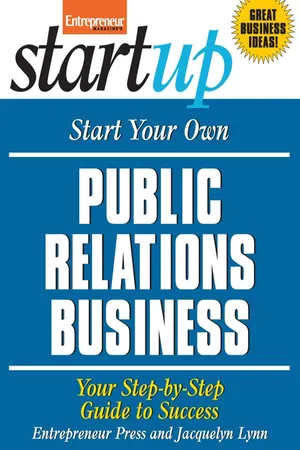
The explosion of media opportunities and the rapidly changing communications landscape have served as key drivers for the public relations industry, creating huge opportunities for communications and PR specialists like you! Coaching you all the way, the experts at Entrepreneur show you how to parlay your PR experience into a successful new business. Our experts take you step by step from building the business foundation to managing day-to-day operations. Learn how to set up your firm, choose your market niche, prospect and sign clients, build media relationships, set fees, and more! Plus, gain priceless insight, tips, and techniques from practicing entrepreneurs and industry experts! Learn how to: • Set up your own PR firm • Choose your market niche • Win over, sign, and keep clients • Build strong, well-planned campaigns using the latest tools of the trade • Develop prosperous relationships and partnerships • Boost profits by expanding your business • And more Go from public relations pro to CEO! Start your own public relations firm today!
- 178 pages
- English
- ePUB (mobile friendly)
- Available on iOS & Android
eBook - ePub
About this book
Information
1
So What Is PR Anyway?
Public relations, or its abbreviation PR, is one of the more misused and even misunderstood terms in the business world—yet it’s a critical element in a company’s marketing strategy. If you’re going to operate a PR firm, you need not only to understand what that means, you must also be able to communicate it to your clients.
dp n="15" folio="2" ?Public relations is the relationship a company or organization has with its various publics, and those publics include customers and potential customers, employees, suppliers, investors, the media, and the general public. Typically in business, the term public relations is used to refer to the management of public relations. As a public relations professional, your job is to help your clients with that process.
The process of public relations is one of helping an organization tell its story and build goodwill with the public and those who influence the public, such as the media. The ultimate goal of PR is credibility.
The Role of a Public Relations Professional
Successful public relations practitioners are able to see themselves and their clients from a variety of perspectives, including through the eyes of every public the organization has. PR professionals are pivotal to the communications process,ensuring that messages are clear, honest, unambiguous, easily understood, and appropriate for the target audience.
Some PR firms are primarily implementers, taking direction from clients without being involved in strategic planning. This narrow role is short-sighted on the part of the client because a skilled PR professional can provide far more value if he or she is involved in the entire public relations process. This means becoming an integral part of the client’s team, learning the client’s operation and goals, helping to put together a strategy that will take the client from where it is now to where it wants to be, and then assembling the necessary elements to implement and monitor the strategy, and make adjustments along the way when circumstances dictate.

Bright Idea
One of the best ways to learn the public relations business is to get a job with an agency. You can get paid while you learn the ropes. It will also give you a great perspective on how to treat your own employees later on.
Ethics and Responsibility
The power of public relations brings with it a tremendous amount of responsibility. Perhaps PR professionals should follow the principle medical students are taught: first, do no harm. History is full of examples of PR professionals who, either intentionally or not, used the public trust they cultivated to convey a message that turned out to be wrong.
dp n="16" folio="3" ?The “father of public relations,” Edward L. Bernays (1892–1995), was the nephew of Sigmund Freud, which could be why he was able to incorporate an astute grasp of human behavior into his work for clients. His work should be studied by every PR professional today. Many of his campaigns are legendary, such as when he promoted Lucky Strike cigarettes during a time when women smoking in public was not acceptable by arranging for a parade of debutantes to march down Fifth Avenue while smoking. He is also credited with convincing America that a proper breakfast was more than just coffee and toast; it was bacon and eggs.
Today, of course, we know that smoking and excessive consumption of high-fat, highcholesterol foods cause a long list of health problems. Certainly Bernays cannot be held responsible for what wasn’t known about his clients’ products, but his career did reflect a number of moral ambiguities. Most notable was his work for United Fruit Company in the early 1950s, when he used questionable tactics to generate support for an overthrow of a freely elected capitalistic Guatemalan government, which was replaced by one of the most despotic governments South America has ever known. That should give today’s PR professionals pause.
Words of Wisdom
“If you once forfeit the confidence of your fellow citizens, you can never regain their respect and esteem. It is true that you may fool all of the people some of the time; you can even fool some of the people all of the time; but you can’t fool all of the people all of the time.”
—Abraham Lincoln
Don’t try to separate your own values and ethics from those of your clients. Do your research, understand what you are being asked to do, and make sure you’ll be able to sleep at night if you are successful.
PR and Publicity
Publicity, which is often a function of the public relations team, is gaining media coverage of a company, its products, and its people. Publicity helps spread information to gain public awareness of a product, person, service, cause, or organization, and can include mentions in print and online publications, on broadcast programming, and in other communication vehicles.
Public relations and publicity are not synonymous, but it’s common for a PR campaign to include publicity. A client may say, “We need some PR,” when in fact he means, “We need some positive publicity.” It’s your job to help him understand that he needs more than some favorable media exposure, and to show him how such exposure is part of an overall PR strategy.
dp n="17" folio="4" ?It’s Not Free Advertising
Publicity is not free advertising. Advertising is a paid message communicated through various media. Because it’s paid for, the advertiser can control the content and placement of the advertisement. The organization seeking publicity can put its message out there but has no control over how—or even if—it will be reported in the media.
Your goal as a PR professional is to have your client’s story accurately represented in the media, and this is not easy because media representatives are independent in their reporting. This is why the Council of Public Relations Firms differentiates between advertising and PR this way: “Advertising is purchased media; public relations is earned media.”
Bill Stoller—whose website PublicityInsider.com offers a wealth of public relations and publicity information—defines publicity this way:
At its core, publicity is the simple act of making a suggestion to a journalist that leads to the inclusion of a company or product in a story. Newspapers, magazines, TV programs, and radio shows have large amounts of space to fill and depend upon publicists to help provide story ideas, interview subjects, background information, and other material. For the most part, the act of making a suggestion to a journalist, when successful, will lead to one of two types of coverage: A story created from scratch built around the story “angle” you suggest (e.g., a feature story on your company; a story about a trend that you present to a journalist; an interview segment, etc.); or the inclusion of your product, company, or service in an already existing story (e.g., the reporter is already working on a story about your field and your contact with her results in your product being included in the piece).
Tools of the Trade
The standard public relations tools and techniques you might use include:
dp n="19" folio="6" ?dp n="20" folio="7" ?
• Entertainment product placement. The placement of branded goods or services in a context usually devoid of advertising, such as movies, the story line of television shows, and news programs.
• Podcast. A collection of digital media files distributed over the internet for playback on personal computers and portable media players.
• Press conference (or news conference). An event where journalists are invited to hear a presentation and then are usually offered the opportunity to ask questions.
• Press kit (or media kit). A package of background materials detailing various aspects of an organization that is presented to members of the media. Press kits may be printed or available in an electronic format. Press kits typically contain some or all of the following: a fact sheet about the company or organization; a brief history; an annual report; a list of key personnel with brief biographical statements; a mission statement; copies of publicity materials, including press releases; photographs of personnel and/or products; listings of products and/or services; lists of awards and achievements; copies of editorial mentions of the organization.
• Press release (or media release). An announcement of an event, information, or other newsworthy item issued to the press.
• Product launch. The introduction of a new product to the market.
• Publication of information material. Making information known to the public through off- or online means.
• Satellite feed. Broadcast material sent via a satellite.
• Seminars. Training events typically targeted to a company’s customers or potential customers.
• Special events. Events designed to generate publicity and public interest.
• Speeches. Presentations that provide public and media exposure for the speaker and organization.
• Video news release (or VNR). Video segments designed to look like news reports that are distributed to television newsrooms and incorporated into newscasts.
• Webcast. A live or recorded broadcast of an event over the internet.
• Wire service distribution. A news-gathering organization that distributes syndicated copy electronically; distribution by wire service is an alternative to traditional news release distribution methods of regular mail and fax.
2
A Day in the Life
So what’s it like to run a public relations firm? One thing you can be sure of, no two days will ever be exactly the same. Situations and circumstances will change at a lightning pace. If you like peace, quiet, and routine, this is not the business for you.
dp n="21" folio="8" ?Certainly there are some tasks you can expect to do on a daily basis. For example, every day you will spend time monitoring local and national media, reading and responding to e-mails, and returning calls. You’ll also need to spend time on the administrative side of the business, making sure bills are paid, employees are supervised, and so on. And, of course, you should regularly market your services. Beyond those constants, who knows?
Any given day might see you working with a client to develop a sound public relations strategy, doing research, writing press materials, calling reporters, setting up press conferences, fielding media requests, helping clients deal with a crisis situation, and any of the countless other tasks that are the responsibility of a successful public relations firm.
One of the best ways to learn the public relations business is to get a job working for an established firm. You’ll have the chance to develop your own skills and see the business side of the operation. You’ll also be able to make connections that will further your career, whether or not you eventually strike out on your own. Just remember to always operate with the highest level of ethics and integrity, which means do the work you are paid for and respect any confidential information to which you may have access.
Words of Wisdom
“A public relations professional is part business manager, part sociologist, part cheerleader, part confessor, and part pit bull. The trick to being successful is to be prepared for anything. And you can always count on the fact that tomorrow will bring new and exciting challenges.”
—Sara Harms,
Account Executive,
Waggener Edstrom, New York
Account Executive,
Waggener Edstrom, New York
The Perfect PR Professional
Though PR professionals need a broad range of skills, the most important are strong communications skills. You need to be able to express yourself both orally and in writing in a clear, concise way that is easy for others to quickly understand. You must also excel at the other half of communication, istening. Few things ...
Table of contents
- Title Page
- Preface
- 1 - So What Is PR Anyway?
- 2 - A Day in the Life
- 3 - What Do You Have to Offer?
- 4 - Who Are Your Clients and How Do You Sign Them Up?
- 5 - Client Relations
- 6 - PR and the Internet
- 7 - Building Media Relationships
- 8 - Grow Your Firm Through Professional Alliances
- 9 - Structuring Your Business
- 10 - Locating and Equipping Your Business
- 11 - Startup Economics and Setting Fees
- 12 - Assembling Your Team
- 13 - Financial Management
- Appendix A - Marketing Your Business
- Appendix B - Crisis Management Lessons Learned
- Appendix C - Search Engine Optimization Ethics and Guidelines
- Appendix D - Public Relations Industry Resources
- Glossary
- Index
- Subscribe to Entrepreneur Magazine
- Copyright Page
Trusted by 375,005 students
Access to over 1.5 million titles for a fair monthly price.
Study more efficiently using our study tools.
Frequently asked questions
Yes, you can cancel anytime from the Subscription tab in your account settings on the Perlego website. Your subscription will stay active until the end of your current billing period. Learn how to cancel your subscription
No, books cannot be downloaded as external files, such as PDFs, for use outside of Perlego. However, you can download books within the Perlego app for offline reading on mobile or tablet. Learn how to download books offline
Perlego offers two plans: Essential and Complete
- Essential is ideal for learners and professionals who enjoy exploring a wide range of subjects. Access the Essential Library with 800,000+ trusted titles and best-sellers across business, personal growth, and the humanities. Includes unlimited reading time and Standard Read Aloud voice.
- Complete: Perfect for advanced learners and researchers needing full, unrestricted access. Unlock 1.5M+ books across hundreds of subjects, including academic and specialized titles. The Complete Plan also includes advanced features like Premium Read Aloud and Research Assistant.
We are an online textbook subscription service, where you can get access to an entire online library for less than the price of a single book per month. With over 1.5 million books across 990+ topics, we’ve got you covered! Learn about our mission
Look out for the read-aloud symbol on your next book to see if you can listen to it. The read-aloud tool reads text aloud for you, highlighting the text as it is being read. You can pause it, speed it up and slow it down. Learn more about Read Aloud
Yes! You can use the Perlego app on both iOS and Android devices to read anytime, anywhere — even offline. Perfect for commutes or when you’re on the go.
Please note we cannot support devices running on iOS 13 and Android 7 or earlier. Learn more about using the app
Please note we cannot support devices running on iOS 13 and Android 7 or earlier. Learn more about using the app
Yes, you can access Start Your Own Public Relations Business by in PDF and/or ePUB format, as well as other popular books in Business & Small Business. We have over 1.5 million books available in our catalogue for you to explore.