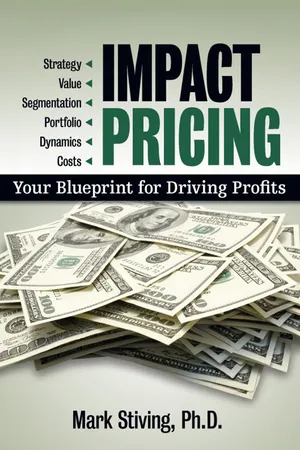
AM I PRICING RIGHT?Every business owner is haunted by this fundamental question. Expert pricing strategist Mark Stiving draws upon more than 15 years of experience in profitable pricing and delivers a practical plan to help you confidently answer.
Price—it’s most powerful marketing tool you have— and the least understood. Zeroing in on the areas where your efforts will generate the greatest impact, Stiving breaks down critical pricing concepts and provides the blueprint to integrate proven pricing strategies into your growth plans. Be empowered to strengthen your pricing structure to withstand any conditions, dramatically elevating your company performance, position, and profits for long-term success.Learn how to:
Set prices that drive your market position
Correctly use costs to make profitable pricing decisionsImplement value-based pricing to charge what customers are willing to payUse price segmentation to leverage value and capture new businessCash-in on complementary products and product versions with portfolio pricingPrepare for changing conditions pricing strategically now
Following in the footsteps of sited examples including Apple, BMW, McDonalds, Mercedes, and other market leaders, learn how to create a powerful price strategy that does more than cover costs.
- 240 pages
- English
- ePUB (mobile friendly)
- Available on iOS & Android
eBook - ePub
About this book
Information
Part One
Pricing Fundamentals: What You Need to Know
It is a socialist idea that making profits is a vice. I consider the real vice is making losses.
Chapter 1
Vision: See Where Your Pricing Needs to Go
Throughout the centuries there were men who took first steps, down new roads, armed with nothing but their own vision.
Key Concepts

When you select a pricing strategy, what is your objective? The first answer that comes to mind may be to maximize profits. But that’s not enough.
For example, when your company develops new products, what’s the goal? To maximize profits. But that doesn’t tell you what types of products to develop.
dp n="25" folio="4" ?When your company invests in a new marketing campaign what’s the goal? To maximize profits. But that doesn’t tell you which customer to target or what message to deliver.
Similarly, pricing strategy requires more direction than simply maximizing profits.
Both Ikea and Mercedes want to maximize profits, but they do so using very different pricing strategies. Yet we don’t think of Ikea and Mercedes in terms of their pricing strategies, we think of them in terms of their products and positioning. Ikea is a fun, designer, starter furniture store; Mercedes is a luxury automobile manufacturer.
Both companies set their pricing strategies to be consistent with their overall goals, with the vision of who they are.
Strategy Is a Communication Tool
A CEO develops the vision of where the company is heading. He or she then develops several overall strategies on how to achieve that vision. Apple’s strategy is to make consumer electronics that are elegant and easy to use. BMW’s strategy is to build fantastic cars. Lew Gerstner famously changed IBM’s strategy from computer hardware into IT solutions to include both hardware and services.
Your overall strategy is the general description of how you compete in the market. It is your sustainable competitive advantage. Your strategy should be based on how your product or service differs from your competition. The basis for your strategy can be product features, it can be location, it can be marketing, it can be breadth or focus of offering. It can be many things, but it shouldn’t be price (with one exception discussed later in this chapter).
Vision and strategies are how a company aligns its people to work toward the same results. If you have employees, you provide them guidance through your vision and your strategies. Vision and strategy start out as a clean expression from the CEO, but each level in a company has to add to them, clarify them, develop their own strategies so the people in that area know what to do. For example, the VP of Engineering, knowing the vision and strategies of the CEO, must create objectives and strategies so the engineers know what’s expected of them. These strategies may include what development platforms they’ll use or their quality control procedures. You may think of these as important processes. For purposes of this section, think of them as strategies for the department. If the VP has directors or managers, these lower levels may develop objectives and strategies for achieving those goals.
Strategies are the persistent processes or procedures that a manager, director, VP, or CEO uses to help the team deliver on the objectives.
Pricing strategies are no different. Typically a marketing person will be the one to determine the price for a product, but he or she does this under the guidance of the processes and procedures established by the person developing the pricing strategy.
It is critical that the pricing strategy is developed to support the company strategy. For example, if a company’s strategy is like Apple’s, building a high-end, highly differentiated brand, then aggressive discounting can severely damage the brand and the company. For a company whose strategy is low pricing, like Walmart, then being caught with high prices on even a few products could damage their reputation. These are two extreme examples, but no matter what your vision and strategies are, pricing plays a major role and must be consistent.
Who should develop the pricing strategy in your company? Hopefully you since you’re reading this book. In small companies the CEO and/or VP of marketing usually determine the pricing strategies. If this is you, be sure to read the next section on high-tech startup strategies.
dp n="27" folio="6" ?In large corporations, rarely does a clear hierarchy exist for setting pricing strategies. Companies that have explicit pricing groups have them reporting to finance, marketing, or the product lines, sometimes even sales. Regardless of where they report, many people in different functional areas of an organization are extremely interested in, if not involved with, pricing. Because of this, strategic pricing decisions are typically challenging to make. Oftentimes functional areas within a company meet to make these decisions collaboratively, but the competing demands of sales (lower prices) and the product line (higher prices) tend to escalate these decisions to the upper levels of an organization.
The key takeaway from this section is you have to know your company’s vision and overall strategies. Only after these are clear should you attempt to create a pricing strategy. The pricing strategy will either help or hinder the company in its actions to fulfill that vision.
Market Cap Pricing
Strategy is how you will achieve your objective. One objective most companies have is to maximize the market cap of the company. Market cap is short for market capitalization and means the total value of the company. If an investor wanted to purchase the entire company, the market cap is basically the price.
Public Corporations
In public companies market cap is calculated by taking the number of shares outstanding times the price per share. The executive who wants to increase the value of the company does so by trying to increase the stock price. CEOs and CFOs of most public companies expend significant mental energy determining how to grow their market cap (increase stock price). The CEO does this by setting a corporate strategy and, as discussed in the previous section, each functional area below that level sets their own objectives and strategies to execute the strategy set by the CEO.
The CEO of a company I worked with believed that increasing ASP (average selling price) and margins would increase the value of their stock. Consistent with his beliefs, he set the company strategy to increase the profit margin and ASP. This included where to invest R&D resources, which markets to target, and which manufacturing processes to develop. Knowing this vision and strategy, the pricing department was then able to create several pricing strategies to help achieve this. For example they were more aggressive on pricing higher ASP, higher margin business, and less flexible with the lower ASP, lower margin business. In this example the CEO set a strategy with the objective to grow market cap, and the pricing organization created strategies to achieve the corporate strategy.
Regardless of the CEO’s strategy to increase stock price, pricing almost always plays an important role.
Entrepreneurial Startups
Maximizing market cap for entrepreneurial startups (who typically are looking to raise the next round of funding) is even more interesting. While the CEO of a public company focuses on the stock price, the CEO of a startup must focus on how potential future investors will value the company. Startup companies get “valued” when an investment event happens.
For example, each session on the ABC show Shark Tank starts out with the announcer saying something like “This entrepreneur is looking for $50,000 in exchange for 20 percent of her company.” By asking for this exchange, she believes her company is worth $250,000. This value is calculated by dividing the investment by the share given up or $50K/20%. If she is lucky, after hearing her pitch, one of the sharks (investors) will offer her something like “I’ll give you $75K for 50 percent of your company.” The shark is saying, “Your company is only worth $150,000 to me.”
The math here isn’t important. What’s important is that the entrepreneur must build the company, including products, services, and pricing, to be attractive to potential investors. She wants the sharks to believe her company is worth a lot.
In startups, the pricing decision is vital to the company’s market cap.
#impactpricing
The startup executive must consciously determine what maximizes the value of the company. In the late 1990s, investors famously invested based on the number of “eyeballs” at an Internet site. During those times Internet companies were focused almost exclusively on how many visitors they could attract to their site and how long each visitor would stay. Price was free or as close to it as possible. The eyeballs generated market cap.
In today’s world, investors look more at how many customers a company has served and at what price. They estimate future sales and profit margins to guess at the future profitability and therefore future value of the company.
Public companies tend to be large, and individual pricing decisions have little effect on the stock value. In startup companies, the pricing decision is vital to the company’s market cap. Initial pricing decisions are almost always made by the CEO and/or VP of marketing.
Startups often break new ground, putting a first price on a new product in a new market without historic examples to follow. There may be very few market indicators on how to set the price. An executive must create the pricing strategy while setting these first prices. This is where market cap pricing is critical.
As a startup executive, you know that if you want to maximize your number of customers you need prices to be very low or even free. The faster your ramp rate of new customers, the more likely the investors will accept your predictions of huge future sales.
However, investors also look closely at your profit margin to see how much money you can make when your idea takes off. The good news is they may look at projected profit margin using...
Table of contents
- Title Page
- Dedication
- Preface
- Acknowledgments
- Part One - Pricing Fundamentals: What You Need to Know
- Part Two - Pricing Segmentation: The Most Profitable Strategies
- Part Three - Portfolio Pricing: No Product Is an Island
- Part Four - Pricing Dynamics: Prepare for Change
- Glossary
- Bibliography
- Index
- About the Author
- Subscribe to Entrepreneur Magazine
- Copyright Page
Trusted by 375,005 students
Access to over 1.5 million titles for a fair monthly price.
Study more efficiently using our study tools.
Frequently asked questions
Yes, you can cancel anytime from the Subscription tab in your account settings on the Perlego website. Your subscription will stay active until the end of your current billing period. Learn how to cancel your subscription
No, books cannot be downloaded as external files, such as PDFs, for use outside of Perlego. However, you can download books within the Perlego app for offline reading on mobile or tablet. Learn how to download books offline
Perlego offers two plans: Essential and Complete
- Essential is ideal for learners and professionals who enjoy exploring a wide range of subjects. Access the Essential Library with 800,000+ trusted titles and best-sellers across business, personal growth, and the humanities. Includes unlimited reading time and Standard Read Aloud voice.
- Complete: Perfect for advanced learners and researchers needing full, unrestricted access. Unlock 1.5M+ books across hundreds of subjects, including academic and specialized titles. The Complete Plan also includes advanced features like Premium Read Aloud and Research Assistant.
We are an online textbook subscription service, where you can get access to an entire online library for less than the price of a single book per month. With over 1.5 million books across 990+ topics, we’ve got you covered! Learn about our mission
Look out for the read-aloud symbol on your next book to see if you can listen to it. The read-aloud tool reads text aloud for you, highlighting the text as it is being read. You can pause it, speed it up and slow it down. Learn more about Read Aloud
Yes! You can use the Perlego app on both iOS and Android devices to read anytime, anywhere — even offline. Perfect for commutes or when you’re on the go.
Please note we cannot support devices running on iOS 13 and Android 7 or earlier. Learn more about using the app
Please note we cannot support devices running on iOS 13 and Android 7 or earlier. Learn more about using the app
Yes, you can access Impact Pricing by Mark Stiving in PDF and/or ePUB format, as well as other popular books in Business & Management. We have over 1.5 million books available in our catalogue for you to explore.