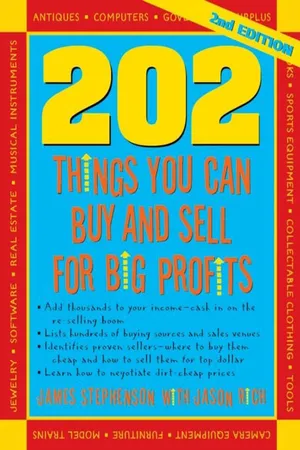
Reap Your Share of Resale Riches!This is it—the bona fide insider’s guide to cashing in on the huge boom in reselling new and used products for big bucks.At last, a soup-to-nuts primer on how to tap into the exploding market for new and "previously owned” merchandise flying off of websites such as eBay and elsewhere.
This book has it all—the latest information on what to buy, where to buy, what to pay, and how to sell it for big profits, online and off. Get the complete lowdown from a true expert on how to launch into this exciting area, plus discover 202 products almost guaranteed to start your business off with a bang.Learn which products are proven sellers, how and where to buy them cheaply, and how to resell them for top dollar:• Tap into page after page of buying sources, including distributors and wholesalers, manufacturers, online and offline auctions, government surplus sources, estate sales and more!• Find out how and where to sell the goods for the most profit, including: eBay, internet malls, websites, e-storefronts, consignment outlets, and mail order, not to mention your own showroom and in-home parties, or at trade shows and seminars.• Learn how to negotiate like a pro for overstock and out-of-season and slightly damaged goods—buying on terms for no money down.• Learn how to "work the room” at auctions, estate sales, liquidations, and flea markets—bidding and buying for less.• Learn how to tap the vast and profitable world of imported goods, with full details on over seas sources and how to deal with them.
- 350 pages
- English
- ePUB (mobile friendly)
- Available on iOS & Android
eBook - ePub
202 Things You Can Make and Sell For Big Profits
About this book
Information
CHAPTER 1
WHAT IS A BUY-AND-SELL ENTERPRISE?
For entrepreneurs, the concept behind a buy-and-sell enterprise is based upon the concept of purchasing items/products inexpensively (at wholesale prices) and then reselling those same items at higher retail prices. The difference between what you pay and how much you sell the products for (after taking into account business operating expenses) is your profit.
Your goal as a buy-sell enterprise operator can be summed up in four words—“buy low, sell high.” Of course, if it were really that easy, absolutely everyone would be doing it and we’d all be millionaires. Well, in reality, many people are doing it, and many of those people have in fact become millionaires, or at least supplemented their income enough to greatly improve their standard of living.
In addition to adhering to the “buy low, sell high” principle, to be successful operating this type of business venture, you’ll need to find the perfect product(s) for you to buy and sell.
This “perfect product” will be based on a wide range of factors, including your:
• Knowledge
• Experience
• Interests
• Schedule
• Available resources
• Geographic location
• Economic conditions
You’ll also need to take into account the following:
• Your ability to raise startup c apital
• When and where you’ll sell your products (online or in the real world)
• Your ability to acquire the products cost-effectively
• Your ability to maintain ample inventory
• Your ability to identify and reach the target audience interested in what you’ll be selling
• Your ability to efficiently m and sell your products
In reality, different people will excel and be successful buying and selling different types of items, so what works for you might not work for someone else (and vice versa). The trick is to find the right product(s) that you believe you can confidently and successfully buy and sell. Ideally, you should find a product you can be truly passionate about and that you wholeheartedly believe in.
Depending on what you’ll be buying and selling, learning basic marketing, advertising, public relations and customer service skills will most likely be essential, as will developing a basic understanding of fundamental business skills, such as the ability to negotiate with suppliers, as well as bookkeeping and record keeping.
Buying and selling for profit is nothing new. It has been around for thousands of years. In recent times, however, one of the primary reasons why buying and selling has exploded, instead of being a closely guarded secret held by a few, is the proliferation of the internet in our culture and daily lives.
dp n="29" folio="3" ?The Internet Makes It Easy to Buy and Sell
The proliferation of the internet gives entrepreneurs from every walk of life and from every geographic location access to a global audience of buying consumers, eager sellers, information and resources. It’s an extremely powerful tool that has changed our buying habits, our social habits and how we communicate as a society.
The internet has made it easier to sell products in the global marketplace utilizing online sales venues, such as eBay.com, e-commerce websites and e-classifieds. It also provides a limitless source of in-demand products, which can be bought cheaply from domestic and overseas suppliers and then resold for potentially handsome profits. (Of course, other people have also caught on to this opportunity, so depending on what you plan to buy and sell, you’ll most likely have to deal with fierce competition.)
Now, with a few clicks of a mouse, you can buy products cheaply from thousands of suppliers around the globe and then resell those same products to a potentially worldwide audience using several different online marketplaces, as well as through local community retailing opportunities such as flea markets or mall kiosks.
eBay Versus an E-Commerce Website
Launched in September 1995, eBay now boasts more than 276 million registered users worldwide (as of December 2007). During 2007, gross merchandise volume totaled more than $59 billion. This translates to worldwide users buying and selling more than $2,039 worth of goods on eBay every second.
Using an online auction business model (that also allows for items to be bought or sold for a fixed price), ordinary people can buy or sell virtually anything. This has created a massive marketplace for new and used items, which is categorized online into 50,000 unique categories. For many entrepreneurs, eBay has allowed them to launch a successful buy-and-sell business venture.
According to a June 2007 survey conducted by ACNielsen International Research, there are approximately 1.3 million sellers around the world who use eBay as their primary or secondary source of income. Depending on how you plan to buy and sell your products once you launch your buy-and-sell enterprise, you too could become one of these success stories.
So what’s really selling on eBay? In a nutshell, almost anything and everything can potentially be bought or sold online using this service. For a small fee, eBay offers a marketplace research service, which allows you to track how well specific products and items are selling on eBay at any given time. For example, once you select a product, you can obtain the average sale price, the average price range, the number of successful sales, the average number of bids per auction, and a wide range of pertinent information that can help you as a buyer or seller. You can also determine what the top searches are in specific product categories, to help you pinpoint products that might be worth selling.
Marketplace research is available from eBay for $9.99 per month (other pricing and service tiers are also available) by visiting http://pages.ebay.com/marketplace_research/index.html.
In addition to using eBay to buy and sell products, many sellers have achieved success by launching their own e-commerce websites or online business ventures. Revenues generated by online businesses—including the online aspects of traditional retail businesses—during 2006 generated over $96 billion, which is up from $83 billion in 2004.
According to the U.S. Census Bureau, “Rapid growth in e-retail has been the norm. From 2000 to 2005, retail e-sales increased at an average annual growth rate of 27.3 percent, compared with 4.3 percent for total retail sales.”
The Census Bureau also reported that “the estimate of U.S. retail e-commerce sales for the second quarter of 2007, adjusted for seasonal variation and holiday and trading-day differences, but not for price changes, was $33.6 billion, an increase of 6.4 percent from the first quarter of 2007.”
When selling online, your potential audience is vast. By 2010, more than 1.8 billion people worldwide are expected to be using the internet, according to the Computer Industry Almanac.
Until recently, if you wanted to launch an e-commerce website to sell products online, you needed to be a computer guru with a thorough understanding of HTML programming, Java, Flash, and a wide range of other complex programming languages and software-based website design tools. You also needed to invest weeks, often months, to create a website from scratch capable of handling the functionality needed to securely sell products online. Of course, a team of programmers and graphic designers could also be hired (at a significant expense) to handle much of the programming for you, but as the website operator, you still needed a good understanding of website design and programming.
These days, however, a handful of well-known and established companies offer complete e-commerce turnkey solutions that allow ordinary people—with no programming or graphic design knowledge whatsoever—to utilize a set of easy-to-use tools and professionally designed templates to effortlessly design and publish awesome-looking and extremely powerful websites in a matter of hours, not days or months. Best of all, many of these turnkey solutions have a very low startup cost (often under $100). These solutions also include the tools needed to begin accepting orders and online credit card payments for those orders.
In other words, you don’t necessarily need to set up a costly credit card merchant account with a local bank or financial institution to begin accepting Visa, MasterCard, American Express or Discover credit card or debit card payments. This alone eliminates a significant barrier to entry that until recently never existed.
Depending on your level of experience, your website design knowledge, what you’re selling, and your personal preferences, you should be able to select and start using a turnkey e-commerce solution that meets your wants and needs.
Some of the powerful, popular, inexpensive and comprehensive turnkey solutions include:
• Yahoo! Stores, http://smallbusiness.yahoo.com/ecommerce/index.php
• eBay.com ProStores, prostores.com
• GoDaddy.com Quick Shopping Cart, godaddy.com/gdshop
• OSCommerce, OSCommerce.com
Even with the most advanced and powerful e-commerce turnkey solutions that utilize the best, most eye-catching website design templates, you’ll still need to create professional-quality text and incorporate professional-looking photos and other graphic elements (referred to as assets) into your website to insure it’s capable of helping you to achieve your goals. Basically, to compete effectively, your website will need to look and function as well, if not better, than what your competition offers. Of course, you must also offer products that your customers want or need.
The New Economy Is Buying and Selling
It is no secret that manufacturing, technology and middle-management jobs in the U.S. and Canada continue to disappear daily, swallowed up by overseas economies with cheaper labor, raw product and lower production costs. In fact, some studies suggest the job drain in these areas is occurring at an alarming rate, faster than most people—including politicians and policy makers—are aware of or care to admit.
If you’re currently employed and working in a specific field or industry, you can learn about the long-term forecast for your industry or occupation by evaluating the ongoing research conducted by the U.S. Department of Labor. The Occupational Outlook Handbook is available online (bls.gov/oco) for free. The hard copy (book) edition can be found at most public libraries.
dp n="32" folio="6" ?According to the U.S. Department of Labor, “Total employment is expected to increase from 150.6 million in 2006 to 166.2 million in 2016, or by 10 percent. The 15.6 million jobs that will be added by 2016 will not be evenly distributed across major industrial and occupational groups. Changes in consumer demand, technology, and many other factors will contribute to the continually changing employment structure in the U.S. economy.”
In February 2008, The Associated Press reported, “With economic growth slowing, the Fed projected that the national jobless rate will rise to between 5.2 percent and 5.3 percent this year. That is higher than the central bank’s old forecast for the rate to climb to as high as 4.9 percent. Last year, the unemployment rate averaged 4.6 percent.”
Like so many people, you may discover that forecasts for your industry or occupation predict massive job reductions and cutbacks. This resulting fallout in North America has created a dramatic increase in the number of new small-business startups. Many people who have been or who will soon be affected by the new global economy have chosen self-employment as a way to keep in tune with changing times, make money and secure their long-term future.
Launching your own buy-and-sell enterprise is just one potential solution for helping yourself survive financially in these rough economic times, whether you choose to pursue this type of opportunity on a part-time, seasonal or full-time basis.
The Advantages of a Buy-and-Sell Enterprise
When you consider the advantages of a buy-and-sell enterprise over traditional retail or service-provider businesses, it quickly becomes apparent why many people have wisely elected to buy and sell, and why buying and selling will make up a large percentage of new business startups and the new economy.
Let’s consider some of these reasons, which include:
• Low Investment/Low Startup Costs: The vast majority of buy-and-sell enterprises require only a minimal investment to start. Many require under $2,000 in initial inventory and under $10,000 in overall startup costs.
• Minimal Financial Risk: Because much the money you spend to get started goes into buying inventory and equipment needed to launch your business, there is limited financial risk involved. If you decide to quit, you can simply sell off stock and equipment in order to potentially recoup much of your investment.
• Impressive Profit Potential: This will depend on what you’re selling and how you’re selling it, plus your ability to “buy low, sell high.” With proper planning and a great business idea, the income potential can be significantly better than working a traditional nine-to-five job.
• Work From Home: F...
Table of contents
- Title Page
- Introduction
- CHAPTER 1 - WHAT IS A BUY-AND-SELL ENTERPRISE?
- CHAPTER 2 - LEGAL AND FINANCIAL ISSUES OF A BUY-AND-SELL ENTERPRISE
- CHAPTER 3 - THERE’S STILL PLENTY MORE YOU’LL NEED TO KNOW
- CHAPTER 4 - WHERE YOU CAN BUY THINGS CHEAPLY
- CHAPTER 5 - WHERE YOU CAN SELL THINGS FOR BIG PROFITS
- CHAPTER 6 - THE MEGA-LIST: 202 THINGS YOU CAN BUY AND SELL FOR BIG PROFITS
- INDEX
- Subscribe to Entrepreneur Magazine
- Copyright Page
Trusted by 375,005 students
Access to over 1.5 million titles for a fair monthly price.
Study more efficiently using our study tools.
Frequently asked questions
Yes, you can cancel anytime from the Subscription tab in your account settings on the Perlego website. Your subscription will stay active until the end of your current billing period. Learn how to cancel your subscription
No, books cannot be downloaded as external files, such as PDFs, for use outside of Perlego. However, you can download books within the Perlego app for offline reading on mobile or tablet. Learn how to download books offline
Perlego offers two plans: Essential and Complete
- Essential is ideal for learners and professionals who enjoy exploring a wide range of subjects. Access the Essential Library with 800,000+ trusted titles and best-sellers across business, personal growth, and the humanities. Includes unlimited reading time and Standard Read Aloud voice.
- Complete: Perfect for advanced learners and researchers needing full, unrestricted access. Unlock 1.5M+ books across hundreds of subjects, including academic and specialized titles. The Complete Plan also includes advanced features like Premium Read Aloud and Research Assistant.
We are an online textbook subscription service, where you can get access to an entire online library for less than the price of a single book per month. With over 1.5 million books across 990+ topics, we’ve got you covered! Learn about our mission
Look out for the read-aloud symbol on your next book to see if you can listen to it. The read-aloud tool reads text aloud for you, highlighting the text as it is being read. You can pause it, speed it up and slow it down. Learn more about Read Aloud
Yes! You can use the Perlego app on both iOS and Android devices to read anytime, anywhere — even offline. Perfect for commutes or when you’re on the go.
Please note we cannot support devices running on iOS 13 and Android 7 or earlier. Learn more about using the app
Please note we cannot support devices running on iOS 13 and Android 7 or earlier. Learn more about using the app
Yes, you can access 202 Things You Can Make and Sell For Big Profits by James Stephenson in PDF and/or ePUB format, as well as other popular books in Business & Imprenditoria. We have over 1.5 million books available in our catalogue for you to explore.