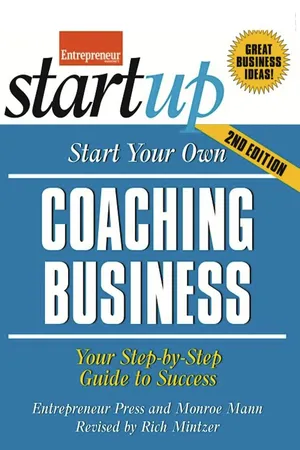
The $100 billion coaching industry has exploded since the 1990s, as harried businesspeople turn to experts to help them make the right decisions and get motivated. And while there are many books on the market teaching the basics of starting a coaching business, this book covers three unique coaching arenas—motivation, life and business.Readers will learn how to master the two separate disciplines of a successful coaching business: the art of motivating clients and the science of running a successful business. They’ll discover how to establish their expertise to find new clients—and how to retain those clients. Smart pricing strategies and creative coaching package ideas will increase entrepreneurs’ revenue potential. Sales and publicity tips will further help entrepreneurs build their business as a motivational, life or business coach, and in-depth explanations of expansion ideas are included to allow readers to go as far as their dreams will take them.
- 240 pages
- English
- ePUB (mobile friendly)
- Available on iOS & Android
eBook - ePub
About this book
Information
1
Prepare to Get Motivated
Congratulations! You’ve just made a brave step into a field that few people understand, and even fewer can actually do well. Welcome to the wild world of motivational and life coaching.
Why is this such a unique field? Well, first off, a lot of people get the wrong idea about the field; the term motivational coach is at best misleading, and at worst, misunderstood and ridiculed. Second, it’s a unique field because it’s somewhat of a hybrid field; it’s not standard consulting where you provide specific business information to someone from a position of expertise, and it’s not psychotherapy, where issues of mental health are handled by professionals with licenses and degrees.

Smart Tip
Motivational coaching is a cross between consulting, coaching, and counseling, and you should aim to be well versed in all three.
Motivational coaching falls in a very strange place somewhere in between consulting and therapy, and to add even more confusion, at one point of the triangle there’s this additional word thrown in: “motivational.” So it’s consulting meets psychotherapy with a motivational twist.
Then there is “life coaching,” which is essentially what takes place in-between the high energy moments of motivational coaching. In essence, life coaches help individuals manage that which goes on in daily life by keeping their clients focused, maintaining order, and making sure they have a plan and are sticking to it.
Let’s face it, most of the day to day aspects of life aren’t dynamic or exciting enough to get pumped up over. Most people’s daily routines do not require the need for constant motivation. Someone cheering you on, and motivating you, to read a book for school or to organize the mess in your office will probably wear thin pretty quickly. The life part of coaching is to help you find concrete solutions that will keep you on track. The motivational aspect looks at the bigger picture and motivates you to reach the goal of passing the course or getting work done more quickly. Can you do both? Certainly, you almost have to in order to get results.
The Evolution of the Motivational Coaching Field
As far as I am concerned, Tony Robbins really put motivational coaching on the map. While certainly there are the greats such as Dale Carnegie and Napoleon Hill, it was Tony Robbins who really took motivational coaching to an international level and made it a modern craze.
This concept of motivation expanded into finance with Robert Kiyosaki and the Rich Dad series, Robert Allen, and Suze Orman; into real estate with Carlton Sheets, and Donald Trump and Trump University; into the stock market with Investools and Robert Allen, and the list goes on.
Over the last 25 years, motivation moved from being a fringe industry into the international spotlight, in large part thanks to the internet and the ease of communication that email brought into nearly every home. Motivational coaching is no longer something that “those people” do; it’s something that is starting to intrigue even Joe Public in Anytown.
Some People Just Won’t Change
This discussion of the growth of motivational coaching leads to an interesting fact: While the number of people who are interested in motivational services these days has greatly increased, the vast majority of those who seek such help don’t really change their lives all that much as a result of what they’ve learned. While I am coaching people today who ten years ago might not have hired me, it is also clear that not everyone I coach soars to new heights. Some just refuse to change. I provide them the information and get them inspired, but they just fizzle out. Sure, many of my clients do take what I give them and run with it to the tops of their field, but others take what I give them, put the information in a closet, and return to their old ways of doing things. While this is disappointing, there is not much I can do about it. And there won’t be much you can do about it, either. Some people are scared of change and many are set in their ways. That’s what makes us all unique. Therefore, not everyone will benefit from a coach.
You see, statistics show that if 100 people attend a seminar, only 30 of them will actually act on the information provided, even if they agree completely with the actions recommended. Why is this? Well, for one, people are generally lazy, no matter what they may tell you or lead you to believe. Second, most people don’t want to actually work to change their life; they want a quick fix that doesn’t require hard work. They would really like to see change in their lives, but they don’t want to change themselves in the meantime to help effect that change in their lives. Unfortunately, the quick fix doesn’t exist, and many people just give up. It takes hard work to make a change.

Beware!
Do not call yourself a psychotherapist unless you are licensed to do so.
This point is crucial. Just because there has been a large increase in curiosity for motivational coaching and services, it doesn’t mean that there is a large change in the psychological tendencies of human beings. Most people still remain unwilling to do what they know they need to do in order to become and remain successful.

Stat Fact
Most people who attend seminars do not implement what they learn from seminars. The same is true of those who use coaches for a brief stint, and then stop. This is why it is in your best interest to work with clients over a period of time. The accountability you provide the client over a long-term coaching period will result in better results.
All Coaching Needs to Be Motivational
The other key transition is that everyone is starting to demand that all coaching—no matter what the field—needs to be motivational. Today, clients not only want the expert analysis, but they also want to be instilled with the confidence to know that they can implement the new plan. They want the passion to come with the plan. They want to be inspired to take the leaps of faith that they just couldn’t do alone. They want—and crave—the validation that they just can’t find anywhere else.
Yes, today, coaching of any sort needs to be motivational, and most consultants will agree that their approach today is beginning to morph to include aspects of coaching, and motivational coaching at that. Isn’t it rather funny, though, that it is even called motivational coaching—as if there are other branches of coaching that are not motivational? How can anyone be a good coach without being motivational? It seems so obvious. Whether you are coaching a basketball team or a five-person computer programming group; the cast of a feature film or an individual entrepreneur; the CEO of a company or a police officer on the local force; it’s all the same—if you’re not motivational, you are not doing your job! If you are not helping them to realize that the plan is doable, and is going to be successful, what kind of coach are you anyway? And it all involves the magic five-syllable word: Mo-tiva-tion-al.

Smart Tip
Read this book with a “no rules” frame of mind. What works for you may differ from what I recommend here. Every company is unique, and needs to be approached as such. Don’t be afraid to break the rules.
You Need to Be Motivated Before All Others
Surprise! In order to be a motivational coach, you need to first be a motivated person!
What does that mean? It means that you can’t just say that you’re a motivational coach; you need to embody it, and mean it. To that end, it’s nothing more than having a passion for igniting and fueling a fire within someone else, especially when they think that they can’t do it.
The key to take away from this introductory section is that you need to be an exciting person! Sure, it seems like an obvious necessity that you need to be motivated first, but a lot of people don’t get that. They think that just because they understand the subject matter they are coaching—voila—they are going to have a successful coaching business. WRONG.
You need to be that “first mover” that Aristotle talks about; that force that inspires motion in others. You need to be the inspiration for your clients. If they don’t see the fire within you from the moment the relationship begins, you are never going to be able to ignite it within them.
Life Is Still Going to Suck Sometimes
Want the harsh reality? Being a motivational coach to others is perhaps one of the most difficult jobs in the world, and for one reason: It is sometimes incredibly hard to motivate others when you yourself are not.
You see, just because you are motivational and inspiring to others does not mean that you are impervious to depression, loneliness, doubt, fear, and self-consciousness yourself. In fact, you, as a motivational coach, may in fact be more in tune with these psychological issues within yourself than any of your clients.
The point here is that being a motivational coach is not always fun. Some days, you are going to look at your appointment book, and think, “Helping someone else out today is really the last thing I want to do right now.” Some days—it is inevitable—you are going to receive some bad news about some aspect of your own career or life. Many times, this bad news will arrive right before a scheduled meeting with a client. That is going to bring you down, and you are not going to want to be a motivational coach anymore. In fact, at times like this, you may question whether you are even qualified to be a motivational coach. You’ll start thinking, “Maybe I’m just a charlatan!”
There is some good news here: Don’t worry about it! All this means is that you are human, and that just as your clients aren’t superhuman, neither are you.
My clients ask me constantly, “But who is your coach?” True, I myself do have my own coaches and mentors, from Jay Conrad Levinson to my various professors at grad school. But they aren’t the ones who get me motivated on a daily basis. Who is then? The answer is clear. My clients! It is by helping my own clients, and seeing their eyes light up, and seeing their hopes and dreams come alive within their own souls that gets me pumped up again about my own hopes and dreams.

Smart Tip
There’s a strange phenomenon that you will encounter over and over again: When you are depressed and don’t want to meet with a client, the best thing you can actually do is go ahead with the client meeting anyway. Why is this? Simple: Your clients are going to end up motivating you!
The end result is that—without fail—I always feel like a million bucks after a client meeting, no matter how depressed I felt going into the meeting. That’s one of the best ...
Table of contents
- Additional titles in Entrepreneur’s Startup Series
- Title Page
- 1 - Prepare to Get Motivated
- 2 - What Is a Motivational Coach?
- 3 - Training to Be a Coach
- 4 - First Steps Setting Up Your Business
- 5 - Choosing a Target Market
- 6 - Setting Up Your Office—Online and Off
- 7 - Finding Those First Clients
- 8 - Deciding How Much to Charge
- 9 - Profit and Loss
- 10 - Running Your Business
- 11 - Improving Your Offerings
- 12 - Keeping Those First Clients
- 13 - Sales and Marketing Systems
- 14 - Making a Profit
- 15 - Company Operations Handbook
- 16 - Publicizing Your Business
- 17 - Expanding Services Offered
- 18 - Expanding Into New Markets
- 19 - Hiring and Firing
- 20 - Hiring an Office Manager
- 21 - Selling It
- 22 - Franchising It
- 23 - Keeping It
- 24 - Expect the Best
- Appendix - Coaching Resources
- About the Authors
- Glossary
- Index
- Subscribe to Entrepreneur Magazine
- Copyright Page
Trusted by 375,005 students
Access to over 1.5 million titles for a fair monthly price.
Study more efficiently using our study tools.
Frequently asked questions
Yes, you can cancel anytime from the Subscription tab in your account settings on the Perlego website. Your subscription will stay active until the end of your current billing period. Learn how to cancel your subscription
No, books cannot be downloaded as external files, such as PDFs, for use outside of Perlego. However, you can download books within the Perlego app for offline reading on mobile or tablet. Learn how to download books offline
Perlego offers two plans: Essential and Complete
- Essential is ideal for learners and professionals who enjoy exploring a wide range of subjects. Access the Essential Library with 800,000+ trusted titles and best-sellers across business, personal growth, and the humanities. Includes unlimited reading time and Standard Read Aloud voice.
- Complete: Perfect for advanced learners and researchers needing full, unrestricted access. Unlock 1.5M+ books across hundreds of subjects, including academic and specialized titles. The Complete Plan also includes advanced features like Premium Read Aloud and Research Assistant.
We are an online textbook subscription service, where you can get access to an entire online library for less than the price of a single book per month. With over 1.5 million books across 990+ topics, we’ve got you covered! Learn about our mission
Look out for the read-aloud symbol on your next book to see if you can listen to it. The read-aloud tool reads text aloud for you, highlighting the text as it is being read. You can pause it, speed it up and slow it down. Learn more about Read Aloud
Yes! You can use the Perlego app on both iOS and Android devices to read anytime, anywhere — even offline. Perfect for commutes or when you’re on the go.
Please note we cannot support devices running on iOS 13 and Android 7 or earlier. Learn more about using the app
Please note we cannot support devices running on iOS 13 and Android 7 or earlier. Learn more about using the app
Yes, you can access Start Your Own Coaching Business by in PDF and/or ePUB format, as well as other popular books in Business & Entrepreneurship. We have over 1.5 million books available in our catalogue for you to explore.