In 2004, Kennedy took on the world of cell phones, PDAs, faxes, emails and every other communication device that pervade the lives of entrepreneurs and suggested when to tap it, and when to give it the heave-ho. He delivered a fresh take on the mantra "time is money” and showed entrepreneurs how to maximize their time to better manage their business. However, times have changed and so has the technology.In this latest edition, Kennedy tackles the technology of today and delivers new insights and tools for boosting personal productivity in keeping with his "less is more” approach. New material includes how to outsource, buying experts, expertise and time. Kennedy covers virtual assistants, errand-running services, and the far-reaching scope of activities and tasks people are paying others to do for them. Kennedy also adds two new chapters discussing how to get more accomplished by leveraging cooperative relationships, why goal setting (and New Year’s Resolutions) fails and how he manages achievement.
eBook - ePub
No B. S. Time Management for Entrepreneurs
The Ultimate No Holds Barred Kick Butt Take No Prisoners Guide to Time Productivity and Sanity
- 240 pages
- English
- ePUB (mobile friendly)
- Available on iOS & Android
eBook - ePub
No B. S. Time Management for Entrepreneurs
The Ultimate No Holds Barred Kick Butt Take No Prisoners Guide to Time Productivity and Sanity
About this book
Information
CHAPTER 1
How to Turn Time Into Money
Eliminate the time between the idea and the act, and
your dreams will become realities.
your dreams will become realities.
—DR. EDWARD L. KRAMER, INVENTOR OF THE
SELF-IMPROVEMENT SYSTEM KNOWN AS “SYNCHROMATICS”
SELF-IMPROVEMENT SYSTEM KNOWN AS “SYNCHROMATICS”
What is “entrepreneurship” if not the conversion of your knowledge, talent, and guts—through investment of your time—into money?
Starting with the very next chapter, we dive into very specific how-to strategies, but first I think you’ll find it useful to understand how I arrived at my philosophy of valuing time and how I value time. I’ll be the first to tell you, you can’t eat philosophy, but you do need your own philosophy of time valuing.
In time management books and in time management seminars, authors and speakers love to show off charts and graphs depicting the dollar value of each workday hour, depending on your income or the income you want to achieve. Maybe you’ve sat through one of these little graph-and-pointer sessions before. You know, Mr. Lecturer up there, laptop computer wired into the overhead projector, lights dimmed, even a laser beam pointer in hand so he can show off his beautiful five-color bar graph. If you use his numbers, for example, based on eight-hour workdays, presuming 220 workdays, earning $200,000.00 a year requires that each hour be worth $113.64.
Unfortunately, it’s all a pile of seminar room B.S.
Here’s why: It’s all based on eight-hour workdays. Eight hours a day. But there’s not a soul on the planet who gets in eight productive hours a day. Not even close. You see, the workday hour is one thing, the productive hour—or what I call the billable hour—is another. Elsewhere in this book, there’s a definition of productivity you may want to use to determine which of your hours are productive.
Now, if you happen to be an attorney, none of this matters. It seems lawyers bill out hours whether productive or not. Here’s a joke. A 35-year-old lawyer in perfect health suddenly drops dead. He gets to Saint Peter at The Gate and argues, “You guys screwed up. You pulled me up here early.” Saint Peter checks his clipboard and says, “No, sir. Judging by your total billable hours, you’re 113 years old and we’re late.” Lawyers.
But the rest of us can only collect on genuinely productive hours.
Can One “Number” Change Your Life?
Let’s go back to the math game and assume that $200,000.00 is your base earnings target. (We’ll talk more about what that term means later.) How many of your hours will be productive, directly generating revenue? How many will be otherwise consumed: commuting, filling out government paperwork, dealing with vendors, emptying the trash cans (I hope not), whatever? Let’s say it is one-third productive, two-thirds other. That’s pretty generous. One study of Fortune 500 CEOs revealed they averaged 28 productive minutes a day. The business legend Lee Iacocca, who made the Mustang happen at Ford and who rescued Chrysler from the brink of bankruptcy in the 1980s with minivans and cup holders and bold warranties, personally told me he figured top CEOs might squeeze in 45 productive minutes per day—the rest of the day fighting off time-wasting B.S. like a frantic fellow futilely waving his arms at a swarm of angry bees on attack. It must be even worse today, given the explosion of time-intruding technology. But let’s generously make 33% of your time productive. With that, only one of three hours counts as “billable.” So you’ve got to multiply the $113.64 times three, $340.92. This becomes your governing number for $200,000.00 a year. For $600,000.00, three times that: $1,022.76.
When I wrote the first edition of this book in 1996, I was charging about $3,500.00 to write an advertising campaign for a client. By the time I updated this book in 2004, that fee had multiplied five times. Today, a full campaign bills at $75,000.00 to $150,000.00 plus royalties. Since the time required is about the same, if not less, as my memory bank of material and proficiency have grown, this puts more and more weight on any time wasted. So the ideas and methods I describe in this book are a lot more important to me today than they were in 1996 or in 2004. Of course, it’s arguably true that I can more easily afford to repel some clients and annoy some people with these methods now than then, but I contend I got here, in part, by thinking about time in this fashion and doing these things long before I could ostensibly afford them.
Anyway, let’s roll back the calendar and assume I currently charge a client $3,500.00, and that my base earnings target number requires an hourly average of $340.92. If you travel in business, you have to think about this a lot. I once lived in Arizona, and often traveled for business. I currently have homes in Ohio and in Virginia, grew to loathe travel, and now do it as little as possible. I insist the clients, coaching groups, even events I speak at occur in my home cities. But when I was traveling, if there were two days of travel bracketing a day of work, that put three days’ cost to that work. Using the $340.92 hourly number, that’s $8,182.08 of cost.
Few people ever factor cost of their time (or their staff’s time) into product, service, deliverable cost, or the maintenance of each client of variable value, or much of anything else. But you should. At just $340.92 an hour, a client who comes to you costs only for the hours he is there. A client you must drive an hour to visit and hour to return from costs $683.84 more. If that’s four times a year, one costs $2,735.36 more than the other. Consider two customers, each worth $3,000.00 a year, but one is needier and more demanding than the other. One consumes eight hours, the other three. The first may not even be worth having, particularly if there are enough of the second to be had. This, by the way, is why I book 20-minute, not 30-minute, calls with my coaching clients. I can do three per hour at 20 minutes each but only three per 1½hours at 30 minutes each. In a year, 10 minutes saved per month per client = two hours! Times 20 clients, a full week!
So, again, let’s say my number is $340.92, calendar rolled back. Here’s how I have to use it.
First, it has to be on my mind constantly. Is what I’m doing worth $340.92 an hour to do it?
Second, it puts a meter on others’ consumption of my time—that unnecessary 12-minute phone conversation just cost $68.18. Same with 12 minutes at Facebook or Twitter. This exercise forces you to think of time and activity in terms of investment and expense. It enables you to quantify what is going on in your life.
dp n="24" folio="5" ?Third, for me it sets the base cost for hours given to a speaking engagement, consulting assignment, copywriting assignment, and other things I do that are directly billable. And if you do anything but earn a fixed salary, you have to weigh this base cost against every activity, to set your fee or to decide whether or not to bother.
I’ve learned to think about time cost and time cost of travel a lot. When I first started shifting from going to clients to getting clients to travel to me, I used differential pricing. At that time, a consulting day billed at $8,300.00 if I came to you but only $7,800.00 if you came to me. Why? Because it’s worth money to me to stay home, be able to write for an hour in the morning before the consulting day, finish and be at home at 4:30, be able to drive in harness races and not miss any, sleep in my own bed, and be at work in my home office promptly at 7:00 A.M. the next morning vs. losing that hour the day of and losing a half day or so to travel on either side. Gradually I eliminated the differential pricing and simply mandated that clients travel to me. I finally converted to flying only by private jet, and that exorbitant expense to be absorbed by a client has pretty much ended any discussion of me coming to them. In a way, that expense added to fees has re-created differential pricing; even the cost of the client plus a couple staff people traveling commercial to me is a lot lower than my fee plus my private jet bill. Looked at side by side on a sheet of paper, it’s dramatic—if the client fails to factor in the dollar value of his and his staff’s travel time. Which most clients do not. Differential pricing is useful for a variety of purposes. Within GKIC, there are lawyers, accountants, dentists, and others who charge a higher fee if they do a client’s work than they do if they only supervise the work done by subordinates.
You don’t have to be flying the unfriendly skies to do travel time cost math. Many years ago, when I was in the field selling, I quickly figured out that you could fit in two, three, four, or five appointments per day, depending on how you routed yourself. A salesman half as good at selling as a competitor but twice as good at efficiently routing himself and clustering prospects makes the same amount of money. With this in mind, I’ve long “clustered” as much productive activity as possible if traveling or even when leaving the house. We’ll talk more about that in Chapter 6. By not “clustering,” most people allow a great deal of inefficiency to sneak into their lives.
By working at home, as a writer, consultant, and tele-coach, as opposed to going to an office, I make a lot of money each day just by not commuting. I have conditioned myself to go directly from bed to shower to work in 15 minutes. If I were leaving the house to go to an office, I’d have those 15 minutes plus another half hour, maybe an hour, commute, then another 15 minutes getting settled in at the office. Not to mention the commute at end of day.
Seek LEVERAGE
In whatever ways you can in your business, you need to seek leverage. In terms of work productivity, leverage is, in essence, the difference between the base cost for your hour and the amount of money you get for it or from it. One good way to evaluate your personal effectiveness is measuring and monitoring this differential, hour by hour, for a week.
Now, let’s go back to the term base earning target. Since you are your own boss, you write your own paycheck, and you decide how much that paycheck is going to be. For most entrepreneurs, that number is—whatever’s left! This is a huge mistake, for two reasons: It indicates zero planning, and it means you pay yourself last, the number-one reason entrepreneurs wind up broke. So, let’s reverse all that, and start with the planning. You’ve got to decide how much money you’re going to take out of your business or businesses this year in salary, perks, contributions to retirement plans, and so on. What is that number?
I’ll tell you this: eight out of ten entrepreneurs I ask
cannot come up with this number.
cannot come up with this number.
Anyway, if you do not have a base income target, then you cannot calculate what your time must be worth, which means you cannot make good decisions about the investment of your time, which means you are not exercising any real control over your business or life at all. You are a wandering generality. Is that what you want to do—just wander around and settle for whatever you get?
Now, you may not have a situation that lends itself to clear-cut billable hours as I do, so how can this strategy work for you? It has to. It’s even more important to you than to me. Let’s say you own six stores. Each store has a manager. Hey, this is complicated. Well, you’ll have to decide how much of the business’s bottom-line profit goal will be provided by the managers whether you sleep or work and how much is still inextricably linked to you. If you want $500,000.00 at the bottom line and you figure half is dependent on you, you’ve got a $250,000.00 target.
Entrepreneurs should think about the purpose of business. A lot of business owners lose sight of that altogether. The purpose of a business is to make its owner rich. The first responsibility of the owner is to extract money from the business, not leave it locked up in it or, worse, put money into it.
For me, it’s reasonably precise. For you, it may not be such an exact science. But that’s OK. I promise you that coming up with a number, even if it is arrived at through some pretty questionable calculations, is still a whole lot better than not having a number at all. Having a number is going to make such a dramatic change in so many of the decisions you make, habits you cultivate, and people you associate with that the benefits will be so extraordinary it won’t matter if the original method of getting to a number had a technical flaw or two buried in it. At least for the sake of our conversation in this book, get a number. YOUR base earnings target for the next full calendar year (see Figure 1.1). Divide it by the number of workday hours. Multiply it to allow for unproductive vs. productive hours. If you haven’t a better estimate of that, use the three-time multiple I’ve used here. Now you have what your time is supposed to be worth per hour. Divided by 60, per minute.
That little number may just change your life.
It’s sort of like a heart attack—or, in my own case, a diabetes diagnosis—being required to really get somebody to change their eating and exercise habits.
FIGURE 1.1: Calculating Your Base Earnings Target
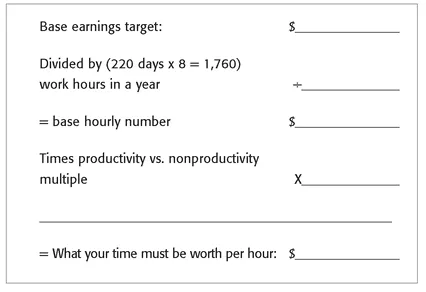
A lot of your decision-making gets easy with this number staring you in the face. It’s hard to con yourself with this number staring you in the face. In fact, I suggest having it stare you in the face a lot until you internalize it. Write your number, “$____ Per Hour,” on a bunch of colorful 4 x 6-inch cards in bold black letters, and stick these cards up in places where you work and will see them often.
Generally speaking, two business life changes probably come to mind immediately, with this number staring you in the face:
First, you realize that you’ve got to surround yourself with people who understand and respect the value of your time and behave accordingly. This is not easy. And they will forget, over time. Familiarity breeds contempt. Periodically, you will have to re-orient them. You also must get people who do not respect the value of your time out of your business ...
Table of contents
- What Others Say About the Impact of the First Edition of This Book
- Title Page
- Foreword
- Preface
- CHAPTER 1 - How to Turn Time Into Money
- CHAPTER 2 - How to Drive a Stake Through the Hearts of the Time Vampires Out to ...
- CHAPTER 3 - Stopping “Productivus Interruptus” Once and For All
- CHAPTER 4 - The Number-One Most Powerful Personal Discipline in All the World ...
- CHAPTER 5 - The Magic Power that Makes You Unstoppable
- CHAPTER 6 - The Ten Time Management Techniques Really Worth Using
- CHAPTER 7 - How to Turn Time into Wealth
- CHAPTER 8 - How to Handle the Information Avalanche
- CHAPTER 9 - Fire Yourself, Replace Yourself, Make More Money, and Have More Fun
- CHAPTER 10 - The Link between Productivity and Association
- CHAPTER 11 - Buy Time by Buying Expertise
- CHAPTER 12 - The Inner Game of Peak Personal Productivity
- CHAPTER 13 - Reasons Why a Year Passes and No Meaningful Progress Is Made
- Dan Kennedy’s No B.S. Time Truths
- Other Books by the Author in the No B.S. Series, Published by Entrepreneur Press
- Index
- Teaser chapter
- Contents
- Subscribe to Entrepreneur Magazine
- Copyright Page
Trusted by 375,005 students
Access to over 1.5 million titles for a fair monthly price.
Study more efficiently using our study tools.
Frequently asked questions
Yes, you can cancel anytime from the Subscription tab in your account settings on the Perlego website. Your subscription will stay active until the end of your current billing period. Learn how to cancel your subscription
No, books cannot be downloaded as external files, such as PDFs, for use outside of Perlego. However, you can download books within the Perlego app for offline reading on mobile or tablet. Learn how to download books offline
Perlego offers two plans: Essential and Complete
- Essential is ideal for learners and professionals who enjoy exploring a wide range of subjects. Access the Essential Library with 800,000+ trusted titles and best-sellers across business, personal growth, and the humanities. Includes unlimited reading time and Standard Read Aloud voice.
- Complete: Perfect for advanced learners and researchers needing full, unrestricted access. Unlock 1.5M+ books across hundreds of subjects, including academic and specialized titles. The Complete Plan also includes advanced features like Premium Read Aloud and Research Assistant.
We are an online textbook subscription service, where you can get access to an entire online library for less than the price of a single book per month. With over 1.5 million books across 990+ topics, we’ve got you covered! Learn about our mission
Look out for the read-aloud symbol on your next book to see if you can listen to it. The read-aloud tool reads text aloud for you, highlighting the text as it is being read. You can pause it, speed it up and slow it down. Learn more about Read Aloud
Yes! You can use the Perlego app on both iOS and Android devices to read anytime, anywhere — even offline. Perfect for commutes or when you’re on the go.
Please note we cannot support devices running on iOS 13 and Android 7 or earlier. Learn more about using the app
Please note we cannot support devices running on iOS 13 and Android 7 or earlier. Learn more about using the app
Yes, you can access No B. S. Time Management for Entrepreneurs by Dan S. Kennedy in PDF and/or ePUB format, as well as other popular books in Business & Entrepreneurship. We have over 1.5 million books available in our catalogue for you to explore.