Looking to start a business and turn a profit in a very short time?
Then becoming a freight broker is likely for you!The experts at Entrepreneur lay out a step-by-step approach to starting a freight brokerage business, showing aspiring entrepreneurs how to establish a business, define services, find reliable carriers, set rates, and more. Requiring no special training or knowledge of the shipping industry, this guide provides real life examples, sound business advice, and priceless tips on creating a successful company in this billion-dollar industry.
eBook - ePub
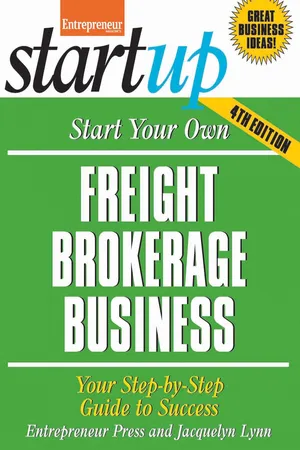
Start Your Own Freight Brokerage Business
Your Step-By-Step Guide to Success
- 114 pages
- English
- ePUB (mobile friendly)
- Available on iOS & Android
eBook - ePub
About this book
Information
1
Introduction
to the Freight Brokerage Business
The transportation industry in general, and the trucking industry specifically, are critical to the economic and social survival of local communities, the country, and, indeed, the entire world. Think about the times major transportation systems have failed because of mechanical problems, natural disasters, or labor conflicts. When cargo can’t move, the repercussions are serious and widespread. Store shelves are emptied, perishable goods spoil, factories are shut down, workers are idled—the list goes on.
The United States may be shifting from a manufacturing to an information-based economy, and technology is certainly impacting every business, but there will never be a time when goods do not have to move.
“Logistics professionals in the United States—shippers, intermediaries, and carriers—have transformed the way we do business,” says Robert A. Voltmann, president and CEO of the Transportation Intermediaries Association (TIA) in Alexandria, Virginia. “In the process, our national economy has been transformed as well. Transportation has become a strategic asset. Inventory is now stored in motion as we have been able to move to just-in-time delivery. More goods are being moved and with more efficiency and reliability than ever before.”
Take a look around your home or office. It’s highly unlikely that you have much—if anything at all—that didn’t reach you either entirely or partially by truck. The size and scope of the motor freight industry can be overwhelming. The good news is that there’s plenty of room for you to start and grow a profitable business serving the industry as a freight broker.
What exactly is a freight broker? Very simply, it is an individual or a company that brings together a shipper that needs to transport goods with an authorized motor carrier that wants to provide the service. The legal definitions of “broker” and “brokerage service” are found in the Code of Federal Regulations, 49CFR371.3:
Broker means a person who, for compensation, arranges or offers to arrange the transportation of property by an authorized motor carrier. Motor carriers, or persons who are employees or bona fide agents of carriers, are not brokers within the meaning of this section when they arrange or offer to arrange the transportation of shipments which they are authorized to transport and which they have accepted and legally bound themselves to transport.
Brokerage or brokerage service is the arranging of transportation or the physical movement of a motor vehicle or of property. It can be performed on behalf of a motor carrier, consignor or consignee. Nonbrokerage service is all other service performed by a broker on behalf of a motor carrier, consignor or consignee.
Fun Fact

According to a recent survey in Transportation Journal magazine, the aspects brokers enjoy most about their work are solving problems for customers and the fast-paced environment. What do they find most frustrating? The lack of trucks, and the feeling that brokers are not respected as professionals.
A freight broker falls into the category of transportation intermediary, which is a company that is neither a shipper nor an asset-owning carrier, but plays a role in the movement of cargo. “Transportation intermediaries leverage their knowledge, investment in technology, and people resources to help both the shipper and carrier succeed,” says Voltmann.
Brokers provide an important and valuable service to both motor carriers and shippers. They help carriers fill their trucks and earn a commission for their efforts. They help shippers find reliable motor carriers that they (the shippers) might not have otherwise known about. In fact, some companies use brokers as their traffic department, allowing the broker to coordinate all their shipping needs.
Brokers are not new to the trucking industry; they’ve been around since the industry itself began in the early part of the 20th century. Prior to the 1970s, however, regulations governing brokers were so restrictive that few firms were willing to even try to gain entry into the industry. But with dramatic changes in federal transportation policy during the 1970s, regulatory restrictions have been eased, creating new entrepreneurial opportunities in the third-party logistics arena.
The Players

An industry so huge and diverse requires a wide range of participants to thrive. Some of these participants’ titles may be a bit confusing, and some of their responsibilities may overlap. But to keep things clear and as simple as possible, let’s look at who the key players are and what they do.
•Freight broker. A freight broker is the middleman who connects shippers and carriers. Freight brokers are also known as “truck brokers,” “transportation brokers,” and “property brokers.” Though we will consistently use the term “freight broker” in this book, you may see or hear these other titles elsewhere.
•Shipper. A shipper is an entity that has products or goods to transport. Technically, shippers can be individuals or companies, but as a broker, you will deal most often with businesses in manufacturing or agriculture industries.
•Motor carrier. A motor carrier is a company that provides truck transportation. There are two types of motor carriers: private (a company that provides truck transportation of its own cargo), and for hire (a company that is paid to provide truck transportation of cargo belonging to others). There are two types of for-hire carriers: common and contract. A common carrier serves the public under two stringent obligations: compulsory service and liability for loss or damage to goods. A contract carrier transports freight under contract with one or a limited number of shippers.
Smart Tip

Many shippers who have their own fleets (private carriers) occasionally function as contract carriers. Many of t...
Table of contents
- Cover
- Title Page
- Copyright
- Contents
- Preface
- Chapter 1: Introduction to the Freight Brokerage Business
- Chapter 2: What Does the Business Require?
- Chapter 3: Operations
- Chapter 4: What Can Go Wrong?
- Chapter 5: Locating and Setting Up
- Chapter 6: Staffing Your Company
- Chapter 7: Marketing
- Chapter 8: Sales
- Chapter 9: Financial Management
- Chapter 10: Tales from the Trenches
- Appendix: Freight Broker Resources
- Glossary
- Index
Trusted by 375,005 students
Access to over 1.5 million titles for a fair monthly price.
Study more efficiently using our study tools.
Frequently asked questions
Yes, you can cancel anytime from the Subscription tab in your account settings on the Perlego website. Your subscription will stay active until the end of your current billing period. Learn how to cancel your subscription
No, books cannot be downloaded as external files, such as PDFs, for use outside of Perlego. However, you can download books within the Perlego app for offline reading on mobile or tablet. Learn how to download books offline
Perlego offers two plans: Essential and Complete
- Essential is ideal for learners and professionals who enjoy exploring a wide range of subjects. Access the Essential Library with 800,000+ trusted titles and best-sellers across business, personal growth, and the humanities. Includes unlimited reading time and Standard Read Aloud voice.
- Complete: Perfect for advanced learners and researchers needing full, unrestricted access. Unlock 1.5M+ books across hundreds of subjects, including academic and specialized titles. The Complete Plan also includes advanced features like Premium Read Aloud and Research Assistant.
We are an online textbook subscription service, where you can get access to an entire online library for less than the price of a single book per month. With over 1.5 million books across 990+ topics, we’ve got you covered! Learn about our mission
Look out for the read-aloud symbol on your next book to see if you can listen to it. The read-aloud tool reads text aloud for you, highlighting the text as it is being read. You can pause it, speed it up and slow it down. Learn more about Read Aloud
Yes! You can use the Perlego app on both iOS and Android devices to read anytime, anywhere — even offline. Perfect for commutes or when you’re on the go.
Please note we cannot support devices running on iOS 13 and Android 7 or earlier. Learn more about using the app
Please note we cannot support devices running on iOS 13 and Android 7 or earlier. Learn more about using the app
Yes, you can access Start Your Own Freight Brokerage Business by Jacquelyn Lynn in PDF and/or ePUB format, as well as other popular books in Business & Entrepreneurship. We have over 1.5 million books available in our catalogue for you to explore.