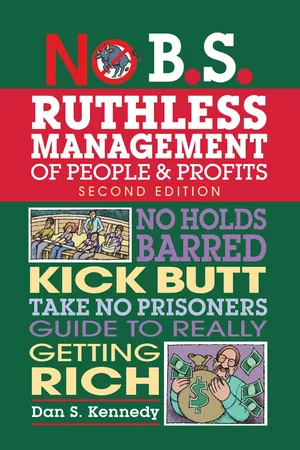
What does it really take to get productivity from people and, by doing so, maximum profits for your business? With a nod to Jeff Bezos, Steve Jobs, Walt Disney, and other ruthless yet highly successful managers, Dan S. Kennedy delivers the answer. In this new edition, Kennedy expands on his proven (if radical) strategies to get accountability, profitability, and productivity from employees.
In his traditional No B.S. style, Kennedy kicks traditional leadership and management ideas squarely in the teeth with a realistic, straightforward assessment of the real relationship between business owners and their employees. Uncompromising strategies help managers gain iron-fisted control and get the results they demand. This take-no-prisoners advice liberates entrepreneurs to act in their best interests and insist on implementation of their objectives. And it leads to a cooperative, high-performance team when traditional textbook methods fail. Topics include learning how to hire profitable employees, taking home as much money as possible, making every employee’s job a profit center, managing the powerful force of word of mouth, compressing the time between idea and action for maximum profits, and posing questions to individuals that force them to think and improve productivity.
eBook - ePub
No B.S. Ruthless Management of People and Profits
No Holds Barred, Kick Butt, Take-No-Prisoners Guide to Really Getting Rich
- 274 pages
- English
- ePUB (mobile friendly)
- Available on iOS & Android
eBook - ePub
No B.S. Ruthless Management of People and Profits
No Holds Barred, Kick Butt, Take-No-Prisoners Guide to Really Getting Rich
About this book
Information
CHAPTER 1

Gobbledygook “R” Us
“Because of the fluctuational predispositions of your position’s productive capacity as juxtaposed to government standards, it would be momentarily injudicious to advocate an increment.”
—ALEXANDER HAIG WHEN SECRETARY OF STATE
“I don’t get it.”
“Exactly.”
—CONVERSATION BETWEEN ALEXANDER HAIG, THEN SECRETARY OF STATE, AND HIS AIDE
I hold in my hand a brochure sent to me in the mail from a highfalutin’ university’s school of management, attempting to sell me on attending its $4,950.00 two-day seminar titled “Managing the New Workforce: Leadership and Strategy.”
This brochure, as well as the seminar it pitches, represents everything that’s wrong with at least 90% of everything being fed to business owners and executives about managing people. It is, in a word, B.S.—but let me demonstrate.
First, it’s chock full of vague, meaningless gobbledygook. Nice sounding, until you critically analyze it. Here are a few priceless examples:
Expand your own perspective and deepen your understanding of how to learn and act on the values and needs that drive a growing portion of your workforce.
Huh? What, exactly, is the take-away, practical value there? After all, you aren’t really interested in running a group therapy program for your employees, are you?
It gets better . . .
With demographic shifts come new demands on leaders who must be prepared to find, develop, and retain the New Workforce.
This is a statement of fact, not a promise of a solution. The brochure is full of these and actually only lists five benefits, one of which is that “expand your perspective” thing. And, really, what is this “New Workforce” anyway? It’s gobbledygook. It makes it sound like aliens from outer space have arrived and suddenly replaced all your employees. Hey, demographic shifts in available employees aren’t anything new. They’ve been a constant since at least the Industrial Revolution. Lincoln freed the slaves. Off we went. Women came into the workforce. Asians, Hispanics, attention-deficit-disordered youth. Pfui. And you don’t want to be prepared (with deeper understanding!) to find, develop, and retain any New Workforce anyway. That misses THE point. You want to be prepared to find, develop, and retain a productive workforce that produces maximum profit for your business. You see, the professors’ very idea of the purpose of employing people, even of owning a company, is misguided. Certainly not in sync with yours.
And I’ll bet you’ll be wildly excited about this . . .
A multigenerational panel discussion will provide an opportunity for participants to interact with undergraduate junior and senior students majoring in business. With an aim toward highlighting both differences and similarities among the generations, participants will come away with a deeper understanding of what makes these young employees tick.
There sure is a lot of talk here about “deeper understanding.” Meaning you, the guy handing out the paychecks, have to more deeply understand the gentle, fragile, difficult-to-motivate, complex individuals entrusted to your care. Gee, sounds like you’re running a day-care center.
Now here’s what is NOT mentioned anywhere in this brochure: managing people for PROFIT. I read every word very carefully. Since I was occasionally convulsed with laughter, I reread it. The word “profit” does not appear. Not even once.
I wonder why?
Because—like virtually all these university-sponsored seminars, most other management seminars, most management books, most newsletters for managers, etc.—this puppy’s being taught by people whose management experience is limited to organizing their sock drawers. No claim is made of even one day spent in the real world, dealing with real employees and real problems—let alone an imperative to create profit. This particular $4,950.00, two-day excursion into the theoretical world of psychobabble has four speakers:
An Academic Director (whatever that is) who is a visiting lecturer at the school of management. That’s it. That’s all that’s said about her in the brochure. Presumably because there’s nothing else to say.
A Chief Marketing Officer and an Adjunct Associate Professor of Marketing at, of course, the school of management. Hmm, Professor of Marketing—maybe he put this nifty brochure together.
A Diversity Coach who wrote a book, Managing Differently. Honest to Mabel, a “Diversity Coach!” “Go be diverse for the Gipper!” I wonder, are the Diversity Cheerleaders going to be there too? Maybe a marching band. Okay, that’s harsh. Heck, I run business coaching programs myself. But this diversity scam has gone way, way too far. It’s replaced the sexual harassment and gender sensitivity scam that previously sucked fortunes out of scared corporate coffers. And the fad before it. Enough already. We’re diverse. Get over it. Get to work. The job isn’t diverse. And the coach word has become the most overused term since excellence.
Nowhere does it say any of these “experts” ever took over a troubled company with horrid employee morale and massive quality control problems and turned it around. Or managed a workforce in a way that led to any measurable accomplishment, like increasing profits by 30% over a year. Or even managed a Dairy Queen. It doesn’t say any of these things because it’s selling professors. (If any of them have actually accomplished anything worth bragging about, managing a real workforce, failing to mention it is still telling. It reveals a certain mindset about the relative importance of practical experience and street smarts vs. academic theory and philosophy. There’s a smugness to it. The folks with the leather elbow patches on tweed jackets and tenure looking down their noses at us sleeves-rolled-up, boots-in-the-muck folks.)
Of course, YOU are a real business owner in the real world, very unlikely to fall for this. I imagine a bunch of corporate executives who also can’t spell p-r-o-f-i-t go on their companies’ tabs and have a grand old time playing eight-people-at-a-table workshop games with their Diversity Coach, then head for happy hour. I doubt you’d catch an entrepreneur in here on a bet.
But the trouble is, this buffoonery and charlatanism seeps out of the colleges’ little side businesses and infects the thinking of business owners in many other ways. This sort of academic gobbledygook and classroom theory finds its way into the articles you and I read in real business magazines, into the books on management we might turn to for help. These professor types actually get hired to come in and screw around in real companies we own or invest in or rely on as vendors. They get hired to speak at our associations’ conventions. And if you hear this stuff enough, you might think it has a place in your business.
It’s actually a cancer on corporate America. Untold millions of dollars and millions of hours are wasted on this sort of thing. Everybody’s in meetings and group discussions and quality circles and deeper-understanding retreats when they should be working. Managers are embroiled in trying to implement this feel-good, talk-in-circles, meaningless stuff when they need to be managing.
I’ve watched otherwise intelligent CEOs and top executives sit in meetings, listening to this silliness, none willing to state the obvious—that the professor has no clothes. I guess for fear of appearing unsophisticated in front of the others. So budgets get approved by people who won’t, themselves, have to suffer through the exercise, who can’t clearly explain what they’re buying, and who have no way of holding it accountable for increased profits.
It’s sad enough this permeates big, dumb companies.
Whatever you do, keep it out of yours. You really need to put up barriers. Inoculate yourself...
Table of contents
- Cover
- Title Page
- Copyright
- Contents
- Preface: Something Different—Straight Talk
- Chapter 1: Gobbledygook “R” Us
- Chapter 2: The True Nature of the Employer-Employee Relationship
- Chapter 3: Shelby’s Excuse List
- Chapter 4: The Willy Loman Syndrome Moves to Management
- Chapter 5: The Program
- Chapter 6: Random and Erratic Acts
- Chapter 7: How to Control Your Business and Your Life By Keith Lee
- Chapter 8: Performance Reviews Suck By Keith Lee
- Chapter 9: Implementing Customer Service That Gets Repeat and New Business By Keith Lee
- Chapter 10: The Two Most Crucial Management Decisions of All
- Chapter 11: In the Wrong Place
- Chapter 12: They ALL Go Lame
- Chapter 13: The Worst Number in Business Is.....
- Chapter 14: Hire Slow, Fire Fast
- Chapter 15: Leadership Is Vastly Overrated
- Chapter 16: Marketing the Master, All Others Servants
- Chapter 17: Beware the Bean-Counters
- Chapter 18: Mice at Play
- Chapter 19: Out Smoking a Cigarette
- Chapter 20: The Holiday Inn Telephone Warning System
- Chapter 21: Thieves Like Us
- Chapter 22: Broken Windows, Broken Business
- Chapter 23: On the Other Hand, Good Enough Is Good Enough
- Chapter 24: “But My Business Is Different . . .”
- Chapter 25: How To Make Every Employee’s Job a Profit Center
- Chapter 26: Create Better Jobs So You Can Demand More (and Fire Faster)
- Chapter 27: Exceptions to All the Rules
- Chapter 28: Fairness Be Damned
- Chapter 29: To the Winners, the Spoils
- Chapter 30: When Bonuses Become Obligations
- Chapter 31: Is a Happy Workplace a Productive Workplace?
- Chapter 32: Hire the Thick-Skinned
- Chapter 33: Managing the Sales Process
- Chapter 34: Maximizing the Value of Your Sales and Marketing Personnel By Clate Mask
- Chapter 35: Three Strategies for Managing Salespeople for Maximum Results
- Chapter 36: The Top-Secret Mission
- Chapter 37: Ruthless Management of Word of Mouth
- Chapter 38: Activity Masquerading as Accomplishment
- Chapter 39: The Speed Imperative
- Chapter 40: Are You a “Control Freak”?
- Chapter 41: How They Should Communicate with You
- Chapter 42: How to Hold Meetings
- Chapter 43: Friendly as Long as You Feed Them
- Chapter 44: Why I Can’t Do These Things
- Chapter 45: What Is “Profit,” Anyway?
- Chapter 46: Management by the Numbers (The Right Numbers)
- Chapter 47: How To Profit from the Age of Tolerated Mass Incompetence and the Coming Monster Recession
- Chapter 48: In the Next 12 Months
- Chapter 49: Your Support Circles
- About the Author
- Index
- Free Offer
Trusted by 375,005 students
Access to over 1.5 million titles for a fair monthly price.
Study more efficiently using our study tools.
Frequently asked questions
Yes, you can cancel anytime from the Subscription tab in your account settings on the Perlego website. Your subscription will stay active until the end of your current billing period. Learn how to cancel your subscription
No, books cannot be downloaded as external files, such as PDFs, for use outside of Perlego. However, you can download books within the Perlego app for offline reading on mobile or tablet. Learn how to download books offline
Perlego offers two plans: Essential and Complete
- Essential is ideal for learners and professionals who enjoy exploring a wide range of subjects. Access the Essential Library with 800,000+ trusted titles and best-sellers across business, personal growth, and the humanities. Includes unlimited reading time and Standard Read Aloud voice.
- Complete: Perfect for advanced learners and researchers needing full, unrestricted access. Unlock 1.5M+ books across hundreds of subjects, including academic and specialized titles. The Complete Plan also includes advanced features like Premium Read Aloud and Research Assistant.
We are an online textbook subscription service, where you can get access to an entire online library for less than the price of a single book per month. With over 1.5 million books across 990+ topics, we’ve got you covered! Learn about our mission
Look out for the read-aloud symbol on your next book to see if you can listen to it. The read-aloud tool reads text aloud for you, highlighting the text as it is being read. You can pause it, speed it up and slow it down. Learn more about Read Aloud
Yes! You can use the Perlego app on both iOS and Android devices to read anytime, anywhere — even offline. Perfect for commutes or when you’re on the go.
Please note we cannot support devices running on iOS 13 and Android 7 or earlier. Learn more about using the app
Please note we cannot support devices running on iOS 13 and Android 7 or earlier. Learn more about using the app
Yes, you can access No B.S. Ruthless Management of People and Profits by Dan S. Kennedy in PDF and/or ePUB format, as well as other popular books in Business & Management. We have over 1.5 million books available in our catalogue for you to explore.