Start Your Own Microbrewery, Distillery, or Cidery and Craft Your Success StoryGrowing each year, this multi-billion dollar industry, driven by consumer preferences, shows no signs of slowing down—giving you the perfect opportunity to start up.Corie Brown of Zester Daily and our experts introduce you to more than 30 craft producers, including pioneers like Ken Grossman of Sierra Nevada Brewing Co., Jörg Rupf creator of Hangar 1 Vodka, Kent Rabish owner of Grand Traverse Distillery, and Mike Beck co-owner of Uncle John’s Cider Mill.You'll gain an insider’s look at how to:
Analyze craft products, their distinct challenges, and dynamic market
Write a winning business plan that promotes growth and secures funding
Keep overhead low and margins high with options like self-distribution
Capture customers and create evangelists with the story behind the brand
Enhance the brand experience with events, taprooms, tastings, and tours
Develop invaluable relationships with distributors and restaurants
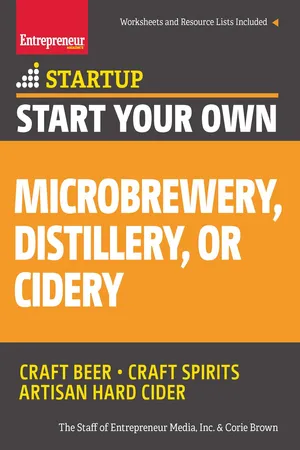
eBook - ePub
Start Your Own Microbrewery, Distillery, or Cidery
Your Step-By-Step Guide to Success
- 282 pages
- English
- ePUB (mobile friendly)
- Available on iOS & Android
eBook - ePub
About this book
Information
CHAPTER 1
Today’s Craft Alcoholic Beverage Industry
Craft beverages are transforming America’s beer, spirits, and hard cider industries. Independent producers using high-quality ingredients to produce idiosyncratic beverages are winning the affections and pocketbooks of consumers, particularly educated, food-focused, affluent drinkers.
A handful of multinational conglomerates overwhelmingly dominate the alcoholic beverage business. Yet smaller craft producers are today’s industry trendsetters. Craft beverages command a premium price over their industrially produced competition. With their emphasis on sustainable ingredients and local production, craft brands reflect the eco-values of the Millennial generation, a force driving innovation across the food and drink market.
fun fact

In the U.S., 700 craft distillery licenses have been issued with 550 distilleries in operation and 200 more in development, according to the American Distilling Institute.
For the uninitiated, the taste of emerging craft brands may be difficult to understand, changing batch to batch as craft producers experiment with recipes and processes. This has been part of craft’s charm for enthusiasts who want the drink in their glass to be made with care by human hands—damn the price, inconvenience, and variability. With each new wave of innovation, ever more specialized producers are emerging to serve ever smaller niche markets.
Unlike the American wine industry’s obsession with recognition for being the “best” of an established type, these craft sectors emphasize innovation and local identity. Many cities boast dozens of craft breweries, offering fans a choice of neighborhood taprooms featuring dramatically different styles and flavors of beer. Craft fans can choose a spirit made from organic, locally grown ingredients that reflects their hometown’s character. A glass of craft hard cider carries the story of the handpicked apples from a nearby orchard.

New consumer research released in February 2015 shows-high frequency wine drinkers shifting from wine to spirits, craft beer, and hard cider. To wit:

Credit: Wine Market Council
In the Beginning
The modern craft movement came to life in the early 1980s when a ragtag collection of homebrewers started selling their then radically different beers. By the mid-1990s, at the crest of the first craft beer boom, craft distillers followed their lead. Craft hard cider makers jumped on the bandwagon in the last decade. By the time the economy started to crumble in 2007, a broad cross-section of Americans had upgraded their favorite libation and were crying into a better glass of liquid solace. It must have made us feel better. Starting that year, and every year since, every segment of craft alcoholic beverage has grown by double digits.
fun fact
At the start of 2015, there were 3,418 craft breweries in America with new breweries opening at a rate of nearly two breweries a day, according to the Brewers Association (www.brewersassociation.org). Another 2,000 craft breweries were in development. Retail sales of craft beer reached $19.6 billion in 2014 with total U.S. beer sales of $101 billion, up from $100 billion in 2013. Retail sales of beer grew 22 percent in dollar value in 2014. Craft beer accounted for 11 percent of total beer sales, by volume, and 19.4 percent, by dollar, in 2014, according to the Brewers Association.
“The recession scared the hell out of everyone,” says Peter Toombs, president of DME Brewing Solutions (www.dmebrewing.ca), an equipment manufacturer for small and medium-sized breweries. “Orders ceased for 90 days. Then the demand came on strong and has been steady ever since.”
“More has happened in beer in the last 20 years than has ever happened to any individual market in history. We are in amazing times. We didn’t see how much could change so fast,” says Ken Grossman, founder of Sierra Nevada Brewing Company (www.sierranevada.com).
Spirits is a far smaller craft sector without clear sales numbers. But the number of producers is expanding rapidly, up nearly 30 percent in 2014, according to the American Distilling Institute (http://distilling.com). “New distillers can point to solid success stories,” says Nicole Austin, master blender at Kings County Distillery in Brooklyn (http://kingscountydistillery.com) and a consultant to many new distilleries. “More people are willing to invest. We are a serious industry.”
The craft sector of hard cider sales also are not broken out. And since cideries are licensed as wineries, it is difficult to track how many are in operation. “Cider is growing faster than any other sector,” says Jake Keeler, director of marketing at BSG, Brewing Supply Group (https://bsgcraftbrewing.com), a craft supply company serving all sectors. “It has the potential to be a decent chunk of the alcoholic beverage business. There is a ton of opportunity.”
Time to Jump In?
How hot is craft? Statistics from the craft beer industry, and anecdotes from other craft sectors, indicate craft alcoholic beverages is as close as it gets to a sure thing for someone who wants to start a new business; remarkably, failure rates hover near 5 percent. By comparison, if you opened a new restaurant, you would face a 70 percent chance of the business failing in the first few years.
tip

U.S. Association of Cider Makers estimates there are 400 hard cideries, up from fewer than 20 ten years ago.
That no-failure rate is somewhat illusory. Craft beverage production is an exceptionally difficult business with long hours, low pay, and a painfully long lead-time before profitability. There are so few failures because the traditional craft producers are passion-driven entrepreneurs who simply refuse to fail. You need to ask yourself if you have that level of commitment. Know it will become more difficult to survive as competition increases. Since craft is hot, that competition is sure to grow. You will need (and want) to be ready to roll with the changes and pivot to position your business always on the cutting edge of craft. If that sounds like a worthwhile challenge, then buckle up!
New challenges to craft’s enviable hold on American consumers will intensify the pressure on ne...
Table of contents
- Cover
- Title Page
- Copyright
- Contents
- Acknowledgments
- Preface
- Chapter 1: Today’s Craft Alcoholic Beverage Industry
- Chapter 2: Making a Mark in the Craft Alcoholic Beverage Industry
- Chapter 3: Launching a New Craft Brand
- Chapter 4: Regulation and Taxation
- Chapter 5: Craft Businesses That Work
- Chapter 6: The Craft Customer
- Chapter 7: Financing Craft Beverage Companies
- Chapter 8: Gaining Traction in a Crowded Market
- Chapter 9: Shovels at the Gold Rush
- Chapter 10: Defining Craft in a New Era
- Chapter 11: Does the Party End?
- Appendix: Craft Brewing, Distilling, and Cidering Resources
- Glossary
- Index
Trusted by 375,005 students
Access to over 1.5 million titles for a fair monthly price.
Study more efficiently using our study tools.
Frequently asked questions
Yes, you can cancel anytime from the Subscription tab in your account settings on the Perlego website. Your subscription will stay active until the end of your current billing period. Learn how to cancel your subscription
No, books cannot be downloaded as external files, such as PDFs, for use outside of Perlego. However, you can download books within the Perlego app for offline reading on mobile or tablet. Learn how to download books offline
Perlego offers two plans: Essential and Complete
- Essential is ideal for learners and professionals who enjoy exploring a wide range of subjects. Access the Essential Library with 800,000+ trusted titles and best-sellers across business, personal growth, and the humanities. Includes unlimited reading time and Standard Read Aloud voice.
- Complete: Perfect for advanced learners and researchers needing full, unrestricted access. Unlock 1.5M+ books across hundreds of subjects, including academic and specialized titles. The Complete Plan also includes advanced features like Premium Read Aloud and Research Assistant.
We are an online textbook subscription service, where you can get access to an entire online library for less than the price of a single book per month. With over 1.5 million books across 990+ topics, we’ve got you covered! Learn about our mission
Look out for the read-aloud symbol on your next book to see if you can listen to it. The read-aloud tool reads text aloud for you, highlighting the text as it is being read. You can pause it, speed it up and slow it down. Learn more about Read Aloud
Yes! You can use the Perlego app on both iOS and Android devices to read anytime, anywhere — even offline. Perfect for commutes or when you’re on the go.
Please note we cannot support devices running on iOS 13 and Android 7 or earlier. Learn more about using the app
Please note we cannot support devices running on iOS 13 and Android 7 or earlier. Learn more about using the app
Yes, you can access Start Your Own Microbrewery, Distillery, or Cidery by Corie Brown in PDF and/or ePUB format, as well as other popular books in Business & Entrepreneurship. We have over 1.5 million books available in our catalogue for you to explore.