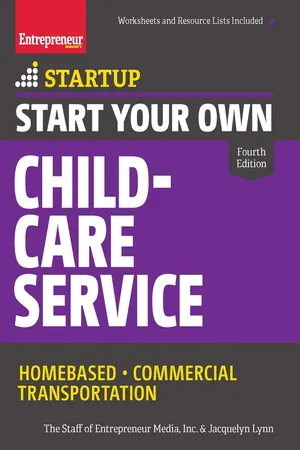
START YOUR OWN CHILD-CARE SERVICE AND GET PAID TO CARE FOR KIDSAs the number of working parents grows the number of children who need quality childcare grows along with it. That need is creating a tremendous entrepreneurial opportunity for people who love children and want to build a business caring for them. This guide has the latest trends, facts, and figures, along with an updated list of resources to help you create a stable and enriching environment for child development, as well as a sound and profitable business.Learn how to:
Choose the type of child care program and services to offer
Acquire the right licensing, permits, insurance protection, and state-specific child care licensing
Analyze the market, asses the needs of the community, and match services to fit those needs
Find the right location, or decide to operate from home
Comply with safety regulations and child-care provisions of the Disabilities Act
Consider zoning laws, space requirements, and legal determinations of offsite properties
Calculate startup costs, get funded, manage finances, create a business plan, and account for the day-to-day operating costs
Stay competitive in the market with low-cost marketing tactics
Find, hire, and keep good employees
- 206 pages
- English
- ePUB (mobile friendly)
- Available on iOS & Android
eBook - ePub
About this book
Information
CHAPTER
1
Introduction
One of the biggest challenges facing working American parents today is caring for their children. While the traditional family model of husband as wage-earner and wife as homemaker, America’s family landscape now populated with a wide range of models, including single parents and married or non-married couples with children with both parents working. As the number of working parents in America rises, so will the demand for child care. Consider these statistics from the Urban Institute: Most infants and toddlers (73 percent) of employed mothers are in non-parental child care. Nearly 5 million children younger than age 3 are in the care of someone other than their parents an average of 25 hours each week. Of the 6.7 million children under age 3 with working mothers, 22 percent are in child-care centers, 17 percent are in family child-care settings, 7 percent are cared for by babysitters or nannies, 27 percent are in the care of relatives, and 27 percent are cared for by a parent. According to the Federal Interagency Forum on Child and Family Statistics, nearly two-thirds of children ages 0 to 6 who are not yet in kindergarten (about 12 million children) receive some form of non-parental child care on a regular basis. Nearly half of children in kindergarten through third grade and more than half of those in fourth through eighth grade receive some non-parental child care.
tip


Take yourself and your business seriously. A child-care service is more than a glorified babysitter; it’s a serious business providing an important service, and it’s capable of generating a substantial income.
Another issue that has an impact on child-care issues is the 24-hour global market. Occupations with a high number of employees working nights and weekends—such as janitorial, hospitality, customer service, and technical support—are experiencing substantial growth, and workers in these fields are finding obtaining quality child care an even greater challenge than their 9-to-5 counterparts.
For many working parents, there is no single solution to their child-care needs. More than a third use more than one option, such as day-care centers part of the time and friends, neighbors, or relatives on other occasions.
In addition to child care, parents also need transportation for their children. Kids who are too young to drive or take public transportation without supervision still need to get back and forth to school, as well as to places after school, whether it’s to games, museums, libraries, music lessons, doctor’s appointments, or whatever. But most parents can’t leave their offices to take their children to these activities, so they’re turning to transportation companies that specialize in schlepping children.
All this means opportunity for you. But before you take the leap into your own business, learn how others did it.
How Did They Start?

The successful child-care and child transportation service business owners interviewed for this book got their starts in a variety of ways.
A dare propelled Lois Mitten Rosenberry of Toledo, Ohio, into the child-care business. In 1982, through an internal political shake-up, she lost her job as the director of a church day-care center. She had two young children of her own, and if she got a job in a different field, she would need child care for her daughters. When she looked around at the child-care options available to her, she didn’t like what she saw. And in the meantime, a number of parents of the children from the church center were asking her to open her own facility.
The idea was appealing, but, she felt, economically out of the question. Her husband got laid off shortly after she left the day-care center, and the only job he was able to find didn’t pay enough to support the family, much less provide startup capital for a new business. “Financially, we were absolutely at the end,” she recalls. “My parents were making our house payment and giving us money for our living expenses, we qualified for the home energy assistance program, and our older daughter was on the free lunch program at school.”
Mitten Rosenberry decided to ask her parents for a loan to open a child-care center. They agreed, but then she found out she was pregnant, and her parents withdrew their financial support for the business, saying her place was at home with her children. She argued, pointing out that running a child-care center was an excellent job for a working mother, but her parents were adamant. They would continue to help with living expenses, but they would not fund her business.
“I pretty much gave up on the idea,” Mitten Rosenberry says. “Then I met with one of the parents who was anxious to get his daughter in our program and told him I couldn’t get the funds. He said, ‘I knew you wouldn’t do it. I knew you’d get cold feet.’ ”
She took it as a dare, reacting at first with anger, then with determination. In 1982, she took out a second mortgage on the family home and was just one month away from the birth of her third child when she opened the first of seven Children’s Discovery Centers in Toledo.
Janet Hale started caring for children in her home in Exeter, California, in 1980, when her own daughter was two. She had been working as a bookkeeper but wanted to be at home with her child. She operated on her own for six ye...
Table of contents
- Cover
- Title Page
- Copyright
- Contents
- Preface
- Chapter 1: Introduction
- Chapter 2: Services and Policies
- Chapter 3: Running Your Child-Care Business
- Chapter 4: Structuring Your Business
- Chapter 5: Startup Economics and Financial Management
- Chapter 6: Locating and Setting Up
- Chapter 7: Furnishing and Equipping Your Center
- Chapter 8: Kitchen and Laundry Facilities
- Chapter 9: Office Equipment
- Chapter 10: Transportation Services
- Chapter 11: Parent Relationships
- Chapter 12: Marketing
- Chapter 13: Staffing
- Chapter 14: Facility Maintenance
- Chapter 15: When Things Go Wrong
- Chapter 16: Tales from the Trenches
- Appendix: Child-Care Service Resources
- Glossary
- Index
Trusted by 375,005 students
Access to over 1.5 million titles for a fair monthly price.
Study more efficiently using our study tools.
Frequently asked questions
Yes, you can cancel anytime from the Subscription tab in your account settings on the Perlego website. Your subscription will stay active until the end of your current billing period. Learn how to cancel your subscription
No, books cannot be downloaded as external files, such as PDFs, for use outside of Perlego. However, you can download books within the Perlego app for offline reading on mobile or tablet. Learn how to download books offline
Perlego offers two plans: Essential and Complete
- Essential is ideal for learners and professionals who enjoy exploring a wide range of subjects. Access the Essential Library with 800,000+ trusted titles and best-sellers across business, personal growth, and the humanities. Includes unlimited reading time and Standard Read Aloud voice.
- Complete: Perfect for advanced learners and researchers needing full, unrestricted access. Unlock 1.5M+ books across hundreds of subjects, including academic and specialized titles. The Complete Plan also includes advanced features like Premium Read Aloud and Research Assistant.
We are an online textbook subscription service, where you can get access to an entire online library for less than the price of a single book per month. With over 1.5 million books across 990+ topics, we’ve got you covered! Learn about our mission
Look out for the read-aloud symbol on your next book to see if you can listen to it. The read-aloud tool reads text aloud for you, highlighting the text as it is being read. You can pause it, speed it up and slow it down. Learn more about Read Aloud
Yes! You can use the Perlego app on both iOS and Android devices to read anytime, anywhere — even offline. Perfect for commutes or when you’re on the go.
Please note we cannot support devices running on iOS 13 and Android 7 or earlier. Learn more about using the app
Please note we cannot support devices running on iOS 13 and Android 7 or earlier. Learn more about using the app
Yes, you can access Start Your Own Child-Care Service by Jacquelyn Lynn in PDF and/or ePUB format, as well as other popular books in Business & Entrepreneurship. We have over 1.5 million books available in our catalogue for you to explore.