ALIGN YOUR BUSINESS FOR SUCCESS From overarching vision to individual competency scorecards, Total Alignment arms you with powerful concepts and tools to run a successful, efficient business. No matter what size or type of business you run, business strategy experts Riaz Khadem and Linda Khadem show you how to align your team and operations from the ground up and from the top down. Total Alignment is the result of innovative thinking, solid research, and thirty successful years of consulting experience with major companies. Whether your team struggles most with communication, accountability, or motivation, this book will help you inspire your organization to produce efficiently, engage in the company's vision, and hold each other accountable for solid, sustained progress. Implement these concepts and tools to gain coherence, strength, and value:• Measure and narrow alignment gaps in key areas of your business using the Alignment Survey
• Plan for your company's growth and measure it along the way with the Alignment Map
• Define clear roles and responsibilities for each member of your team to ensure accountability with Accountability Assignment worksheets
• Eliminate silos, inefficiencies, and redundancies with the one page management strategy
• Set short- and long-term goals that add value to each branch of the company as well as the business as a wholePlus, gain access to easy-to-use templates to analyze your company's alignment, including Business and Individual Scorecards, the Competency Worksheet, an Action Plan Commitment chart, and the Performance and Effort Indexes.
eBook - ePub
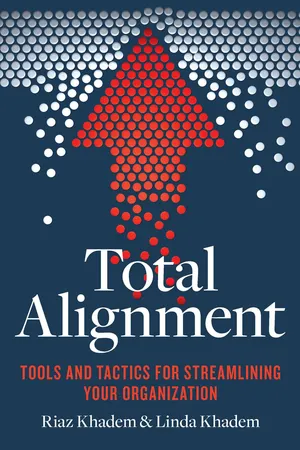
Total Alignment
Tools and Tactics for Streamlining Your Organization
- English
- ePUB (mobile friendly)
- Available on iOS & Android
eBook - ePub
About this book
Information
Subtopic
ManagementIndex
BusinessCHAPTER 1
The Need for Alignment
Let’s begin with the case study we mentioned in the introduction. This running case study appears at the beginning of each chapter. In this chapter, you will get to know Brian, the CEO of XCorp, a large and successful group of companies in need of alignment. You will learn what we mean by alignment and why it is so critical to the success of an organization.
THE CASE STUDY
BRIAN SCOTT, the CEO of XCorp Group, walked into a crowded conference hall in Chicago and took his seat in the front row. He was scheduled to deliver the keynote address. Brian had been invited to speak because of his success in turning around an ailing company during the previous year, as well as his recent acquisition of a successful high-tech start up.
When his name was announced, he walked to the podium and surveyed the large crowd. He glanced down at his notes and confidently launched into his speech. Brian spoke about the type of leadership he had provided as XCorp Group’s CEO. He communicated his vision for the expanded organization and his forecast of industry trends. He explained why TechCorp, a newly acquired company, was the right fit for the XCorp Group.
When Brian finished, he opened up the floor to questions. A young woman in the sixth row raised her hand and asked how Brian was planning to integrate the culture of the entrepreneurial acquisition with that of the larger group of companies. “Great question,” Brian replied. It was a good question and was right on point. Brian knew he had taken on some risk by acquiring a startup with a distinct culture, but it was a calculated risk with the potential of phenomenal returns.
As Brian answered the woman with an optimistic explanation, his eyes fell upon a familiar face a few rows behind her. He was happy to recognize Mark Wesley. Mark had been a trusted advisor to Brian when he had first become the CEO of XCorp and was struggling to turn the company around. Brian had affectionately given him the name “Infoman” because he had solved many of Brian’s information problems.
Brian proceeded to call on other people and field questions. When his time was up, he left the platform and pushed his way through the milling crowd hoping to greet Mark, the “Infoman,” but Mark was gone. Brian shook hands with a few friends and colleagues and then made his way to his suite on the executive floor. Entering the room, he saw an envelope propped up on the credenza. Inside the envelope was a note that read, “Congratulations! And best wishes for the challenge you’ve taken on.” It was signed, “The Infoman.” Brian smiled as he read the message from his old friend and advisor. Mark knew that Brian loved a challenge, even though he viewed it as more of an opportunity. Taking on a new acquisition was both.
TechCorp was the brainchild of Norman Evans, an exceptionally gifted and creative entrepreneur who had started the company 15 years earlier with little capital but great ideas. From scratch he had built up a $75 million business but then opted to sell. Brian wasn’t sure why Norman decided to sell, but assumed that the company was having difficulty “scaling up” or moving from a successful startup to a high-growth company. TechCorp was still relatively small, but Brian could see that it had great potential. He had studied the numbers, done his due diligence, and then made the owner an attractive offer. Norm happily accepted. Brian was hoping that this startup would become a source of research and development (R&D) for XCorp and that it would complement XCorp Group’s other products and services.
Brian was right. TechCorp was scaling up and had hit a stage many entrepreneurial organizations know all too well: a challenge with capital. Norm’s vision was to move beyond the inflection point, the point at which a company is too small to be big and too big to be small, and become a major player in the industry. That vision, unfortunately, hadn’t panned out. He had put tremendous effort into obtaining a source of funding that wouldn’t cause him to give up too much control. But every source he had turned to insisted on securing the controlling share in his company. He had also researched and found a professional CEO whom he hoped would bring new energy to the organization and enable it to get to the next level. But Peter Bergman, the new CEO, hadn’t worked out the way Norm had hoped. Peter had his own agenda and had made several bad judgment calls that had actually hurt TechCorp. Norm was on the verge of getting rid of Peter and looking for someone else when Brian Scott entered the picture and made him an offer he literally couldn’t refuse. So, he sold TechCorp. He had a few twinges of regret, but mostly he just felt relief and gratitude for the excellent deal.
Alignment challenges with TechCorp began a couple of months after the public lecture where Brian had seen his old advisor. Suddenly, the new acquision lost its two largest accounts. Brian was concerned and wanted to learn the cause. He called the CEO, Peter, but found him evasive and unhelpful.
Brian decided to take a trip to the West Coast and visit the headquarters of TechCorp. After he arrived, he immediately set up headquarters in the conference room. He began his investigations by talking with Andrew Carlson, the director of sales. He was surprised and concerned to discover that despite a clear strategy developed at a planning meeting six months earlier, each area had continued to pursue its own agenda. The strategy was to focus on growing the core business, eliminating non-core products, and leveraging technology as the company’s competitive advantage. To grow the core business aggressively, the strategy included implementing an integrated software system. It became clear that Andrew had not agreed with the strategy of eliminating non-core products because he felt they were still viable. To prove his point, he had continued pushing those products with existing customers as well as targeting new customers. Meanwhile, the sales people, busy promoting two of the non-core products, failed to spend time with important key customers.
The operations manager had fought to maintain the existing software system, which he had designed himself a couple of years before. So he passively resisted the new software and did little to support its testing and implementation. When complaints came in from customers about the software conversion, they were given excuses rather than solutions. There were also issues in marketing. The marketing people were promoting products the sales people were not actively pushing, thus creating expectations that were not met.
“All in all a rudderless ship,” Brian thought to himself. He decided that the first step in getting TechCorp back on track would be to fire Peter, the CEO. Although it was a drastic measure, Brian could see that Peter was not working out. No doubt Norman, as he was struggling to get control of his business, had hired a CEO to help him manage and to put systems in place. This particular hire was a clear mistake. Peter certainly should have been able to prevent the loss of the two key accounts.
ALIGN IT: DEFINING ALIGNMENT AND MISALIGNMENT
TechCorp shows an example of a company that has become mis...
Table of contents
- Cover
- Title Page
- Copyright
- Contents
- Foreword
- Preface
- Introduction
- Chapter 1: The Need for Alignment
- Chapter 2: Unifying the Vision
- Chapter 3: Measuring the Vision
- Chapter 4: Aligning Strategy
- Chapter 5: The Alignment Map
- Chapter 6: Accountability
- Chapter 7: The Scorecard
- Chapter 8: Three One-Page Reports
- Chapter 9: Aligning Competency
- Chapter 10: Aligning with Values
- Chapter 11: Aligning for Results
- Chapter 12: Coaching for Results
- Chapter 13: Aligning Compensation
- Chapter 14: Implementing Total Alignment
- Chapter 15: A New Vision of Alignment
- Glossary
- About the Authors
- Index
Trusted by 375,005 students
Access to over 1.5 million titles for a fair monthly price.
Study more efficiently using our study tools.
Frequently asked questions
Yes, you can cancel anytime from the Subscription tab in your account settings on the Perlego website. Your subscription will stay active until the end of your current billing period. Learn how to cancel your subscription
No, books cannot be downloaded as external files, such as PDFs, for use outside of Perlego. However, you can download books within the Perlego app for offline reading on mobile or tablet. Learn how to download books offline
Perlego offers two plans: Essential and Complete
- Essential is ideal for learners and professionals who enjoy exploring a wide range of subjects. Access the Essential Library with 800,000+ trusted titles and best-sellers across business, personal growth, and the humanities. Includes unlimited reading time and Standard Read Aloud voice.
- Complete: Perfect for advanced learners and researchers needing full, unrestricted access. Unlock 1.5M+ books across hundreds of subjects, including academic and specialized titles. The Complete Plan also includes advanced features like Premium Read Aloud and Research Assistant.
We are an online textbook subscription service, where you can get access to an entire online library for less than the price of a single book per month. With over 1.5 million books across 990+ topics, we’ve got you covered! Learn about our mission
Look out for the read-aloud symbol on your next book to see if you can listen to it. The read-aloud tool reads text aloud for you, highlighting the text as it is being read. You can pause it, speed it up and slow it down. Learn more about Read Aloud
Yes! You can use the Perlego app on both iOS and Android devices to read anytime, anywhere — even offline. Perfect for commutes or when you’re on the go.
Please note we cannot support devices running on iOS 13 and Android 7 or earlier. Learn more about using the app
Please note we cannot support devices running on iOS 13 and Android 7 or earlier. Learn more about using the app
Yes, you can access Total Alignment by Riaz Khadem, Linda Khadem in PDF and/or ePUB format, as well as other popular books in Business & Management. We have over 1.5 million books available in our catalogue for you to explore.