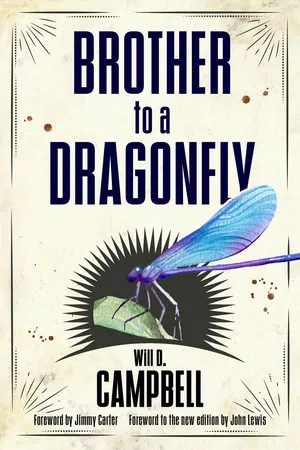
In Brother to a Dragonfly, Will D. Campbell (1924–2013) writes about his life growing up poor in Amite County, Mississippi, during the 1930s alongside his older brother, Joe. Though they grew up in a close-knit family and cared for each other, the two went on to lead very different lives. After serving together in World War II, Will became a highly educated Baptist minister who later became a major figure in the early years of the civil rights movement, and Joe became a pharmacist who developed a substance abuse problem that ultimately took his life. Brother to a Dragonfly also serves as a historical record. Though Will's love and dedication to his brother are the primary story, interwoven throughout the narrative is the story of the Jim Crow South and the civil rights movement. Will is present through many of the most pivotal moments in history—he was one of four people who escorted black students integrating the Little Rock public schools; he was the only white person present at the founding of the SCLC; he helped CORE and SNCC Freedom Riders integrate interstate bus travel; he joined Dr. Martin Luther King Jr.'s campaign of boycotts, sit-ins, and marches in Birmingham; and he was at the Lorraine Motel the night Dr. King was assassinated. Will's accomplishments, however, never take the spotlight from his brother, and as his relationship with Joe evolves, so does Will's faith. Featuring a new foreword by Congressman John Lewis, this book brings back to print the combined lives of Will Campbell—Will the brother and Will the preacher.
- 288 pages
- English
- ePUB (mobile friendly)
- Available on iOS & Android
eBook - ePub
Brother to a Dragonfly
About this book
Trusted by 375,005 students
Access to over 1.5 million titles for a fair monthly price.
Study more efficiently using our study tools.
Information
EVENING

If blue skies, lenient summer temperature, and an unruffling breeze moving in rhythmic and welcome spurts off the Louisiana Gulf make for beauty, then the day after my thirty-fifth birthday was a beautiful Sunday. All of us, including Webb—still in the womb—had checked into the Holiday Inn in Baton Rouge. Baton Rouge is just seventy miles from Liberty and we would drive up there on Monday. The folks were getting old and living alone and I felt both duty and desire to see them as often as I could. But for five years there had been increasing reasons why I should be somewhat discreet about visiting. Though no one was even talking at that point about integrating schools or churches anywhere in the state of Mississippi, everyone sensed the imminent storm. And everyone knew that I worked in “race relations.” Therefore, if integration came and I was in the county it would be perfect logic to assume that I had brought it. Until six months earlier, the urgency to visit outweighed the pressure to stay away.
Joe had bought out Uncle Luther’s old homeplace just down the road from our parents’ house. He, who could ill afford it, had purchased it so that the folks would not be so alone and so that our sister and her family would have a decent place to live. He was also feeling some of the agony of wanting to visit the home folks but, since he had so clearly identified with what he had begun to call “Will’s cause,” he sometimes felt it best to stay away. Since he had bought the place and Sister was next door, I did not feel uncomfortable in being so close and yet not there. Brenda and the children wanted to swim in the Holiday Inn pool and visit her sister, and I needed to see some people in Baton Rouge who were active in civil rights. It started out to be a day of work, fun, and relaxation.
Less than an hour after we had checked in Joe was on the phone. We were traveling by car from Houston to Nashville and how he found us from his pharmacy in Meridian I never got around to asking.
“Brother, I have some bad news.” His voice broke slightly as he rambled on about unrelated trivia, seeming never to get to the news which I somehow knew was bad as soon as the phone rang in a motel room no one except the room clerk knew we were in. He assured me that Daddy and Mamma were all right. So was he, Joey, and Julie. It was almost by elimination that he got around to who was not all right.
“Sister’s folks were going to church and some of the kids wanted to go early to Sunday School. They sent Will Edward up the highway to tell Daddy to pick up the rest of them when he passed going to the meetin.” Then there was silence except for a faint sobbing. (The “meetin” was an expression our Father had always used for the main church service.) I had to pry the story out. Will Edward, fourth of our sister’s seven children, was riding an English bicycle I had given them a year before—because they had never had one and I had never had one as a child. As he was crossing the road in front of Sister’s house a car had hit him. No, he didn’t know how badly he was hurt but since I was so close he felt it important that I go on up there as quickly as I could.
Further questions brought no more information. That was all he knew. I called the McComb Infirmary and Sister was able to talk. “The doctor just gives him a fifty-fifty chance of living. We sure do need you, Will. I hate to bother you but come as soon as you can.”
It was a traitorous Sunday. The beauty of the early morning had turned to forenoon tragedy. I did not get the details until I reached the hospital. The car had thrown the bike and Will Edward onto the hood and his head had gone through the windshield. The jugular had been severed as with a knife. During the half-hour period from the moment of the collision to the moment transfusion needles could be inserted into his veins most of his own blood had been lost. O. B. Honea, the father, and Britt, elder brother, had raced as fast as the four-year-old station wagon would go, O. B. driving, thirteen-year-old Britt in back holding his twelve-year-old brother in his arms, thinking, each of them, what thought no one will ever know.
Britt was to Will Edward as Joe had been to me. He was older brother, ever ready to defend and protect against any threat. And best friend. Now he was befriending and protecting him the only way he knew how—holding him cradled in his arms, pressing his body and clothing against the lacerated neck, and absorbing as much of the hurt as he could stand. But there was no defense, no protection against the rapid emptying of the vital fluid from the young and strong, but human, body.
He was rushed through everything the country hospital and its staff had skill and equipment to offer. Blood had been replaced, X-rays had been made, and the neck wound, eight inches or so, had been closed. And that was all. He remained conscious until they reached the hospital. No words were spoken but as they placed him on the stretcher he looked at his daddy and smiled. It was a way he had of doing when he was caught in mischief.
But the smile was not enough. When I arrived I found him unconscious and struggling to free his arms and legs from the restraining ties. The room was filled with relatives and neighbors, some being helpful, some simply satisfying their own morbidity. Sister had not gone into the room, and never did. “I can’t stand it. I can’t stand to look at him with his head cut off.” Some insisted that she do so, saying that she would be sorry later if she didn’t. And both she and they knew what “later” meant. She preferred to wait until she could see him in his pretty sport coat, bow tie, and white shirt he had saved his money to buy a month earlier. And she knew what the circumstances would be. In her mind the consignment was already made. I refused to let it happen. But my efforts to reverse the consignment took only the form of standing by and begging him not to die. There was too much at stake. Too much that was unfair, too much suffering, too much that was cruel, too much agony inflicted over the years on these more innocent than most people.
Lee Campbell. A man called good. Declining years filled with boredom, head held high yet bowed and shoulders stooped from so many defeats, so much worry over the years about his only daughter and her children and the welfare of them all. For six months—since their move to live in the house Joe had bought—there had been joy for him bordering on ecstasy. Every morning two little boys ran eagerly up the road. “What we gonna do today, Grand-daddy?” It turned the pages back thirty years. And the return was better than the original for then it had been a matter of survival—making the crops, feeding the pigs, milking the cows. Now it could be fun. Plant a garden with those two boys. Make a little crop with them. Teach them to plow a straight furrow, to make a mule go right or left, gee from haw, giddup, whoa, tie a hame string, what a clevis is, seven-inch oliver chill, trace chain, when to plant butterbeans, which land is best for peanuts—all the things a farmer is proud to see his sons learning. And more fun to see grandsons learning it for it is an extension of mortality few experience anymore. Now his reprieve was a sand castle on a drill field, trampled and washed away by the tide.
Lorraine Honea. Firstborn and only daughter. God how much! What’s it all about? Seven children in not many more years. Maybe that’s too many but it is far from enough if you’re talking about giving one of them up. Every offspring is an only child. Even identical twins are born one at a time. And what of all her other suffering? Doesn’t that even count? The misery, the violence, the unhappiness, the poverty, the loneliness, the … god … dammit … all of it! Just all of it! She didn’t have it coming. And I knew it. And I wasn’t going to have it.
And Joe. Four times a day he would call from his pharmacy in Meridian. Sometimes more. “Any change?” “How you’re holding up, Brother?” Things like that. He could no longer ask about Sister. He had said before he bought the house for her that he simply refused to think of her situation. And each time he called, there was the obvious he would state. “If I had left them down there in those damn woods this wouldn’t have happened.” I could counter with, “Yes, Joe, but something worse could have happened and we both know what that could have been.” But that which could have happened was a part of what he refused to think about.
And he could articulate his greater tragedy. “This is the most decent thing I ever tried to do. Everything I’ve ever done in my life has been somehow mixed up with my own self. I swear, Will, there was absolutely nothing selfish in this. I didn’t want that land. I just wanted Mamma and Daddy to have somebody close and Sister and her folks to have a nice place to stay.” “I know, Joe. I know.” And that was all there was to say.
Now his act of selflessness, his act of purity, of nobility had boldly, arrogantly set out to bring us all more suffering than we had yet known.
And Will Edward. Half of his name was mine. The other half belonged to our other brother, Paul Edward. Put together it belonged to him. And he wore it proudly. A good kid. Pleasant. Always a little browbeaten, yet with a countenance of openness and stability. “Don’t die, pal. You’re gonna make it little buddy. Come on, man. We’re gonna help you, and you’re gonna make it.”
It lasted three days. Who knows what—shock, kidney failure, rejection of that much new blood. The doctor had been most concerned with kidney failure. I had told him that we would bring in a college friend who was a successful urologist in New Orleans. He said that we would wait another day and see if there were any change. “Why another day?” “Well, let’s see if there is any change in the morning.”
There was. He was dead.
Even when it came I would not have it. I pumped his adolescent chest with frantic and defiant motions. There had to be something left to do. His breathing had stopped the night before and the pumping motions I had done restored it. Why didn’t it again?
It was about five o’clock in the morning. The sun was inching its way down the dreary hospital corridor. I knew that any minute Sister would be calling to check. The telephone was in the lounge far down the hallway but I could hear it when it rang. At just about the time the doctor had arrived, answering the nurse’s call to him, the ringing began. My feeble and futile efforts to resurrect a corpse must have been both comic and tragic to one trained in the science of doing the practical thing. He motioned me away and ceremoniously placed the stethoscope upon his chest. He shook his head and walked away. The nurse said she was sorry, that he was so young. One other person was in the room, a young truck driver and neighbor named Maxie Whittington. I embraced him and he returned the embrace with equal emotion. The phone at the end of the hall was still ringing. And I knew I had to answer it.
“How is he Uncle Will?” It was Carolyn Sue’s voice, Sister’s oldest child, now in her second year in college. “Not too well, Sugar. I’ll be home in a little while.” “Okay, Uncle Will.” That was it. She knew. And I knew that she would say nothing until I arrived.
An aunt, and a good woman, lives a quarter of a mile down the road and, since the coming of Southern Bell to the East Fork community, she has felt it her Christian duty to listen in on all phone calls on her party line in any time of crisis. She meant no more harm by that practice than others would mean by stopping on the street where two or more people stand talking. If the occasion is right she will join in the conversation, answering questions one or the other party is not able to answer or offering information they do not have. To her, telephones are a means of visiting with one’s neighbors or responding to news of tragedy. As I drove in she was walking into the house with eggs for breakfast and homemade biscuits ready for baking. Somehow in rural, Southern culture, food is always the first thought of neighbors when there is trouble. That is something they can do and not feel uncomfortable. It is something they do not have to explain or discuss or feel self-conscious about. “Here, I brought you some fresh eggs for your breakfast. And here’s a cake. And some potato salad.” It means, “I love you. And I am sorry for what you are going through and I will share as much of your burden as I can.” And maybe potato salad is a better way of saying it.
Sister was standing in the middle of the front room floor when I arrived. She had not heard but she knew. I had pondered what words to use. I tried to recall some of the things they told us in “Care of the Parish,” or “Pastoral Counseling.” But when I saw her standing there, the helpless, hopeless, pleading look on her face, I raced far back into my earliest beginning for a resource.
“He just went to sleep.” I had mumbled the only words I could think of. I was the only one crying. The others stood around, moving here and there and nowhere, looking at me in stunned silence. After a minute or so Sister turned and moved into the room where the boys slept. Everyone followed. As placid as I had ever seen her she reached under the bed and pulled out a plain little box. Inside was a sack with draw strings which she unloosened. One by one she began to remove tiny, very personal articles. A pretty rock. A well shined bolt. A glass marble. Dozens of things that were dear to a little boy who did not have access to what the world would consider much, but which had never occurred to him were not much, for no one had ever told him that his precious possessions were less than much. One by one she looked at them, held them up for all to see, and put them back. Then into every room gathering pictures. There were faded school pictures of as many different years as she could find and a few snapshots. The most recent one was placed on the mantle in the parlor. She had not whimpered.
“Sister, you have to cry. Will Edward is dead, and you have to cry.”
“I’ll cry, Will. I’ll cry. It was just so sweet the way you told us.”
But the crying was slow in coming. News of death seems to carry a sort of built-in mercy. It produces various degrees of shock which act as some kind of sieve, letting just the amount of consciousness seep through that one can bear at the moment. She busied herself with the pictures and a few other personal belongings. When crop time had come after the move, Daddy had looked all over two nearby towns for the type of straw hat he used to buy for us when we were small and working in the fields. That was a sombrero type, round crown with a crease down the front. Not succeeding in the search he found some more in the western style. Since the boys had never known the type Daddy’s nostalgia sent him out looking for, they were just as pleased, and wore them every waking hour. Will Edward’s hat was carefully wrapped in a piece of cellophane and hung in the hall where it remains to this day. His few clothes—pants, shirts, socks, underwear, everything—were as carefully folded and put in a drawer. Everything he owned was sought out. “He mowed Daddy’s lawn on Saturday and Daddy gave him a dollar. Does anybody know where it is?” No one did, so a new search was begun.
At two o’clock the body would be in the parlor at the funeral home. The child who had lived in simplicity would be buried in splendor. The insurance company of the driver had hastily assured us that they were taking care of all expenses. He lay in a bronze casket and upon the finest satin. I had preceded the others to town, though I do not know why. By then I was beginning to go through motions without reason. When Sister, her husband, and six remaining children arrived, I walked inside with them and ever so slowly we approached the front, each one making certain no one got there either before or behind the others. Sister was not crying. She stood in a silence of reverence and a silence approaching awe. Then there were her voluble, yet subdued words: “Now ain’t that the prettiest thing you’ve ever seen!”
And then the crying began.
I had walked back down the hall and had not heard Daddy and Mamma come in. Suddenly everyone in the room was startled by loud and hysterical words: “What we gonna do today, Granddaddy?” Then a hush spread into every corner and crevice and sideroom of the building. Daddy was repeating words he had heard every morning for six months by two wide-eyed and anxious little boys. Now he was saying them one more time for a little boy who ...
Table of contents
- Cover
- Title Page
- Copyright
- Contents
- Foreword to the New Edition
- Foreword to the 25th Anniversary Edition
- Prologue
- Morning
- Midday
- Evening
- Epilogue
Frequently asked questions
Yes, you can cancel anytime from the Subscription tab in your account settings on the Perlego website. Your subscription will stay active until the end of your current billing period. Learn how to cancel your subscription
No, books cannot be downloaded as external files, such as PDFs, for use outside of Perlego. However, you can download books within the Perlego app for offline reading on mobile or tablet. Learn how to download books offline
Perlego offers two plans: Essential and Complete
- Essential is ideal for learners and professionals who enjoy exploring a wide range of subjects. Access the Essential Library with 800,000+ trusted titles and best-sellers across business, personal growth, and the humanities. Includes unlimited reading time and Standard Read Aloud voice.
- Complete: Perfect for advanced learners and researchers needing full, unrestricted access. Unlock 1.5M+ books across hundreds of subjects, including academic and specialized titles. The Complete Plan also includes advanced features like Premium Read Aloud and Research Assistant.
We are an online textbook subscription service, where you can get access to an entire online library for less than the price of a single book per month. With over 1.5 million books across 990+ topics, we’ve got you covered! Learn about our mission
Look out for the read-aloud symbol on your next book to see if you can listen to it. The read-aloud tool reads text aloud for you, highlighting the text as it is being read. You can pause it, speed it up and slow it down. Learn more about Read Aloud
Yes! You can use the Perlego app on both iOS and Android devices to read anytime, anywhere — even offline. Perfect for commutes or when you’re on the go.
Please note we cannot support devices running on iOS 13 and Android 7 or earlier. Learn more about using the app
Please note we cannot support devices running on iOS 13 and Android 7 or earlier. Learn more about using the app
Yes, you can access Brother to a Dragonfly by Will D. Campbell in PDF and/or ePUB format, as well as other popular books in Social Sciences & Social Science Biographies. We have over 1.5 million books available in our catalogue for you to explore.