eBook - ePub
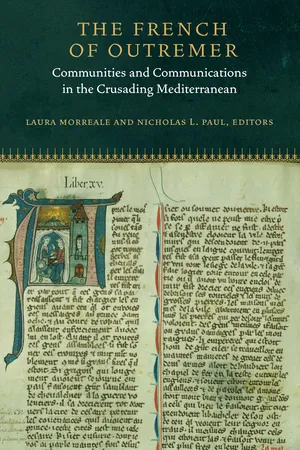
The French of Outremer
Communities and Communications in the Crusading Mediterranean
- 320 pages
- English
- ePUB (mobile friendly)
- Available on iOS & Android
eBook - ePub
The French of Outremer
Communities and Communications in the Crusading Mediterranean
About this book
The establishment of feudal principalities in the Levant in the wake of the First Crusade (1095-1099) saw the beginning of a centuries-long process of conquest and colonization of lands in the eastern Mediterranean by French-speaking Europeans. This book examines different aspects of the life and literary culture associated with this French-speaking society. It is the first study of the crusades to bring questions of language and culture so intimately into conversation. Taking an interdisciplinary approach to the study of the crusader settlements in the Levant, this book emphasizes hybridity and innovation, the movement of words and people across boundaries, seas and continents, and the negotiation of identity in a world tied partly to Europe but thoroughly embedded in the Mediterranean and Levantine context.
Information
A NEGLECTED RELATIONSHIP: LEONTIOS MAKHAIRAS’S DEBT TO LATIN EASTERN AND FRENCH HISTORIOGRAPHY
Angel Nicolaou-Konnari
The historiographical tradition of medieval and early modern Cyprus occupies an exceptional place in the literary history of the Latin- and Ottoman-ruled Greek world, thanks to its continuity, variety, and volume.1 The change from one period to the other of the language used for these histories of Cyprus (French, Greek, or Italian) reflects historical mutations, intercultural relations, and linguistic evolution on the island as well as the process of the formation of ethnic identities.2 The composition in the fifteenth century of the chronicle attributed to Leontios Makhairas marked perhaps the most important phase of Cypriot historiographical production. Written in the Greek Cypriot dialect and in prose, the chronicle recounts the history of Cyprus from the fourth-century visit of Saint Helen to the death of King John II of Lusignan (r. 1418–58), but it is, in fact, the history of the island’s Lusignan rule, its focus lying on the reigns of Peter I (r. 1359–69) and Peter II (r. 1369–82).3 The inexhaustible historical, literary, linguistic, and philological wealth of the text constantly opens new, fascinating vistas of research, interpretation, and artistic interaction.4 This essay intends to investigate the underestimated relationship between the chronicle and earlier or contemporary historical texts in French from either the crusader Latin East or France, tracing affinities and differences in content, form, style, and ideological perspective and identifying textual links, direct borrowings, and common sources. Although French influences on Latin Eastern history writing produced in French have been relatively well studied,5 the relationship between medieval French and medieval Cypriot historiography produced in Greek has been largely neglected in secondary literature. Establishing these connections will hopefully show the extent and nature of the place that a Greek narrative text, produced in a multicultural society under Frankish rule, can occupy within the French language historiography.
MAKHAIRAS AND HIS CHRONICLE
The chronicle survives in three sixteenth-century manuscripts that preserve two recensions: Venice, Biblioteca Nazionale Marciana, MS Gr. VII, 16, 1080 (=V), the longest and probably the oldest text; Oxford, Bodleian Library, MS Selden, supra 14 (=O), a version with long lacunae that differs greatly from V; and Ravenna, Biblioteca Classense, MS Gr. 187 (=R), a version similar to the one in O, albeit more complete.6 Brief extracts from O, copied in the middle of the seventeenth century,7 and a late sixteenth-century Italian translation of R, preserved in Vatican City, Biblioteca Apostolica Vaticana, MS Vat. Lat. 3941 (=S),8 do not contribute much in terms of textual criticism or manuscript tradition. To the extent that Makhairas is credited with the original text, or rather the V version, which features first-person references not only to his person and his family but also to his sources,9 its composition may be placed in the second quarter of the fifteenth century, sometime after 1426 (the last mention of Leontios in V) and 1432 (the last known mention of his person in the sources), with later annalistic additions (probably by another writer).10
Makhairas’s life and career, patchily reconstructed from the sparse evidence provided by the V version,11 as well as his cultural and ethnic awareness as revealed in the chronicle, had a great impact on the text’s literary nature and ideological identity.12 He was probably born around 1360/80 and died sometime after 1432. He came from a Greek Orthodox family whose members seem to have traditionally served in the Frankish royal and seigneurial administration. Leontios himself was a secretary of the important Nores (or Norès) family13 and participated in the Lusignan army during the 1426 Mamluk invasion of Cyprus as the person in charge of the wine distribution. He also served the Lusignans on diplomatic missions as attested by the Burgundian Bertrandon de La Broquère, who met “Lyon Maschere” in southern Anatolia in 1432 and says that he spoke “assés bon françois.”14 Therefore, Leontios belonged to that group of administrators and jurists (Greek, Christian Syrian, and Latin burgesses) who participated in both the Greek and Latin cultures, acquired social and economic prominence by virtue of their education and linguistic abilities, and were actively involved in what we might call the school of Cypriot historiographers. By the end of the fourteenth century, a common group consciousness in relation to Cyprus as a geographical and political entity had emerged among the particular milieu to which Makhairas belonged and the circles in which he moved—namely, the wealthy, educated Greek burgesses and the Frankish ruling class. The product of the political, social, and economic changes but also of two centuries of peaceful cohabitation and cultural interaction between Greeks and Franks, this shared identity is eloquently expressed in the chronicle by the ethnic name “Kυπριώτης” (Kypriotis or Cypriot), used extensively to denote the entire population of the island, regardless of rite, origin, or social status; language in the form of the local Greek idiom (as either a first or a second language or a lingua franca) seems to have been a condition of ethnic affiliation associated with it, which, however, did not exclude French.15
Therefore, although he writes the history of the last Crusader State in the Levant, Makhairas’s text reflects the Lusignan Kingdom’s evolving character from a French crusader society with Greek subjects and a vested interest in the Kingdom of Jerusalem in the thirteenth century to a Cypriot society of Franks and Greeks in the fifteenth. Makhairas’s chronicle embodies, in fact, the fusion of the Byzantine and Latin Eastern worlds, transforming the crusader tradition of the historians of the Kingdom of Jerusalem into a Greco-Frankish tradition proper to the sociocultural reality of fifteenth-century Cyprus. Consequently, his text does not fit well into any of the conventional categories of the Western or Byzantine historiographical traditions, as Makhairas invents a kypriotike tradition of history writing, situated at the fringe of crusader, Western, and Byzantine historiography.16 This particular kypriotikos character is expressed by the use of the medieval Cypriot dialect, the literary influences received, and the choice of the sources used.
The use of the local Greek vernacular, an idiom rich in lexical and phonetic French influences, as a literary medium instead of the Byzantine koine, Latin, or French implies the existence within Cypriot society of phenomena such as linguistic interaction, code-switching, and bilingualism. Most importantly, it reflects the use of the dialect as a lingua franca by the entire Cypriot population as well as its movement into prestigious domains of textuality (administration, law, literature). This does not prevent Makhairas, whose knowledge of Ancient Greek (and Latin) seems to have been limited, from deploring the “barbarous” state of the Greek language in Cyprus as a result of French influences, thus being one of the first writers to express the “diglossia complex” of the Cypriots vis-à-vis their dialect, a persistent characteristic of Greek linguistic consciousness in general. From the point of view of history writing, the use of the vernacular together with the use of prose primarily serves as a mark of authenticity.17
Makhairas’s narrative adheres to many literary genres and styles but remains foremost a kind of national history, structured as a dynastic history that becomes at times the biographical encomium of the Lusignan kings,18 as well as a memoir of sorts. Thematically, the text is inextricably linked with the Frankish Kingdom of Cyprus and, ideologically, is consistently loyal to its ruling dynasty. Despite Makhairas’s undisguised partiality for the Lusignans and the fact that the text is clearly addressed to a Cypriot audience (Frankish and Greek) from a Cypro-centric perspective, nothing in the text indicates that it was commissioned or composed as officially sponsored propaganda, although one cannot resist regarding the Nores family as potential patrons. Historical time is organized according to genealogical time, but the narrative becomes significantly more detailed when the events approach Makhairas’s lifetime. This is the history of a period that is contemporary, or almost contemporary, to the time the author lived, the latter acting not only as a simple compiler of past events but as a first- or secondhand witness and sometimes an essential participant.19
Accordingly, Makhairas draws extensively on personal recollection, while at the same time he makes a point of specifying his written or oral sources, thus furnishing his work with authentication. He meticulously marks the day of the week, month, year, and sometimes hour of an event and specifies the way he collected his information, often supplying the name of his informant.20 The chronicler ascribes the same degree of credibility to both written and oral sources, which vary considerably and include documents and letters, literary, narrative, genealogical or hagiographical texts, legends and oral tradition, and information provided by direct or indirect witnesses. This notarial minuteness with which Makhairas provides detailed information about his sources betrays his background as a secretary and a diplomat and allows a better understanding of the way he constructed his text. Interestingly, he does not mention French historical or literary sources, and, with the exception of a lost account by the Cyp...
Table of contents
- Cover
- Half Title
- Series Announcement Page
- Title Page
- Copyright
- Contents
- Half Title
- Map
- Introduction
- What We Know and Don’t Yet Know about Outremer French
- The Denier Outremer
- Ernoul, Eracles, and the Collapse of the Kingdom of Jerusalem
- L’Estoire d’Eracles in Outremer
- Western Eyes on the Latin East: The Chronique d’Ernoul et de Bernard le Trésorier and Robert of Clari’s Conquête de Constantinople
- A Neglected Relationship: Leontios Makhairas’s Debt to Latin Eastern and French Historiography
- “Re-Orienting” Estoires d’Outremer: The Arabic Context of the Saladin Legend
- The Tasks of the Translators: Relics and Communications between Constantinople and Northern France in the Aftermath of 1204
- The Pilgrim Translation Market and the Meaning of Courtoisie
- The French of Outremer Beyond the Holy Land
- Roles for Women in Colonial Fantasies of Fourteenth-Century France: Pierre Dubois and Philippe de Mézières
- Color plates
- List of Contributors
- Acknowledgments
- Index
- Series Page
Trusted by 375,005 students
Access to over 1.5 million titles for a fair monthly price.
Study more efficiently using our study tools.
Frequently asked questions
Yes, you can cancel anytime from the Subscription tab in your account settings on the Perlego website. Your subscription will stay active until the end of your current billing period. Learn how to cancel your subscription
No, books cannot be downloaded as external files, such as PDFs, for use outside of Perlego. However, you can download books within the Perlego app for offline reading on mobile or tablet. Learn how to download books offline
Perlego offers two plans: Essential and Complete
- Essential is ideal for learners and professionals who enjoy exploring a wide range of subjects. Access the Essential Library with 800,000+ trusted titles and best-sellers across business, personal growth, and the humanities. Includes unlimited reading time and Standard Read Aloud voice.
- Complete: Perfect for advanced learners and researchers needing full, unrestricted access. Unlock 1.5M+ books across hundreds of subjects, including academic and specialized titles. The Complete Plan also includes advanced features like Premium Read Aloud and Research Assistant.
We are an online textbook subscription service, where you can get access to an entire online library for less than the price of a single book per month. With over 1.5 million books across 990+ topics, we’ve got you covered! Learn about our mission
Look out for the read-aloud symbol on your next book to see if you can listen to it. The read-aloud tool reads text aloud for you, highlighting the text as it is being read. You can pause it, speed it up and slow it down. Learn more about Read Aloud
Yes! You can use the Perlego app on both iOS and Android devices to read anytime, anywhere — even offline. Perfect for commutes or when you’re on the go.
Please note we cannot support devices running on iOS 13 and Android 7 or earlier. Learn more about using the app
Please note we cannot support devices running on iOS 13 and Android 7 or earlier. Learn more about using the app
Yes, you can access The French of Outremer by Laura K. Morreale, Nicholas L. Paul, Laura K. Morreale,Nicholas L. Paul in PDF and/or ePUB format, as well as other popular books in History & European Medieval History. We have over 1.5 million books available in our catalogue for you to explore.