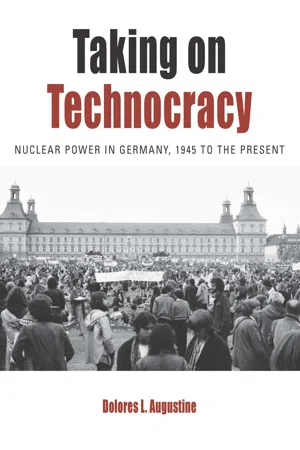
The German abandonment of nuclear power represents one of the most successful popular revolts against technocratic thinking in modern times—the triumph of a dynamic social movement, encompassing a broad swath of West Germans as well as East German dissident circles, over political, economic, and scientific elites. Taking on Technocracy gives a brisk account of this dramatic historical moment, showing how the popularization of scientific knowledge fostered new understandings of technological risk. Combining analyses of social history, popular culture, social movement theory, and histories of science and technology, it offers a compelling narrative of a key episode in the recent history of popular resistance.
- 306 pages
- English
- ePUB (mobile friendly)
- Available on iOS & Android
eBook - ePub
About this book
Trusted by 375,005 students
Access to over 1.5 million titles for a fair monthly price.
Study more efficiently using our study tools.
Information
Chapter 1
Nuclear Dreams and Radioactive Nightmares
Popular Culture and the Quest for Nuclear Consensus in East and West Germany, 1945–1970
As Germany dug out of the rubble in 1945–1946, the power of the atom in its military and peaceful forms became a major theme in the press. The Munich-based Süddeutsche Zeitung, the first newspaper given permission to publish in the American zone of occupation, ran an article in 1946 that asserted, “The bombing of Hiroshima and Nagasaki ushered in a new era,” in which “it is vital to transform the power of the atom into a blessing.” Atomic energy could bring forth “wonders” in the areas of medicine, biology, transportation, and public welfare, according to the article. But it also raised the terrifying possibility that it would eventually be possible to develop nuclear bombs that could smash apart the earth or suck all the oxygen out of the atmosphere.1
A similar narrative was to be found in a 1946 article in the illustrated magazine Neue Berliner Illustrierte, published in the Soviet-occupied sector of Berlin. It showed a frightening artist’s depiction of the 1 July 1946 US atomic bomb test at Bikini Atoll, along with actual photos from the test. Should atomic power be used this way?, it asked. “Up until now, atomic energy has only been used and tested for destructive ends. This development must be brought to a complete halt and prohibited by international law because it could eventually mean the end of human culture. By contrast, the use of atomic energy in industry will provide the entire world with untold possibilities for peaceful progress.”2
The atomic bomb and atomic power were inextricably intertwined in popular narratives of this period. Media across the globe depicted humankind as standing “at the crossroads,” confronted with a choice between the annihilation of the human race through nuclear war and the creation of a better world through nuclear-fueled prosperity and progress.3 This was not a new idea. In his 1913 novel, The World Set Free, H.G. Wells first formulated the idea that radiation either could provide huge amounts of energy, thus providing prosperity for all, or, if used in a bomb, could spell the destruction of humanity. Wells invented both the concepts and the terms “atomic bomb” and “Atomic Age.”4
According to historian David Nye, the destructive power of the bomb evoked religious feelings, a sense of awe and profound fear among Americans, giving way to “a somber feeling” and a new sense of the vulnerability of life on earth. Paul Boyer shows that Americans were initially gripped with an overwhelming sense of terror. However, he argues that within a couple of years, government, the media, and corporate America succeeded in convincing the US public that the “peaceful atom” somehow outweighed and even cancelled out the threat of destruction through nuclear war.5
The American and Soviet military administrations in Germany and, later, German authorities made major attempts to mold popular perceptions of the unfolding Atomic Age. Germans were receptive because, to them, nuclear technologies represented a modern world that would help them escape from the past.6 The theme of redemption through the turn away from war and the building of peace and prosperity was fundamental to the American Atoms for Peace policy, as well as its Soviet equivalent. West and East Germans sought security, defined in three ways: peace and protection as allies of the United States and the Soviet Union, economic security, and progress through science. Nuclear power was widely held to be compatible with and even essential to all three. More importantly, by being welcomed into the new nuclear regime of their respective blocs, East and West Germany gained new respectability that might allow them to shed their Nazi past.
However, the association of atomic power with the atom bomb never wore off. In the decades after World War II, political leaders and elites who promoted nuclear power certainly viewed these misgivings as irrational and attempted to build a nuclear consensus from the bottom up by educating the public, promoting technical safety, and providing a legal framework for the safe use of nuclear power. However, an undercurrent of fear lived on. This chapter looks at conflicting tendencies in depictions of nuclear power and at the relationship between science and emotion in East and West German popular culture from the 1940s to the 1960s, placing this analysis in the context of wartime experiences, the Cold War, and the development of a dictatorial socialist system in the GDR and a capitalist–democratic system in the Federal Republic. The media did not just filter and transmit attitudes and ideas about nuclear power but also helped to mold them.
Media and Popular Opinion in the Atomic Age
Shattered and subjugated during the Nazi period, West German media rapidly recovered in the postwar period, in many cases returning to Weimar era patterns. The elite upheld the idea of Germany as a Kulturnation (cultured nation) and disdained popular entertainment. The educated classes held certain newspapers and newsmagazines to be the most dependable purveyors of political news. These included the Center-Right daily Frankfurter Allgemeine Zeitung (founded in 1949), the Center-Left daily Süddeutsche Zeitung, and the Center-Left weekly news magazine Der Spiegel (founded in 1947). However, tabloids and illustrated magazines far surpassed the “serious” press in terms of circulation.7
Public opinion polls carried out by or commissioned by the US occupation authorities provided a corrective to overly elitist views of the West German press.8 Illustrated magazines such as Stern regained their pre-1933 popularity after the war. In 1950, about 16.3 percent of the adult population in West Germany read Stern, according to a US survey. This translates into a readership of about eight million.9 Stern had a circulation of 1.2 million in 1960, but Stern estimates that it had over ten million readers at that time. Thus, about one in five West Germans read it, making it as popular a magazine in West Germany as Life was in the United States.10 Many read the magazine in a beauty salon, a barbershop, or a waiting room, or they read a friend’s, relative’s or colleague’s copy. The readership of magazines cut across class lines. Professionals, businessmen, and office workers were the most avid readers of magazines and illustrated magazines, according to a US survey of 1955.11
Gradually, television became the dominant popular medium. Most Germans did not watch television in the 1950s. Only 24 percent of West German households and 17 percent of East German households owned a television set in 1960.12 By contrast, 60 percent of West Germans surveyed in 1955 read magazines.13 By 1966, however, over half of all households in the Federal Republic and the GDR had a TV.14
The driving force behind popular media was the desire to appeal to the broad masses. In the early days, Stern published a good many articles about scandals, stars, and members of royal families, but by the mid-1950s, it was doing a good deal of investigative journalism and featuring pointedly critical articles on world affairs. Its editors saw it as part of the “fourth power” or “fourth estate,” that is, a watchdog overseeing the three branches of government. Its Center-Right leanings up into the mid-1960s gave way to a more Center-Left orientation by the 1970s.15
The East German press was state or party owned and was subject to strict censorship. The SED’s party newspaper, Neues Deutschland, closely hewed to the party line. Journalists were carefully monitored by the authorities and were expected to adhere to guidelines issued by the “agitation/propaganda” division of the SED and by bodies such as the German Peace Council, a GDR affiliate of the Soviet-dominated World Peace Council.16
Although never criticizing the Communist system, some publications sought to appeal to a popular audience. One example is Neue Berliner Illustrierte, an illustrated magazine published since 1945 in the Soviet sector of Berlin and later the GDR. With a circulation of 700,000 in a country with a population of about seventeen million, NBI was the most popular magazine in the country around 1970, although the authorities restricted the number of copies printed, and it was sold from “under the counter.”17 From its inception, it was a lively magazine that sought, not just to promote a socialist consciousness but also to draw in readers with arresting images, drama, and teaser headlines. Its articles, although never critical of the SED or the Soviet Union, were sometimes illustrated with photos rich in ambiguity and Westernized imagery, particularly after Joseph Stalin’s death in 1953.
Internal documents from the Berliner Verlag (Berlin Publishing House), the publisher of NBI and the tabloid BZA (Berliner Zeitung am Abend, the evening edition of the Berliner Zeitung, or Berlin News), make clear that journalists were under great pressure to fulfill SED mandates. It was evidently rare for a journalist to push back, yet I was able to find one such instance. At a 1962 meeting behind closed doors, an SED party official objected to the headline, “He Does Not Want to Commit Suicide,” placed above a photo of a Western demonstrator carrying a banner that read, “War is our greatest enemy.” This item, published in BZA, “contains pacifist tendencies,” he contended. (This was problematic because it might call into question Soviet “self-defense.”) A journalist countered that such scruples stood in the way of making BZA massenwirksam, meaning “appealing to the masses.”18 This desire to connect with the reader opened mass media in the GDR to currents in popular culture that did not align perfectly with official goals.
The first part of this chapter places the popular culture of the Atomic Age in the context of German history and the Cold War, drawing on my quantitative content analysis of all issues of Stern and NBI published between 1945 and 1965 (about 2,000 in number—none digitized). This study was compiled as part of a larger project on popular culture depictions of nuclear technologies in eight countries.19 In keeping with Germany’s position on the potential front lines of any nuclear war, military technologies overshadowed civilian technologies in articles on the Atomic Age from the late 1940s to 1965. Of 270 articles on nuclear technologies published in Stern between 1948 and 1965, only thirty-five discussed atomic power or other nonmilitary technologies (such as medical uses). NBI published forty-seven articles about civilian nuclear technologies out of a total of 186 articles with nuclear themes in the same period.20 The following sections discuss some of the most important tropes, beginning with one whose significance is sometimes overlooked.
Scientists as Heroes, 1945–1953
Popular attitudes were molded, not just by the peaceful atom/destructive atom narrative but also by the stature of science and scientists. Across the globe, science was presented as an objective anchor in an uncertain world and a return to rationality after the irrationality of the ideological extremism of wartime. In Germany, whose scientific tradition was the source of considerable pride, journalists, authorities, and the people could construe science as representing a “better Germany.” Such retrospection invoked a redeemable German past that ostensibly stood above politics, making it useful in both the Soviet and Western zones of occupation. The first article about nuclear technology published after the war by NBI focused on Wilhelm Röntgen (1845–1923), a German scientist responsible for the discoveries that led to the development of modern radiology. It extolled not only his scientific contribution but also his ethos: “In a selfless manner, he made his beneficial discovery available to all of humankind.”21 Similarly, a 1947 article in Der Spiegel about the death of Max Planck recounted that the physicist, who was pushed out as head of the Kaiser-Wilhelm Society in 1936, had asked in vain to speak to Hitler to protest against the persecution of Jews.22
In reality, the place of scientists in German society, both during and after the Nazi era, was rather different. According to historian Dieter Hoffmann, Planck had in fact displayed a marked lack of solidarity with Jewish physicists such as Albert Einstein.23 Physicist Erwin Schrödinger was one of the rare non-Jewish scientists who fled Nazi Germany.24 Most scientists were only too happy to work on projects with military applications during the war.25 They included a project to build an atomic bomb. The reasons for its failure have been the subject of a good deal of academic debate. German scientists ended up working on a wartime project to build an atomic reactor that used heavy water as a moderator.26 Few scholars believe Werner Heisenberg’s claim that as head of an important research team working on the bomb, he deliberately...
Table of contents
- Cover
- Title Page
- Copyright Page
- Dedication Page
- Contents
- List of Illustrations and Figures
- Acknowledgments
- List of Abbreviations and Acronyms/Glossary
- Introduction
- Chapter 1. Nuclear Dreams and Radioactive Nightmares: Popular Culture and the Quest for Nuclear Consensus in East and West Germany, 1945–1970
- Chapter 2. On the Brink of Disaster? Safety Regimes and Nuclear Accidents in the Two Germanys
- Chapter 3. Dissenting Voices: The Emergence of Counterexperts in West Germany
- Chapter 4. From Local Roots to National Prominence: The Struggle over Wyhl
- Chapter 5. Environmentalism as Civil War: Brokdorf—and the Consequences
- Chapter 6. The Shock of Chernobyl and the Environmentalist Breakthrough in West Germany
- Chapter 7. Not Immune to Error: Chernobyl’s Impact in the GDR
- Chapter 8. Abandoning Nuclear Power—Or Not?
- Conclusion
- Bibliography
- Index
Frequently asked questions
Yes, you can cancel anytime from the Subscription tab in your account settings on the Perlego website. Your subscription will stay active until the end of your current billing period. Learn how to cancel your subscription
No, books cannot be downloaded as external files, such as PDFs, for use outside of Perlego. However, you can download books within the Perlego app for offline reading on mobile or tablet. Learn how to download books offline
Perlego offers two plans: Essential and Complete
- Essential is ideal for learners and professionals who enjoy exploring a wide range of subjects. Access the Essential Library with 800,000+ trusted titles and best-sellers across business, personal growth, and the humanities. Includes unlimited reading time and Standard Read Aloud voice.
- Complete: Perfect for advanced learners and researchers needing full, unrestricted access. Unlock 1.5M+ books across hundreds of subjects, including academic and specialized titles. The Complete Plan also includes advanced features like Premium Read Aloud and Research Assistant.
We are an online textbook subscription service, where you can get access to an entire online library for less than the price of a single book per month. With over 1.5 million books across 990+ topics, we’ve got you covered! Learn about our mission
Look out for the read-aloud symbol on your next book to see if you can listen to it. The read-aloud tool reads text aloud for you, highlighting the text as it is being read. You can pause it, speed it up and slow it down. Learn more about Read Aloud
Yes! You can use the Perlego app on both iOS and Android devices to read anytime, anywhere — even offline. Perfect for commutes or when you’re on the go.
Please note we cannot support devices running on iOS 13 and Android 7 or earlier. Learn more about using the app
Please note we cannot support devices running on iOS 13 and Android 7 or earlier. Learn more about using the app
Yes, you can access Taking on Technocracy by Dolores L. Augustine in PDF and/or ePUB format, as well as other popular books in History & German History. We have over 1.5 million books available in our catalogue for you to explore.