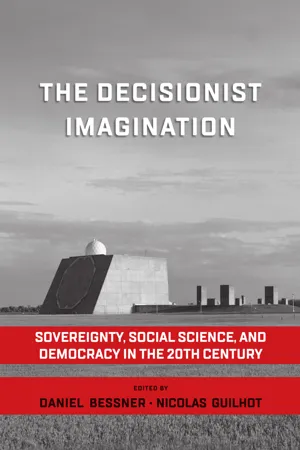
In the decades following World War II, the science of decision-making moved from the periphery to the center of transatlantic thought. The Decisionist Imagination explores how "decisionism" emerged from its origins in prewar political theory to become an object of intense social scientific inquiry in the new intellectual and institutional landscapes of the postwar era. By bringing together scholars from a wide variety of disciplines, this volume illuminates how theories of decision shaped numerous techno-scientific aspects of modern governance—helping to explain, in short, how we arrived at where we are today.
Trusted by 375,005 students
Access to over 1.5 million titles for a fair monthly price.
International Public Opinion in Early Twentieth Century Anglo-American Thought
Stephen Wertheim
In 1939, E. H. Carr assailed those naive utopians who supposed that something called public opinion could usher in world peace. A generation of internationalists, he charged, had placed their faith in a “double fallacy”: first, that public opinion would ultimately prevail, and second, that public opinion was always right.1 After twenty years of crisis, and a failed League of Nations, such nostrums looked absurd. Carr hardly needed to argue against them, only to state them plainly. But had League supporters really been so naive? Carr had evidence. He rattled off quotation after quotation from US President Woodrow Wilson, British diplomat Robert Cecil, and others, all seeming to affirm what Cecil told the House of Commons about the League in 1919: “The great weapon we rely upon is public opinion … and if we are wrong about it then the whole thing is wrong.”2
The whole thing did rely on public opinion, on a belief that public opinion could surmount international conflict. Yet that belief was not as straightforward as Carr suggested or as conventional usage ever since would imply. “Public opinion” today evokes the momentary preferences of individuals aggregated together, as expressed in scientific opinion polls. Such polls, however, came into being in the latter half of the 1930s, just when Carr was writing. Outside the United States, they became widely used only after World War II.3 Until then, the internationalists Carr criticized possessed no reliable method for quantifying momentary mass preferences within their own nations, let alone across nations. And they knew it. When they invoked international public opinion—staking the peace of the world on it in 1919—what did they mean, and what were they doing?
Carr at least recognized the importance of the discourse of public opinion, despite neglecting to theorize it. By contrast, subsequent scholars of liberal internationalism have sidelined the subject altogether, centering their accounts on world organization instead. Yet in the long-range history of internationalism, public opinion is as fundamental a category as world organization. Public opinion served as a discursive and conceptual frame for internationalist’s projects well before constructing a permanent organization of states became part of their agenda during World War I. It signified, in part, the harmony of interest they assumed to be immanent in the world, beneath the violent clashes constantly on display. Through “public opinion,” through its expression and enlightenment, international society would transcend power politics. On that much, liberal internationalists, ranging from diplomatic officials to legal and business professionals to peace activists, could agree. But what the public was, and how to discern its opinion, was another matter.
This chapter charts a genealogy of the concept of international public opinion in Anglo-American political discourse. It follows the lead of scholars who have reconstructed the diverse meanings of “public opinion” within national and transnational contexts since the eighteenth century.4 These scholars have generally emphasized that, given its historical origins, “‘public opinion’ in its common usage is a positively Orwellian expression,” as John Durham Peters writes.5 Although public opinion is today manifested by solitary individuals answering surveys, the concept was formerly imagined as a form of collective rationality, often forged from deliberative debate (despite, or because of, the many categories of persons excluded from the public sphere). Notions of corporate will and cultivated reason also attached to the compound concept of international public opinion, although the latter presents a special case given the relative paucity of associational life at the international level.6 The real conditions of international society before the twentieth century, then, make all the more important the illocutionary force of public opinion talk—who deployed it and to what end.
In anointing “public opinion” as the watchword of their new diplomacy, the founders of the League scarcely intended to anoint popular preferences as the guide of diplomatic practice. While trading on the term’s democratic connotations, they valorized something closer to Kantian will or Hegelian spirit. Most important, they empowered national politicians to interpret public opinion through decision processes they declined to specify. In so doing, they elaborated on the usage of “public opinion” by prewar internationalists, particularly liberal legalists, who for decades held up themselves as public opinion’s arbiters. As invoked by these successive groups of internationalists, in short, the concept of international public opinion differed in several ways from that of momentary mass preferences. The “public” in an international context designated anything from states vis-à-vis each other to literate civil society to broad populations. Its “opinion” tended to be enduringly rooted, more akin to customs, norms, will, or spirit than to mere preferences obtaining at a point in time. Because these various meanings were seldom parsed, internationalist elites assigned to themselves the authority to articulate public opinion, regardless of actual public sentiment. In the name of public opinion, they exercised their own discretion, practicing a kind of Schmittian decisionism avant la lettre. Before Walter Lippmann launched his attack on “public opinion” in 1922, and Carr and others developed the critique into International Relations (IR) realism, opinions about public opinion were hardly egalitarian.7
This interpretation implies that mid-twentieth-century realists misunderstood, or misrepresented, the idealists they named and criticized. They charged that idealists, in thrall to popular judgment and legalist–moralist rules, evaded the policymaker’s responsibility to decide.8 But the so-called idealists were elitists, too. Both idealism and realism, not just the latter, elevated the ineffable discernment of leaders—except that if idealists dared not speak the name of their decisionism, realists were only too glad to do so. In this regard, the real break occurred not in the 1930s and 1940s but rather in the 1950s and beyond, when the decision, having been exalted as the locus of international relations, was claimed by “decision sciences” like rational choice and systems analysis, which jettisoned the Schmittian mystique of unconditioned judgment. By the same token, neither realism nor the decision sciences were responsible for removing the public from International Relations (or international relations). The public was barely there to begin with, a discursive entity above all. Before faulting the postwar social sciences for evacuating the public and its opinion from political life, one must begin by asking which prior version of “public opinion” one means.9
The Judgment of History: Public Opinion and International Law, 1870–1914
“Public opinion” featured in internationalist debates no less than a century before World War I began. Its rise accompanied the gradual spread of popular sovereignty within European states. Contrary to Carr, however, public opinion as an international concept was not simply transposed from domestic doctrines of laissez faire liberalism, as though individuals within the civil state were easily analogized to states within the anarchic international arena.10 Public opinion had a distinct career in the realm of international thought. It addressed concerns specific to international relations, and those who invoked it intended to shape the global power structure as well as advance transnational interests and solidarities that took form in an increasingly interconnected world, particularly across the North Atlantic.11
Following the Napoleonic wars, diplomats, newspaper writers, salon-lobbyists, and festivalgoers gathered at the Congress of Vienna and made claims in the name of public opinion.12 In his chronicle of the Congress, Abbé de Pradt, Napoleon’s former secretary, dramatized how statesmen had begun to take account of the wider public, to heed “a new power, called opinion, from the empire of which nothing can be taken, at the tribunal of which governments themselves incessantly appeal.”13 In accounts like de Pradt’s, public opinion began its long career as an evaluative–descriptive term linked to reason and civilization and opposed to military force and power politics. Many emergent internationalists employed the term in a similar manner but, unlike de Pradt, believed that the great powers trampled “public opinion” rather than respecting it. In particular, Quaker peace societies, Cobdenite free traders, and Mazzinian nationalists defended what they called public opinion against its armed suppression by the Concert of Europe and Holy Alliance.14
By the mid-nineteenth century, these internationalists formulated manifold programs to transform international society. Through the “people-diplomacy” of free trade, open congresses, and national autonomy, states would express their true, harmonious interests and prevent disputes from arising.15 Through disarmament and arbitration, states would resolve whatever disputes arose by discussion rather than war. Such formulae glorified a “public opinion” irreconcilable with the existing order of monarchical and aristocratic states. To many internationalists, therefore, the ideal of public opinion precluded rather than required international organization. Any practicable international organization would necessarily have great powers at its core and “public opinion” at its mercy.16
In the latter half of the nineteenth century, “public opinion” claim-making ascended to the centers of power in international politics—but not because pacifists or revolutionaries ascended as well. To the contrary, public opinion entered the vocabulary of reformist liberals who organized transnationally to construct international society as a legalistic project. In the 1870s, the first international law society, the Institut de Droit International, formed in Europe, and British and American peace movements promoted the codification of law and the arbitral and judicial settlement of disputes.17 Seeking to square their aspiration to transcend power politics with their confidence in the rising middle and professional class, liberal legalists articulated public opinion in a nonliteral, historico-cultural way. Although not necessarily contradicting the vague position of Benthamite advocates of publicity in the first half of the nineteenth century, they distanced themselves more explicitly from any support for popular decision-making.18
“Public opinion!” wrote Gustave Rolin-Jaequemyns, the Belgian founder of the Institut, in 1869. Rolin, echoing Blaise Pascal, hailed public opinion as “really and rightly the queen and legislator of the world,” the “very voice of reas...
Table of contents
Cover
Title Page
Copyright Page
Contents
List of Figures and Tables
Acknowledgments
Introduction Who Decides?
Chapter 1 Reading the International Mind: International Public Opinion in Early Twentieth Century Anglo-American Thought
Chapter 2 Militant Democracy as Decisionist Liberalism: Reason and Power in the Work of Karl Loewenstein
Chapter 3 Parliamentary and Electoral Decisions as Political Acts
Chapter 4 Decision and Decisionism
Chapter 5 How Having Reasons Became Making a Decision: The Cold War Rise of Decision Theory and the Invention of Rational Choice
Chapter 6 Computable Rationality, NUTS, and the Nuclear Leviathan
Chapter 7 The Unlikely Revolutionaries: Decision Sciences in the Soviet Government
Chapter 8 Prediction and Social Choice: Daniel Bell and Future Research
Chapter 9 Predictive Algorithms and Criminal Sentencing
Conclusion The Myth of the Decision
Index
Frequently asked questions
Yes, you can cancel anytime from the Subscription tab in your account settings on the Perlego website. Your subscription will stay active until the end of your current billing period. Learn how to cancel your subscription
No, books cannot be downloaded as external files, such as PDFs, for use outside of Perlego. However, you can download books within the Perlego app for offline reading on mobile or tablet. Learn how to download books offline
Perlego offers two plans: Essential and Complete
Essential is ideal for learners and professionals who enjoy exploring a wide range of subjects. Access the Essential Library with 800,000+ trusted titles and best-sellers across business, personal growth, and the humanities. Includes unlimited reading time and Standard Read Aloud voice.
Complete: Perfect for advanced learners and researchers needing full, unrestricted access. Unlock 1.5M+ books across hundreds of subjects, including academic and specialized titles. The Complete Plan also includes advanced features like Premium Read Aloud and Research Assistant.
Both plans are available with monthly, semester, or annual billing cycles.
We are an online textbook subscription service, where you can get access to an entire online library for less than the price of a single book per month. With over 1.5 million books across 990+ topics, we’ve got you covered! Learn about our mission
Look out for the read-aloud symbol on your next book to see if you can listen to it. The read-aloud tool reads text aloud for you, highlighting the text as it is being read. You can pause it, speed it up and slow it down. Learn more about Read Aloud
Yes! You can use the Perlego app on both iOS and Android devices to read anytime, anywhere — even offline. Perfect for commutes or when you’re on the go. Please note we cannot support devices running on iOS 13 and Android 7 or earlier. Learn more about using the app
Yes, you can access The Decisionist Imagination by Daniel Bessner, Nicolas Guilhot, Daniel Bessner,Nicolas Guilhot, Nicolas Guilhot, Daniel Bessner in PDF and/or ePUB format, as well as other popular books in History & Decision Making. We have over 1.5 million books available in our catalogue for you to explore.