Situated at the crossroads of performance practice, museology, and cultural studies, live arts curation has grown in recent years to become a vibrant interdisciplinary project and a genuine global phenomenon. Curating Live Arts brings together bold and innovative essays from an international group of theorist-practitioners to pose vital questions, propose future visions, and survey the landscape of this rapidly evolving discipline. Reflecting the field's characteristic eclecticism, the writings assembled here offer practical and insightful investigations into the curation of theatre, dance, sound art, music, and other performance forms—not only in museums, but in community, site-specific, and time-based contexts, placing it at the forefront of contemporary dialogue and discourse.
eBook - ePub
Curating Live Arts
Critical Perspectives, Essays, and Conversations on Theory and Practice
- 382 pages
- English
- ePUB (mobile friendly)
- Available on iOS & Android
eBook - ePub
Curating Live Arts
Critical Perspectives, Essays, and Conversations on Theory and Practice
About this book
Trusted by 375,005 students
Access to over 1.5 million titles for a fair monthly price.
Study more efficiently using our study tools.
Information
PART I

Historical Framings
CHAPTER 1

From Content to Context
The Emergence of the Performance Curator
BERTIE FERDMAN
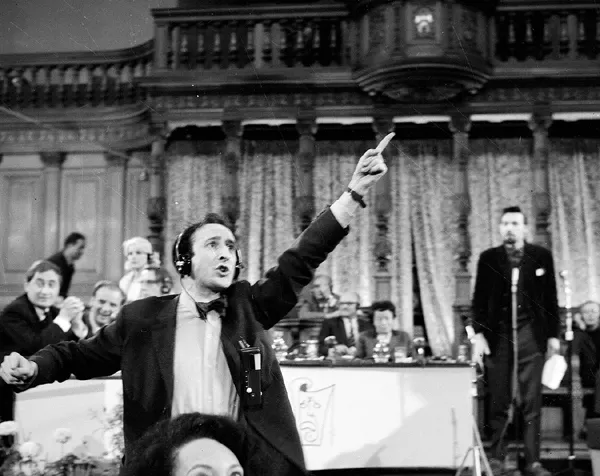
Figure 1.1. Kenneth Dewey at The Theatre of the Future conference, Edinburgh Festival, 1963. Courtesy of the Scotsman Publications, 1963. Used with permission.
In 1963 at the Edinburgh Festival, a theater conference took place organized by director Jim Haynes, John Calder, and critic Kenneth Tynan at the brothel turned th eater club now known as the Traverse Theatre, one of the better-known venues for cutting-edge performance at the Fringe. During the last day of The Theatre of the Future, Calder invited artists Allan Kaprow and Ken Dewey to do performance pieces, unannounced, during the course of the discussions. Dewey’s Play of Happenings, which he created with collaborators Charles Lewsen and Mark Boyle as a reaction to the presentations they saw at the conference, caused an uproar (Malsbury 2013). Edinburgh model Anna Keseler was wheeled out in the nude; a sheep’s skeleton was hung from the ceiling; men stood from windows seventy feet above; a piper played; tape-recorded voices of the audience’s own skepticism were heard; and when American actress Carroll Baker jumped from the platform to pass over the audience to the exit, people stood up, craned, and shouted. An observer asked, “Was this ‘theatre’ in any recognizable form?” The Lord Provost of Edinburgh called it “a pointless vulgarity” (Calandra and Dabrowski 1973). After the general outrage at such a disruption of what, according to conference organizer Kenneth Tynan, should have remained a “serious discussion of the shape of the future stage,” Dewey had the following response when prompted by Tynan:
I am trained in the classical traditions of theatre, but my feeling about the pyramidal structure of the theatre—management, director, author, cast—is what I want to deal with. This kind of theatre is like jazz, at one level: It is held together not by law, not by control, but by the rapport between collaborators. We are trying to give back to you, the audience, the responsibility of theatre—performing your own thoughts, building your own aesthetics. Maybe you will get the most out of it by disliking it. (Calandra and Dabrowski 1973: 56)
Although Dewey’s Happening at Edinburgh went down in theater history as shocking the public mostly due to nudity, the structure of the event was unprecedented. The very conventions of the theater event—when it took place, where it took place, why it took place—were being challenged. There was no “show” to speak of, no box office, no typical “venue,” only a constellation of live events that infiltrated another, apparently, more important event titled The Theatre of the Future, but that itself did not provide enough of a framework for the audience to contextualize what was going on. Dewey’s performance stirred much anxiety precisely because it undermined the hierarchy of theatrical production and questioned the very politics of this art system. It would have been impossible to purchase this show and present it at the festival. It could not tour in the conventional way. By paying attention to the context of the theatrical event and rethinking the norms of participation in the realm of the live, prompting everyone to ask “what is this?,” Dewey and his collaborators had unwittingly upset the logic of the programming establishment, which, according to TDR’s 1973 article on the Edinburgh Festival, went something like this: “The machinery for soliciting performance groups for the Official Festival consists of a theatre adviser, who presumably spends much of his time visiting theatres around the world and who then submits his recommendations for approval to a committee made up of artistic, business, and city representatives. There is no discernible policy aside from the “excellence” criterion” (Calandra and Dabrowski 1973: 56).
Even though Dewey was reacting to the conventional play structure within theatrical practice, he was also reacting against the system that promoted such a lineup. In other words, the assumptions about where, when, and how theater should exist went unquestioned at the “official” venue. The “excellence” criterion lacked focus, intent, vision. Looking back, Dewey’s performance (as well as Kaprow’s No Exit) helped to foment the Traverse Theatre as an antidote to the official festival and developed the aim “to promote the work of new playwrights and to expand the frontiers of theatre technique” (Calandra and Dabrowski 1973: 58). Audiences would come to associate the Traverse with a certain kind of programming, as with any festival or venue, and come with a specific set of expectations. By essentially orchestrating a dramaturgy of liveness, which simultaneously operated as institutional critique, Dewey’s work generated the creation, assemblage, and distribution of meaning that in many ways would precede curatorial thinking in performance at the turn of the twenty-first century.
Given the changing lens of performance since the 1960s, as exemplified here with Dewey’s intervention, the role of the curator—programmer, festival director, producer—as one who generates connections and structures formats around new work is of growing concern, in particular to influence how a public interacts, understands, and receives such work. The role of the curator as a mediator between artists and audiences is becoming more visible, as both artists and audiences look for new ways to present, interpret, program, produce, finance, and experience work.
The rise of interdisciplinary performance festivals in the last decade has increased the visibility of the curator as a central and powerful figure in the changing landscape of the performing arts.1 A growing number of artistic directors, festival programmers, creative producers, and artists not only are beginning to pay attention to what gets seen—either commissioning new work and/or selecting finished work—but are also conceptualizing how, where, when, why, and for whom such events are structured and presented. As more exhibitions in art galleries and museums continue to embrace theater and dance, and visual and conceptual art is presented in performing arts institutions and festivals, the act of “curating” performance is becoming vital to both its development and its reception. If the 1960s and 1970s were the heyday of experimental theater and rise of postmodern dance—in line with the historical avant-garde—the current moment, almost half a century later, is seeing a renewed interest not only in breaking with disciplinary models but also in providing new frameworks in which such work can exist. Presenters are now often faced with the challenge of producing work that does not necessarily fit into preconceived conventions of theater. What practices do they implement? What presentational forms do they create? Does a curatorial paradigm for such trends exist?
The term curator historically derives from the visual arts as one who cared for museum collections and objects. According to art historian and cultural critic Beatrice von Bismarck, the professional profile of the curator began to evolve in the late eighteenth century with the advent of museums and galleries. It crystallized as a job description after 1945 with the expansion of the art market and the cult status eventually granted to the curator, what Michael Brenson has called “the curator’s moment” (O’Neill 2012: 5), which according to von Bismarck degraded artists and scholars who now held a lower position in the art world (2010). Initially, the job and function of the curator as caretaker of collections expanded as art became more discursive and attuned to context, in particular in the 1960s with the rise of immaterial production such as installations, happenings, and performance art. As art critic and curator Paul O’Neill explains, “Art and its primary experience became recentered around the temporality of the event of the exhibition rather than the artworks on display” (2012: 2). He charts a genealogy of curatorial practice in the visual arts that exploded in the 1960s with the “demystification” of the exhibition (an object of critique in its own entity) and that grew to “supervisibility” in the late 1990s with the proliferation of curatorial anthologies, graduate programs, symposia, and journals devoted to the subject (2012: 27). With the rise of group exhibitions and biennials in the late 1980s, the independent curator became like an art star, whose role began “to be understood as a constellation of creative activities, akin to artistic praxis” (2012: 1). This transformation of what O’Neill calls the curator-as-auteur, exemplified by Swiss curator Harald Szeemann’s concept of “the modern-day Großausstellung” (great exhibition) in which artworks are tied to a central concept and are assembled into new and often surprising interrelationships” (von Bismarck 2010: 51), was a significant shift in the development of curatorial models that continues to this day. As the curator’s role grew in importance, so did the discourse and awareness of its prominence in legitimizing and shaping our understanding of art.
Just as a need to question curatorial models in the visual arts grew once contemporary art began to expand beyond objecthood and traditional museum spaces, a similar need has developed in the performing arts, in terms of rethinking how such works get labeled, produced, and “staged” as part of a larger vision. Performing artists are increasingly employing site-based practices, infiltrating the public, private, and virtual worlds, challenging modes of spectatorship, and creating live encounters that blur the boundaries between what is real and what is staged. In site-based practices in particular, we have moved away from a concern with location—which reached its heyday in the 1980s—to a concern with interaction and mediating situations (Ferdman 2018). A diverse range of artists are increasingly questioning the form of performance just as much as content, using “the live” as the source for their work. As a direct response to such rapid changes, Lois Keidan, for example, who served as director of live arts at the Institute of Contemporary Arts (ICA) in London from 1992 to 1997, co-founded the Live Art Development Agency in 1999 to provide a curatorial platform for artists engaging in practices that were difficult to categorize.2 She writes:
The term Live Art is not a description of an art form or discipline, but a cultural strategy to include experimental processes and experiential practices that might otherwise be excluded from established curatorial, cultural and critical frameworks. Live Art is a framing device for a catalogue of approaches to the possibilities of liveness by artists who chose to work across, in between, and at the edges of more traditional artistic forms. (Keidan 2013)
Given the fact that Keidan, prior to her tenure at ICA, was responsible for funding interdisciplinary artists at the Arts Council of Great Britain, she was well aware of the necessity of labeling work as the legitimizing process that would get it funded. Keidan’s legacy is an important one for performing arts curatorship, for she exemplifies how curating operates as both cultural and financial strategy. The curator is one who envisions an intention for the work and thus, as Leslie Hill writes, “places” the work in a specific historical and interdisciplinary context (206: 3–7). Keidan’s contribution to practices she has termed “live art” continues to expand the field and provide a curatorial frame for their reception. A similar example of curating as strategy, but one with a very different agenda, is RoseLee Goldberg’s Performa, which is “dedicated to exploring the critical role of live performance in the history of twentieth-century art and to encouraging new directions in performance” (Performa 2014). Performa launched a curatorial fellowship program with the aim of providing training in organizing exhibitions about performance to directly address a need among the multiple performance departments being established in museums. While Keidan established live art as its own category of interdisciplinary work that embraced both performing and performance art, Goldberg is very particular about “placing” her curation within the visual arts establishment. This is an important distinction that enables a different kind of financial value on the work, as well as a different set of assumptions and expectations, particularly as more museums, galleries, and art biennales introduce performance into their collections. More than just precursors of taste, curators thus position work within a specific set of disciplinary and institutional frameworks that have lasting repercussions for its circulation and economies.
Whereas the function of the curator has been the subject of much discourse in the realm of the visual arts as a direct response to changing paradigms in art making,3 the conversation around curating in performing arts is only just beginning. In 2011, Wesleyan University created the Certificate Program in Curatorial Practice in Performance with a focus on “the curation of live and time-based work” that helps students and professionals “develop tools to contextualize performance.”4 The first program of its kind in the United States, its inception mirrors in significance the establishment of the Whitney Museum’s Curatorial Program and Critical Studies Program in 1987, headed by Hal Foster, which foregrounded the possibility “to develop alternative curatorial forms and challenge the established conventions” (O’Neill 2012: 2). O’Neill marks 1987 as a pivotal year that changed in how curating was conceived in the visual arts—“from vocational work with collections in institutional contexts to a potentially independent, critically engaged and experimental form of exhibition-making practice” (2012: 2)—that paralleled the shift, from a logistics of programming to a concept for programming, in curatorial models happening now in performing arts contexts. In January 2013, I attended the first ever panel on rethinking curating practices at the Association of Performing Arts Presenters in New York, which is essentially a shopping mall for performance, on rethinking curating practices. The panel was hosted by the Wesleyan curatorial faculty, among them Danspace Project curator Judy Hussie-Taylor and choreographer Ralph Lemon, and Philip Bither, senior curator of performing arts at Walker Art Center, who challenged the audience’s conceptions (mostly composed of presenters) regarding live programming—“booking the season, fulfilling season subscriptions, filling seats, or selling tickets”—as not necessarily the curator’s job. As a position that combines production demands with aesthetic goals, he provoked the audience to think beyond “the box” ...
Table of contents
- Cover
- Title Page
- Copyright Page
- Dedication
- Contents
- LIST OF ILLUSTRATIONS
- PROLOGUE: Bethinking One’s Own Strengths: The Performative Potential of Curating
- ACKNOWLEDGMENTS
- A COLLECTIVE INTRODUCTION
- A NOTE ON CURATORIAL STATEMENTS—A THIRD SPACE: CHASING THE INTANGIBLE | Michèle Steinwald and Michael Trent
- PART I. Historical Framings
- PART II. Ethical Proposals
- PART III. The Artist-Curators
- PART IV. Exhibitions as Events
- PART V. Artivism
- PART VI. Institutional Reinventions
- EPILOGUE: Situation Critical: What Comes Next for the Field of Performance Curation?
- THE PARABLE OF THE CURATOR | Michel Herreria (drawing) and Jean-Paul Rathier (text)
- INDEX
Frequently asked questions
Yes, you can cancel anytime from the Subscription tab in your account settings on the Perlego website. Your subscription will stay active until the end of your current billing period. Learn how to cancel your subscription
No, books cannot be downloaded as external files, such as PDFs, for use outside of Perlego. However, you can download books within the Perlego app for offline reading on mobile or tablet. Learn how to download books offline
Perlego offers two plans: Essential and Complete
- Essential is ideal for learners and professionals who enjoy exploring a wide range of subjects. Access the Essential Library with 800,000+ trusted titles and best-sellers across business, personal growth, and the humanities. Includes unlimited reading time and Standard Read Aloud voice.
- Complete: Perfect for advanced learners and researchers needing full, unrestricted access. Unlock 1.5M+ books across hundreds of subjects, including academic and specialized titles. The Complete Plan also includes advanced features like Premium Read Aloud and Research Assistant.
We are an online textbook subscription service, where you can get access to an entire online library for less than the price of a single book per month. With over 1.5 million books across 990+ topics, we’ve got you covered! Learn about our mission
Look out for the read-aloud symbol on your next book to see if you can listen to it. The read-aloud tool reads text aloud for you, highlighting the text as it is being read. You can pause it, speed it up and slow it down. Learn more about Read Aloud
Yes! You can use the Perlego app on both iOS and Android devices to read anytime, anywhere — even offline. Perfect for commutes or when you’re on the go.
Please note we cannot support devices running on iOS 13 and Android 7 or earlier. Learn more about using the app
Please note we cannot support devices running on iOS 13 and Android 7 or earlier. Learn more about using the app
Yes, you can access Curating Live Arts by Dena Davida, Marc Pronovost, Véronique Hudon, Jane Gabriels, Dena Davida,Marc Pronovost,Véronique Hudon,Jane Gabriels in PDF and/or ePUB format, as well as other popular books in Media & Performing Arts & Museum Studies. We have over 1.5 million books available in our catalogue for you to explore.