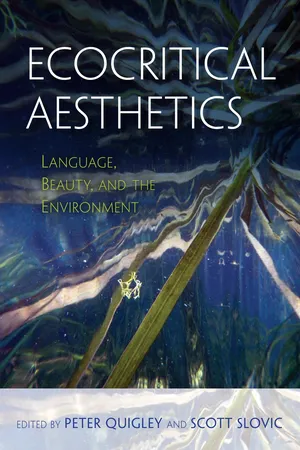
This lively collection of essays explores the vital role of beauty in the human experience of place, interactions with other species, and contemplation of our own embodied lives. Devoting attention to themes such as global climate change, animal subjectivity, environmental justice and activism, and human moral responsibility for the environment, these contributions demonstrate that beauty is not only a meaningful dimension of our experience, but also a powerful strategy for inspiring cultural transformation. Taken as a whole, they underscore the ongoing relevance of aesthetics to the ecocritical project and the concern for beauty that motivates effective social and political engagement.
eBook - ePub
Ecocritical Aesthetics
Language, Beauty, and the Environment
- 256 pages
- English
- ePUB (mobile friendly)
- Available on iOS & Android
eBook - ePub
Ecocritical Aesthetics
Language, Beauty, and the Environment
About this book
Information
Topic
PhilosophySubtopic
Aesthetics in PhilosophyPART 1
THE RELEVANCE OF BEAUTY
CHAPETR 1
“IT IS OUT OF FASHION TO SAY SO”
THE LANGUAGE OF NATURE AND THE RHETORIC OF BEAUTY IN ROBINSON JEFFERS
TIM HUNT
IN HIS 1914 ESSAY “Vorticism,” Ezra Pound explains that “In a Station of the Metro” was initially “a thirty-line poem,” which he “destroyed … because it was what we call a work ‘of secondary intensity.’” He then, he notes, “made” from it “a poem half that length” and finally distilled that into the two-line imagist jewel so frequently anthologized. For Pound, “the ‘one image poem,’” by setting “one idea … on top of another,” offered him a way “out of the impasse in which I had been left by my metro emotion” (89).1 The year and a half that Pound reports that it took him to fashion “In a Station of the Metro” illustrates his meticulous craftsmanship, but what matters for this discussion is how he characterizes his “metro emotion,” in these comments, as merely the ore from which the precious metal of the poem is to be smelted: “In a poem of this sort one is trying to record the precise instant when a thing outward and objective transforms itself, or darts into a thing inward and subjective” (89). When this happens, it seems, the dialectic of the merely “objective” (the world out there) and the merely “subjective” (the accidental matters of personality and experience), which are the “being about” that characterizes “secondary intensity,” are thereby transcended, transfiguring the referentiality of “secondary intensity” into the primary intensity of the fully aesthetic. To Pound, it seems, “In a Station of the Metro” is neither a beautifully crafted comment on reality nor a beautifully crafted act of self-reflection or self-expression. It is, instead, itself beauty and itself a reality; it has been derived from the initiating experience or its subjective dynamics but is no longer bound to either. For Pound, “In a Station of the Metro” ceases to be a poem of secondary intensity when it is liberated from its occasion and thereby ceases to be a comment on its origin or a mere reflection of it and becomes, instead, through the poet’s craft and genius, its own reality—an aesthetic and (thereby?) self-authenticating reality.2
Neither Pound nor “In a Station of the Metro” are the focus here, nor are the various critical paradigms of his era and ours that would see his comments as self-evident and synonymous with “poetry.” But his comments offer a productive contrast to an early remark of Robinson Jeffers from an unused preface dated “June, 1922”: “The poet is not to make beauty but to herald beauty; and beauty is everywhere; it needs only senses and intelligence to perceive it” (4: 374). This remark helps delineate the fundamental division between Jeffers and his modernist contemporaries. For Jeffers, beauty is necessarily outside the poem. The poet, by being able to respond to beauty, is able to construct a poem that “heralds” beauty, and the poem thereby offers the reader a way to “perceive” the beauty to which the poem is witness but which the poem does not and cannot contain. In Jeffers’s view the “objective” and the “subjective” are not transformed into the poem, which then both contains and escapes them in transforming them. Instead, the poem provides a means to move from the subjective to a heightened awareness of the redemptive beauty of the objective, which is necessarily prior to, subsequent to, and beyond the poem. The poem enacts a subjective engagement of the world beyond the poet and the poem, and this engagement enables a heightened awareness of nature (an “objective”) that is validated by nature’s perceived beauty. Jeffers, that is, imagines the poem as, for the poet, an act (even more a process) of witness and thereby as, for the reader, a means of witness. As such, his poems aim at being (and, from Pound’s perspective, are necessarily) works of secondary intensity.
That Jeffers’s poems can be seen as works of secondary intensity has contributed to his frequent critical dismissal. If his poems are about things, if they are comments on them, and if they are (worst of all) discursive and rhetorical, then they have failed to transcend their “objective” and “subjective” origins, and they have, thus, failed as well at being poems—or at least good or significant poems. While it is true that Jeffers “failed” at being Pound (or Eliot, for that matter), what has been insufficiently understood is that he was not concerned with transcending (in the sense of escaping) what Pound would see as the objective and subjective, but was forgoing such transcendence (the transcendence of the aesthetic object, the beauty of the “well-wrought urn”) in order to engage the objective and subjective and determine, by exploring the terms of their interplay, the nature of beauty and its meaning for the regarding self. That Jeffers’s poems are at least in part reflections on our relationship to nature helps explains why his work has interested those concerned with environmental literature, in spite of the way his emphasis on the beauty of nature risks converting the physical world, the environment, into an aesthetic category.
Jeffers’s late lyric “The Ocean’s Tribute” (especially if considered in the context of its preliminary workings) helps clarify both his oppositional relationship to his modernist contemporaries and the significance of beauty for his environmental poetics. The poem, I’d also suggest, implicitly functions as an argument for the necessity of secondary intensity if poetry is to matter for our participation in the natural world that is, after all, the basis of our being.
✳ ✳ ✳
Published as a broadside by the Grabhorn Press in 1958, “The Ocean’s Tribute” is a seemingly casual, even naïve, piece that can be read as little more than a conventional celebration of a conventional scene using the typical details of a sunset—“purple cloud, and the pink rose-petals over all and through all”—to validate the claim of “very beautiful.” The poem, though, is both richer and literarily more ambitious than its simple surface suggests. Moreover, it demonstrates something of how Jeffers understood the triad—the trinity?—of art, beauty, and why “beauty” is fundamental to both his aesthetic project and his environmental vision.
The conversational tone and pacing of “The Ocean’s Tribute” suggest that it is simply a casual, offhand moment of observation awaiting the better making of an Ezra Pound so that “a thing outward and objective” might be “transform[ed]” into “a thing inward and subjective”:
Yesterday’s sundown was very beautiful—I know it is out of fashion to say so, I think we are fools
To turn from the superhuman beauty of the world and dredge our own minds—it built itself up with ceremony
From the ocean horizon, smoked amber and tender green, pink and purple and vermilion, great ranks
Of purple cloud, and the pink rose-petals over all and through all; but the ocean itself, cold slate-color,
Refused the glory. Then I saw a pink fountain come up from it,
A whale-spout; there were ten or twelve whales quite near the deep shore, playing together, nuzzling each other,
Plunging and rising, lifting luminous pink pillars from the flat ocean to the flaming sky. (3: 439)
That this “Tribute” is “out of fashion” is evident both in its occasion (a sunset) and how the rhetorical declaration that bridges the first two lines seemingly casts it as merely an illustration of an abstract proposition. Any self-respecting New Critic of the era would, clearly, dismiss the poem for failing to rise above secondary intensity. However, the sketch from which Jeffers derived the first two-thirds of the poem suggests that this failure to transcend secondary intensity was, in part, the point, and that he was not simply failing to write an imagist masterwork but openly rejecting the aesthetic paradigm of modernism in order to aim at something quite different:
I was admiring a magnificent sundown—it is not done now but I do it, I think we are fools
If we refuse the inhuman beauty, to chase our own minds and make quotations—or abstractions,
Which are meaner and easier—it builded itself, purple and gold, pink, green and apricot, and the great sculpture,
Of purple clouds flying northward rank above rank and the pink rose-petals over all, and a scythe moon
Caught in the glory. But the ocean below, dull slate-color,
Denied the light. I saw a pink fountain come up,
A whale-spout (5: 890)
In the completed poem, “it is out of fashion to say so” functions implicitly as a rejection of modernist poetics and the critical orthodoxy of mid-century derived and elaborated from it. The equivalent unit in this initial sketch makes that rejection explicit. The speaker is not merely noticing a sunset, nor simply praising it. He is, instead, actively engaging it. And such “admiring” of nature’s “inhuman beauty” stands as the opposite of “mak[ing] quotations” and “abstractions”; it is a rejection of such making. The speaker in this initial draft is the opposite of those who “chase” their “own minds” because they “refuse the inhuman beauty” and end up reduced to the inauthenticity of merely following “fashion.”
Were “The Ocean’s Tribute” primarily a critique of modernist poetics (or perhaps more specifically the critical “fashion” derived from it, which, at midcentury, had contributed to the eclipse of Jeffers’s reputation), the poem would be of some interest as a polemic. But in both the initial sketch and the completed poem, the polemical gesture is a parenthetical that contextualizes what follows rather than being either the poem’s central action or its point. The polemical impulse, as an initial reaction to the recognition of beauty in nature, initiates the poem’s imaginative and aesthetic action, not because the poem is to celebrate the sunset as a kind of coded criticism of modernism but because the impulse to polemic is something to be overcome by turning away from “fashion” (and the concern with recognition and status it implies) in order to turn to “admiring” the “inhuman” and “superhuman” world—both by means of (through) its “beauty” and for its “beauty.” The poem, then, is neither a critique of modernism (though such a critique is present) nor a landscape painting in words—a celebration of a particular sunset. Instead, it is (in spite of its brevity) a dramatic piece in which the tension between the impulse to celebrate the sunset and the recognition that this “is not done now” drives the assertion that “I [still] do it,” which in turn drives the desire (need) to reconnect the inhuman and the superhuman by “admiring.” As such, the admiring is both the action generating the poem and what the poem does. And as such, the dramatic presentation of admiring (engaging through admiring) that follows the parenthetical yields a poem—and a poetics—in which the poem is a record of the process of perceiving, engaging, and responding to an occasion (through aesthetic awareness) rather than an aesthetically crafted object that transcends the engagement that might have occasioned it (and which is validated through the skill of its making and the degree to which the realized work subsumes, even consumes, its occasion and occasioning).
“The Ocean’s Tribute” is not, then, a conventional description of a sunset. Rather, it is an enactment of an aesthetic process. And the poem, through this enactment, demonstrates not only that the sunset is “beautiful” but also that actively “admiring” (engaging) such phenomena as sunsets to perceive beauty establishes that beauty is beyond fashion. In the poem, beauty is not merely something decorative the artist ascribes to reality or something the artist fashions through his or her artistry. Instead, beauty is fundamental to the self’s relationship to nature, to reality, and it is, and crucially so, redemptive.
* * *
The way the finished version of “The Ocean’s Tribute” functions as a dramatized enactment of consciousness is perhaps clearer if one considers why Jeffers might have broken off the initial sketch to start the poem over. In the initial sketch, the speaker is characterizing what he has seen—and admired—in order to support the assertion that “we are fools” if we “chase our own minds” instead of focusing on the “inhuman beauty.” The key to how the description functions in this preliminary attempt at the poem is the word “glory” in the fifth line: “a scythe moon / Caught in the glory.” Here, “glory” characterizes the details of the sunset which the speaker has been presenting and through which he perceives the “scythe moon.” Functioning as a kind of summary or recapitulation, “glory” is more literal (the matrix of light and color) than it is figural (glory as an exalting, a divine splendor). And this literal dimension of “glory” as light, in turn, controls the next sentence: “But the ocean below, dull slate-color, / Denied the light.”
In the fragment, the figural possibilities of “glory” are occasioned by the literal features of nature (in this case the lights and colors of the sunset) but are not actually part of nature. The speaker, that is, can cast natural light metaphorically as “glory,” but the light of nature is simply light, whatever beauty we may ascribe to it. As such, the ocean can deny neither the actuality of light nor its glory, and this reduces the claim (“the ocean … Denied the light”) to an allegorical construction. It reflects the speaker’s efforts to project a significance for nature through the drama he invents for it. The claim reflects the speaker’s desire to participate in nature, but the drama exists only in the speaker’s “own mind” rather than in (or as) the “inhuman beauty” (Jeffers 5: 890). Having set out to reject “abstractions” as “meaner and easier,” the logic of the speaker’s relationship to the scene he remembers and constructs for the reader traps him into figuring the “inhuman” as a humanized allegory—an abstraction.
In developing the completed poem from the preliminary draft, Jeffers subtly but decisively alters the speaker’s relationship to beauty and nature. Exchanging “inhuman beauty” (in the fragment) for “superhuman beauty” (in the completed poem) is one element of this. Characterizing nature as “inhuman beauty” projects it as a nonhuman object for human contemplation. Characterizing nature as “superhuman” recasts it as a potentially transcendent, comprehensive being, which contains the human as an element within it. As such, nature (here the sunset) shifts from being something that happens to elicit “admiring” to something that is, instead, a dynamic reality that can be contemplated—and implicitly worshipped. In the initial fragment nature is a “great sculpture”—a structure. In the completed poem, it is a “ceremony” enacting itself—a process. The former invites (aesthetic) awareness; the latter invites worshipful participation. In the fragment, that is, affirming the sunset’s beauty (and rejecting the modernist paradigm) leads to the more passive (and conventional) act of using the imagination to celebrate nature for its beauty. In the completed poem, rejecting the modernist move of “dredg[ing] our own minds” leads to the more active (and radical) move of using perception, extended through imagination, to recognize nature as process (ceremony) rather than object, and then, through perception and imagination, to participate in the “ceremony” through the parallel (but lesser) process of building up the poem in parallel to nature building up the sunset. In the finished version, the poem, thus, is not only an affirmation of “glory” but also a means by which the speaker (and potentially the reader) participate in it. As such, the poem becomes a part of the celebration. And even though nature necessarily transcends the poem and remains beyond it, the speaker (as actively contemplating awareness) and the reader are drawn into the ceremony through the poem. In “The Ocean’s Tribute,” then, engaging nature through creative awareness leads to the poem as a record of creative engagement, which in turn the reader can use as a script with which to engage nature.
By casting the sunset as a “ceremony” that nature itself enacts (or that God enacts through nature) instead of treating the sunset as “the great sculpture,” Jeffers, in effect, reverses the logic of Pound’s operation of distilling the “secondary intensity” of his “metro emotion” into “In a Station of the Metro.” Where Pound tries “to record the precise instant when a thing outward transforms itself, or darts into a thing inward and subjective,” Jeffers tries to enact (and record) the process by which the contemplating figure of the poet moves beyond the inwardness of the subjective in order to participate in the “superhuman beauty” that contains, but necessarily transcends and outstrips, the perceiving self. In Jeffers, consciousness, “a thing inward,” is drawn “outward,” and the poem both records that process and provides a script for it. As such, the poem must be of secondary intensity because, for Jeffers, it is most fully and powerfully a poem when it is about something rather than when it is being something. And this, I’d suggest, further ...
Table of contents
- Cover
- Title Page
- Copyright
- Contents
- Acknowledgments
- Introduction
- Part 1. The Relevance of Beauty
- Part 2. Beauty and Engagement
- Part 3. Materiality, Transcendence, and Aesthetics
- Index
Trusted by 375,005 students
Access to over 1.5 million titles for a fair monthly price.
Study more efficiently using our study tools.
Frequently asked questions
Yes, you can cancel anytime from the Subscription tab in your account settings on the Perlego website. Your subscription will stay active until the end of your current billing period. Learn how to cancel your subscription
No, books cannot be downloaded as external files, such as PDFs, for use outside of Perlego. However, you can download books within the Perlego app for offline reading on mobile or tablet. Learn how to download books offline
Perlego offers two plans: Essential and Complete
- Essential is ideal for learners and professionals who enjoy exploring a wide range of subjects. Access the Essential Library with 800,000+ trusted titles and best-sellers across business, personal growth, and the humanities. Includes unlimited reading time and Standard Read Aloud voice.
- Complete: Perfect for advanced learners and researchers needing full, unrestricted access. Unlock 1.5M+ books across hundreds of subjects, including academic and specialized titles. The Complete Plan also includes advanced features like Premium Read Aloud and Research Assistant.
We are an online textbook subscription service, where you can get access to an entire online library for less than the price of a single book per month. With over 1.5 million books across 990+ topics, we’ve got you covered! Learn about our mission
Look out for the read-aloud symbol on your next book to see if you can listen to it. The read-aloud tool reads text aloud for you, highlighting the text as it is being read. You can pause it, speed it up and slow it down. Learn more about Read Aloud
Yes! You can use the Perlego app on both iOS and Android devices to read anytime, anywhere — even offline. Perfect for commutes or when you’re on the go.
Please note we cannot support devices running on iOS 13 and Android 7 or earlier. Learn more about using the app
Please note we cannot support devices running on iOS 13 and Android 7 or earlier. Learn more about using the app
Yes, you can access Ecocritical Aesthetics by Peter Quigley, Scott Slovic, Peter Quigley,Scott Slovic in PDF and/or ePUB format, as well as other popular books in Philosophy & Aesthetics in Philosophy. We have over 1.5 million books available in our catalogue for you to explore.