eBook - ePub
Available until 23 Dec |Learn more
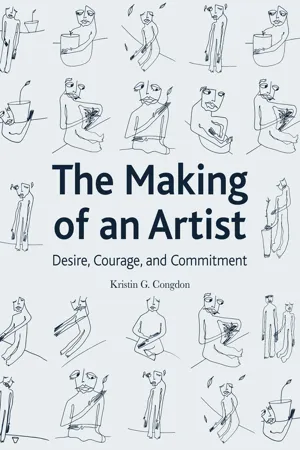
The Making of an Artist
Desire, Courage, and Commitment
This book is available to read until 23rd December, 2025
- 256 pages
- English
- ePUB (mobile friendly)
- Available on iOS & Android
eBook - ePub
Available until 23 Dec |Learn more
About this book
What drives an artist to create? And are there common traits that successful artists possess? In The Making of an Artist, Kristin G. Congdon draws on her years of studying and teaching art at all levels – from universities to correctional settings – to identify three traits that are regularly found in successful artists: desire, courage and commitment. In this collection Congdon explores each of those traits, as well as giving ethnographic case studies of six visual artists from diverse backgrounds and locations whose practices embody them. Marrying the work of biography, journalism, sociology and psychology, the book opens up the often mysterious process of making art, showing us how those characteristics play into it, as well as how other factors, such as trauma, madness, class and gender, affect the ways that people approach the creative process.
Powerfully insightful and fully accessible, The Making of an Artist will be an invaluable resource for practicing artists, those just setting out on artistic careers, and art teachers alike.
Powerfully insightful and fully accessible, The Making of an Artist will be an invaluable resource for practicing artists, those just setting out on artistic careers, and art teachers alike.
Frequently asked questions
Yes, you can cancel anytime from the Subscription tab in your account settings on the Perlego website. Your subscription will stay active until the end of your current billing period. Learn how to cancel your subscription.
No, books cannot be downloaded as external files, such as PDFs, for use outside of Perlego. However, you can download books within the Perlego app for offline reading on mobile or tablet. Learn more here.
Perlego offers two plans: Essential and Complete
- Essential is ideal for learners and professionals who enjoy exploring a wide range of subjects. Access the Essential Library with 800,000+ trusted titles and best-sellers across business, personal growth, and the humanities. Includes unlimited reading time and Standard Read Aloud voice.
- Complete: Perfect for advanced learners and researchers needing full, unrestricted access. Unlock 1.4M+ books across hundreds of subjects, including academic and specialized titles. The Complete Plan also includes advanced features like Premium Read Aloud and Research Assistant.
We are an online textbook subscription service, where you can get access to an entire online library for less than the price of a single book per month. With over 1 million books across 1000+ topics, we’ve got you covered! Learn more here.
Look out for the read-aloud symbol on your next book to see if you can listen to it. The read-aloud tool reads text aloud for you, highlighting the text as it is being read. You can pause it, speed it up and slow it down. Learn more here.
Yes! You can use the Perlego app on both iOS or Android devices to read anytime, anywhere — even offline. Perfect for commutes or when you’re on the go.
Please note we cannot support devices running on iOS 13 and Android 7 or earlier. Learn more about using the app.
Please note we cannot support devices running on iOS 13 and Android 7 or earlier. Learn more about using the app.
Yes, you can access The Making of an Artist by Kristin G. Congdon in PDF and/or ePUB format, as well as other popular books in Art & Art General. We have over one million books available in our catalogue for you to explore.
Information
CHAPTER 1
Education
School’s been blown to bits.
Artists respond to their formal educations positively and negatively, and sometimes somewhere in between. Artists with formal educations often refer to themselves as being self-taught, dismissing the influence of their teachers. Artists who do not have a formal education in the arts often embrace the fact that they figured things out for themselves. Everyone recognizes that formal education is but one way in which artists become educated. These facts raise questions and challenges for educators. Are art schools educating artists well? What are they doing right and what could they do better? And how is it that artists without formal educations become good artists?
Ben Davis notes that each generation of artists since the 1950s has been increasingly tethered to academia. So many people have MFAs these days that a Ph.D. is currently being pitched as a way for artists to rise above the sea of graduates.2 Many artists will tell you that graduate education in the arts may be a way to learn skills, but it is more so a way to secure college or art school teaching jobs. Getting a graduate degree does not necessarily lead the way to becoming a successful practicing artist. However, many would-be artists still act as though schooling is the primary route to take if one wants a life centered in creative expression. They recognize that the G.I. Bill3 was extremely helpful in educating many artists (including Ellsworth Kelly, Richard Diebenkorn, Kenneth Noland, Robert Rauschenberg, Romare Bearden, Leon Golub, Norman Bluhm, Robert Colescott, Philip Pearlstein, and Larry Rivers).4 But the question remains (especially in today’s artistic and educational climate): how important is a formal education for the artist?
Academics
Daniel Joseph Martinez, recognizing the considerable level of enrollment in art programs in 2005, phrases the question differently: “I wonder if the popularity of art schools suggests that the way you become an artist is by going to school?”5 This question is repeatedly raised as tuition rises, education becomes more factory-like, and innovation, risk, and playfulness are less welcome in the classroom.
Universities, for example, have become so managerial, with the idea of play almost obsolete, that David J. Siegel asks if anarchy can save the university. He cites the increase in intellectual efforts that now go into ubiquitous conversations on costs, credit-hour production, and graduation rates. He writes:
The ranks of nonacademic administrative and professional staff members more than doubled from 1987 to 2012, according to the New England Center for Investigative Reporting and the American Institutes for Research, while tenured and tenure-track faculty positions are rapidly yielding to a contingent work force.6
As universities and colleges have become more institutionalized and hierarchal, so too have those who teach and study in them. Play becomes stifled, a sense of freedom is diminished, and the creative spirit has little room to explore.7 Likewise, anthropologist David Graeber blames the lack of creativity in today’s universities on the ubiquitous bureaucracy that overrides most everything: “If I were to generalize, I would say that what we see is a university system which mitigates against creativity and any form of daring.”8
Moreover, the control of corporations and legislators is increasing in educational institutions. Gordon Lafer reports that the Kansas Board of Regents has weakened academic freedom “by deciding that faculty members can be fired for social-media comments deemed ‘contrary to the best interests of the university.’”9 The Governor of Florida has proposed that differential tuition should be employed at state universities, raising fees on the humanities while keeping them lower for computer science and business majors. And across the United States, online courses costing less than $10,000 are proliferating based on legislative demands. Lafer claims these efforts are well-coordinated, coming from the nation’s premier corporate lobbies.10 Minority voices are muffled and the majority suffers from missing out on hearing diverse voices. Sameness and predictability are becoming the norm, characteristics especially detrimental to the art student.
For Nigerian-born, US-educated Ojih Odutola, this sameness meant challenging how her art program taught blackness: “Art professors don’t know how to read blackness – as a color, a material, a concept, a tool. We know all about light, contrast, rendition. Why can’t we apply that to the black surface?”11
According to Adam Grant, child prodigies rarely change the world. They may do well in school, but they do not do any better in their adult lives than less precocious children from families of similar means. The most creative children are the ones that are less likely to be teachers’ pets. In fact, teachers tend to discriminate against those children who demonstrate highly creative behaviors. Furthermore, creative children do not worry too much about being non-conformists like their peers tend to do. Grant writes: “They’re programmed to be iconoclasts, rebels, revolutionaries, troublemakers, mavericks, and contrarians who are impervious to fear, rejection, and ridicule.”12 These children end up having strong opinions about institutional education that can continue into adulthood.
We can also look to other artists who have strong opinions about institutional education. Ai Weiwei dislikes academia more than officialdom.13 And Dave Hickey, who was eventually removed from his teaching position at the University of Las Vegas, claims that students who weren’t already artists got nothing from his classes. Although his colleagues asked him to encourage critical thinking and self-awareness in his teaching, he resisted. In fact, he maintained that art students were far more apt to get recognition as artists if they didn’t go to graduate school. If you do go, he contended, you should bring your own ideas and culture with you and work from that.14 Although he spent ten years as a university art professor teaching, he slams the institution:
My optimum solution would be to abolish graduate studies in art altogether. Failing this, one might just avoid it. Try the late Michael Balog’s solution: make surfboards that are better than art then make art like that. Try Raymond Pettibon’s trajectory: grow up in a literary family in a beach house full of books, get a degree in economics, teach math, draw posters for your brother’s band [Black Flag], hang out, and get discovered. Or Josiah McElheny’s trajectory: study anthropology, become interested in single-source traditions like glassblowing, go to Italy and study that tradition, learn to blow glass from the masters, and start making art. Or, as a last resort, try the solution my classmate Gilbert Shelton fell upon. Gilbert and his crew went up to the art department at the University of Texas every day and painted Abstract Expressionism. Every night, they came home to draw posters and underground comic books. When they had enough pages, they founded Zap Comix and moved to San Francisco. Finally, they moved to Paris, where they still draw comics.15
In keeping with this line of thinking, Ken Robinson believes everyone is born with immense natural talents that are rarely realized. He claims that one reason for “this massive waste of talent is the very process that is meant to develop it: education.”16
Nancy Andreasen, who has studied creative individuals for several decades, finds that artists are autodidacts, and that for them, university systems can be limiting. One reason is that would-be artists enjoy teaching themselves and like to study more than one subject. In universities, a student is generally forced to focus on one or two subjects. She notes that George Lucas, who was awarded both the National Medal of Arts in 2012 and the National Medal of Technology in 2004, has interests in many areas of study, including anthropology, architecture, interior design, history, sociology, neuroscience, literature, and digital technology. Andreasen concludes that the usual academic path of selecting either the arts or the sciences as an area of expertise may be a serious mistake.17 Increasingly, artists are working to heal the environment (for example, Mel Chin, and Newton and Helen Mayer Harrison), and hundreds of artists are working with new technology to discover what it can do to enhance their artwork. There can’t be, and should not be, any limits to what artists study.
It is no secret that all levels of modern education are in some kind of crisis, with education in the arts in particular turmoil. Holland Cotter, in his excellent New York Times article “Lost in the Gallery-Industrial Complex” (2014), makes the connection between money, art, and education, lamenting the fact that today’s artists and educators are far too involved in the “money game”, which controls all aspects of art. His assessment is that art schools are too accommodating to the art market and its “caste-system values”: “Programs are increasingly specialized, jamming students into ever narrower and flakier disciplinary tracks. Tuitions are prodigious, leaving artists indentured to creditors for years.”18 He wonders how innovation can take place in such an environment:
How confidently can they [students] take risks in an environment that acknowledges only dollar-value success? How can they contemplate sustaining […] long and evolving creative careers? The temptation for many artists, after a postgraduate spurt of confidence, is to look around, see what’s selling, and consider riffing on that.19
While he acknowledges that he may be exaggerating, Cotter asks that students be taught the inseparable connection between art and politics, thereby returning art from what he calls “the brink of inconsequence.”20
Cotter’s disappointment in the way the United States (and I would extend his laments to other parts of the western world) now regards art can be extended to the humanities. In 2013, then Governor of North Carolina, Pat McCrory, threatened to cut funding to the University of North Carolina at Chapel Hill, suggesting that disciplines like gender studies should not be taught in a public university; the focus should instead be placed on practical matters and jobs training.21 (It is distressing to note that other governors and politicians have followed suit.) According to Kristen Case, McCrory implies that students should not think about “imagining their lives because their lives have already been imagined for them.”22
It is notable how many artists talk about receiving their best lessons from experiences outside school. Additionally, many artists have had little to no formal art training at all. And studying the arts in college, as everyone knows, doesn’t ensure a career in the arts.
Truthfully, even decades ago, academic organizations seemed rigid and unwelcoming to many creative people, including researchers in the arts. The fiery ethnomusicologist Alan Lomax wrote to Jack Harrison of the humanities division of the Rockefeller Foundation in 1962, justifying why he had not enrolled in graduate school:
I had come to feel strongly that big institutions often kill good research. Those long corridors, those administrative routines, those bloodless and vicious battles of grades and positions, the weariness of institutional lunches, especially the heavy and puritanical atmosphere that somehow pervades many places – all this combined to stifle the imagination and the impulse to work hard and the freedom to enjoy the work. I resolved to be as unbuttoned as possible during my brief stint of cooperative research and to make the standard of the job that everybody enjoys himself.23
Because creative people are divergent and unorthodox thinkers,24 they often do not fit into factory-like education systems. It can take hard work on a student’s part to find inspiration in academia. Although sculptor Rachel Harrison dropped out of Wesleyan University, where she was study...
Table of contents
- Cover Page
- Copyright
- Title Page
- Introduction
- Chapter 1: Education
- Chapter 2: Desire
- Chapter 3: Flo Oy Wong
- Chapter 4: The Highwaymen
- Chapter 5: Courage
- Chapter 6: Richard Brown
- Chapter 7: Asma M Alahmad
- Chapter 8: Commitment
- Chapter 9: Erick Wolfmeyer
- Chapter 10: Catherine Beaudette
- Chapter 11: Teaching
- Notes
- Bibliography
- Acknowledgments
- Index