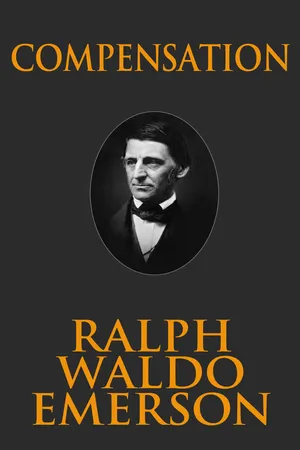
Emerson's discourse on the laws of compensation, takes on the notion that one who has money must be wicked and those who do not must be good, among other topics. It appeared in his book Essays, first published in 1841.
- 40 pages
- English
- ePUB (mobile friendly)
- Available on iOS & Android
eBook - ePub
Compensation
About this book
Information
Subtopic
Literary EssaysIndex
LiteratureCompensation 93
The wings of Time are black and white,
Pied with morning and with night.
Mountain tall and ocean deep
Trembling balance duly keep.
In changing moon, in tidal wave,
Glows the feud of Want and Have.
Gauge of more and less through space
Electric star and pencil plays.
The lonely Earth amid the balls
That hurry through the eternal halls,
A makeweight flying to the void,
Supplemental asteroid,
Or compensatory spark,
Shoots across the neutral Dark.
Pied with morning and with night.
Mountain tall and ocean deep
Trembling balance duly keep.
In changing moon, in tidal wave,
Glows the feud of Want and Have.
Gauge of more and less through space
Electric star and pencil plays.
The lonely Earth amid the balls
That hurry through the eternal halls,
A makeweight flying to the void,
Supplemental asteroid,
Or compensatory spark,
Shoots across the neutral Dark.
Man's the elm, and Wealth the vine,
Stanch and strong the tendrils twine;
Through the frail ringlets thee deceive,
None from its stock that vine can reave.
Fear not, then, thou child infirm,
There's no god dare wrong a worm.
Laurel crowns cleave to deserts,
And power to him who power exerts;
Hast not thy share? On winged feet,
Lo! it rushes thee to meet;
And all that Nature made thy own,
Floating in air or pent in stone,
Will rive the hills and swim the sea,
And, like thy shadow, follow thee.
Stanch and strong the tendrils twine;
Through the frail ringlets thee deceive,
None from its stock that vine can reave.
Fear not, then, thou child infirm,
There's no god dare wrong a worm.
Laurel crowns cleave to deserts,
And power to him who power exerts;
Hast not thy share? On winged feet,
Lo! it rushes thee to meet;
And all that Nature made thy own,
Floating in air or pent in stone,
Will rive the hills and swim the sea,
And, like thy shadow, follow thee.
Ever since I was a boy, I have wished to write a discourse on Compensation: for it seemed to me when very young, that on this subject life was ahead of theology, and the people knew more than the preachers taught. The documents,94 too, from which the doctrine is to be drawn, charmed my fancy by their endless variety, and lay always before me, even in sleep; for they are the tools in our hands, the bread in our basket, the transactions of the street, the farm, and the dwelling-house, greetings, relations, debts and credits, the influence of character, the nature and endowment of all men. It seemed to me, also, that in it might be shown men a ray of divinity, the present action of the soul of this world, clean from all vestige of tradition, and so the heart of man might be bathed by an inundation of eternal love, conversing with that which he knows was always and always must be, because it really is now. It appeared, moreover, that if this doctrine could be stated in terms with any resemblance to those bright intuitions in which this truth is sometimes revealed to us, it would be a star in many dark hours and crooked passages in our journey that would not suffer us to lose our way.
I was lately confirmed in these desires by hearing a sermon at church. The preacher, a man esteemed for his orthodoxy, unfolded in the ordinary manner the doctrine of the Last Judgment. He assumed that judgment is not executed in this world; that the wicked are successful; that the good are miserable;95 and then urged from reason and from Scripture a compensation to be made to both parties in the next life. No offense appeared to be taken by the congregation at this doctrine. As far as I could observe, when the meeting broke up, they separated without remark on the sermon.
Yet what was the import of this teaching? What did the preacher mean by saying that the good are miserable in the present life? Was it that houses and lands, offices, wine, horses, dress, luxury, are had by unprincipled men, whilst the saints are poor and despised; and that a compensation is to be made to these last hereafter, by giving them the like gratifications another day,—bank stock and doubloons,96 venison and champagne? This must be the compensation intended; for what else? Is it that they are to have leave to pray and praise? to love and serve men? Why, that they can do now. The legitimate inference the disciple would draw was: "We are to have such a good time as the sinners have now"; or, to push it to its extreme import: "You sin now; we shall sin by and by; we would sin now, if we could; not being successful, we expect our revenue to-morrow."
The fallacy lay in the immense concession that the bad are successful; that justice is not done now. The blindness of the preacher consisted in deferring to the base estimate of the market of what constitutes a manly success, instead of confronting and convicting the world from the truth; announcing the presence of the soul; the omnipotence of the will: and so establishing the standard of good and ill, of success and falsehood.
I find a similar base tone in the popular religious works of the day, and the same doctrines assumed by the literary men when occasionally they treat the related topics. I think that our popular theology has gained in decorum, and not in principle, over the superstitions it has displaced. But men are better than this theology. Their daily life gives it the lie. Every ingenuous and aspiring soul leaves the doctrine behind him in his own experience; and all men feel sometimes the falsehood which they cannot demonstrate. Few men are wiser than they know. That which they hear in schools and pulpits without afterthought, if said in conversation, would probably be questioned in silence. If a man dogmatize in a mixed company on Providence and the divine laws, he is answered by a silence which conveys well enough to an observer the dissatisfaction of the hearer, but his incapacity to make his own statement.
I shall attempt in this and the following chapter to record some facts that indicate the path of the law of Compensation; happy beyond my expectation, if I shall truly draw the smallest arc of this circle.
Polarity,97 or action and reaction, we meet in every...
Table of contents
- Title
- About Ralph Waldo Emerson
- Compensation
- Notes
Trusted by 375,005 students
Access to over 1.5 million titles for a fair monthly price.
Study more efficiently using our study tools.
Frequently asked questions
Yes, you can cancel anytime from the Subscription tab in your account settings on the Perlego website. Your subscription will stay active until the end of your current billing period. Learn how to cancel your subscription
No, books cannot be downloaded as external files, such as PDFs, for use outside of Perlego. However, you can download books within the Perlego app for offline reading on mobile or tablet. Learn how to download books offline
Perlego offers two plans: Essential and Complete
- Essential is ideal for learners and professionals who enjoy exploring a wide range of subjects. Access the Essential Library with 800,000+ trusted titles and best-sellers across business, personal growth, and the humanities. Includes unlimited reading time and Standard Read Aloud voice.
- Complete: Perfect for advanced learners and researchers needing full, unrestricted access. Unlock 1.5M+ books across hundreds of subjects, including academic and specialized titles. The Complete Plan also includes advanced features like Premium Read Aloud and Research Assistant.
We are an online textbook subscription service, where you can get access to an entire online library for less than the price of a single book per month. With over 1.5 million books across 990+ topics, we’ve got you covered! Learn about our mission
Look out for the read-aloud symbol on your next book to see if you can listen to it. The read-aloud tool reads text aloud for you, highlighting the text as it is being read. You can pause it, speed it up and slow it down. Learn more about Read Aloud
Yes! You can use the Perlego app on both iOS and Android devices to read anytime, anywhere — even offline. Perfect for commutes or when you’re on the go.
Please note we cannot support devices running on iOS 13 and Android 7 or earlier. Learn more about using the app
Please note we cannot support devices running on iOS 13 and Android 7 or earlier. Learn more about using the app
Yes, you can access Compensation by Ralph Waldo Emerson in PDF and/or ePUB format, as well as other popular books in Literature & Literary Essays. We have over 1.5 million books available in our catalogue for you to explore.