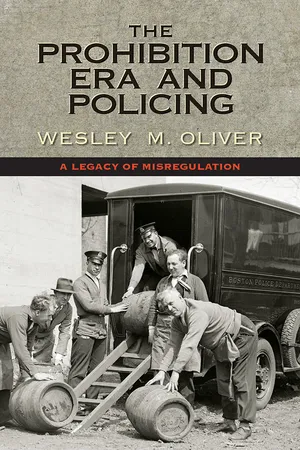
Legal precedents created during Prohibition have lingered, leaving search-and-seizure law much better defined than limits on police use of force, interrogation practices, or eyewitness identification protocols. An unlawful trunk search is thus guarded against more thoroughly than an unnecessary shooting or a wrongful conviction.Intrusive searches for alcohol during Prohibition destroyed middle-class Americans' faith in police and ushered in a new basis for controlling police conduct. State courts in the 1920s began to exclude perfectly reliable evidence obtained in an illegal search. Then, as Prohibition drew to a close, a presidential commission awakened the public to torture in interrogation rooms, prompting courts to exclude coerced confessions irrespective of whether the technique had produced a reliable statement.Prohibition's scheme lingered long past the Roaring '20s. Racial tensions and police brutality were bigger concerns in the 1960s than illegal searches, yet when the Supreme Court imposed limits on officers' conduct in 1961, searches alone were regulated. Interrogation law during the 1960s, fundamentally reshaped by the Miranda ruling, ensured that suspects who invoked their rights would not be subject to coercive tactics, but did nothing to ensure reliable confessions by those who were questioned. Explicitly recognizing that its decisions excluding evidence had not been well-received, the Court in the 1970s refused to exclude identifications merely because they were made in suggestive lineups. Perhaps a larger project awaits—refocusing our rules of criminal procedure on those concerns from which Prohibition distracted us: conviction accuracy and the use of force by police.
- English
- ePUB (mobile friendly)
- Available on iOS & Android
eBook - ePub
About this book
Information
Topic
DirittoSubtopic
Procedura penalePART ONE
Urban Problems, the Invention of the Police as Regulators of Morality, and the Introduction of Modern Criminal Procedure
History matters a great deal to lawyers. Many of the rules that govern society, and certainly most of the rules that govern police, are found in legal precedents, which are essentially the results of past disputes. The US Supreme Court, in its criminal procedure decisions, has often expressed an almost religious faith in the decisions of judges during the Framing Era who defined the limits on constables and watchmen of the late eighteenth century.1 The police that the modern court regulates are, however, very different than the officers considered by judges deciding limits on constables in the 1700s. Additionally, the apparatus of criminal procedure that the Supreme Court must start with, as a result of principles of stare decisis, is one created in the early twentieth century, not the late eighteenth.
The rules that govern police practices as well as society and technology—and indeed police officers themselves—have changed many times over since the country was founded. Yet we have fundamentally revamped our rules of criminal procedure only once, in the early 1920s, the early years of Prohibition, and that outdated set of rules, thanks to the Warren Court, largely remains intact to this day. Prohibition itself transformed police regulation so radically because it reopened old wounds. Mid-nineteenth-century police departments created officers with powers the Founding Fathers could not have fathomed. These new powerful officers had barely gained the public’s acceptance when Prohibition required them to enforce a highly unpopular law and provided unethical officers opportunities for corruption on a scale larger than previously ever known.
To understand the misregulation of modern police, one must therefore understand the history of police and the historical efforts of the law to control their conduct. The law enforcement apparatus that existed in the 1700s would not remotely resemble modern police departments. As importantly, modern police departments could not imagine the very stringent Framing Era limitations placed on their authority. New, powerful police departments in the mid-1800s faced considerable resistance and efforts to restrict their authority but would gain acceptance by the end of the century. At the turn of the twentieth century, police enjoyed sufficient public trust that they were largely free from oversight and were essentially self-regulated. The unpopularity of Prohibition and the excesses of police in enforcing it then undermined the public’s faith in these officers and ushered in the judicial oversight of police departments with which we are familiar today.
Prohibition would create the system of police regulation for the following century, but the scheme of police regulation created during Prohibition did not occur in a vacuum. The lawless and violent actions of police during Prohibition followed decades of satisfying the public of the legitimacy of very powerful police and their competency to govern themselves. If Prohibition had been attempted in the 1820s, it would not have prompted extraordinary police reforms. Police officers had gone from strictly regulated “petty officers” in that late 1700s to law enforcement professionals in the early 1900s, answerable only to their superiors in the department. Their newly acquired powers doubtlessly played a role in the extent of offensive enforcement of the liquor laws in the 1920s—and the outrage from these excesses ushered in a new body of law we now know as constitutional criminal procedure. An understanding of the eighteenth- and early nineteenth-century history of American police is thus essential to understand that modern criminal procedure is largely a creature of America’s Noble Experiment to abolish alcohol.
1
FROM PETTY OFFICERS TO POWERFUL POLICE
Law enforcement officers had very limited authority and neither the legal authority, nor the social clout, to engage in investigations or even aggressively defend the peace in the colonial era and during the early American Republic, nor did they have any such authority until the mid-nineteenth century. Those familiar with colonial-era complaints about British rule will be surprised to learn that law enforcement officials in the colonial period and in the first decades of the country’s history were so powerless as to be ineffective and incapable of systemic abuses. This is, of course, surprising because one of the best-known complaints about British colonial rule involved searches by customs officers acting under the authority of writs of assistance.1 Customs agents, however, had unique powers and incentives before and after independence.2 Officers who policed early American cities and towns were, for all practical purposes, limited to assisting crime victims with the searches they requested to vindicate the wrongs done to them. Only with the rise of major cities and the problems that accompanied mid-nineteenth-century urbanization did law enforcement officers acquire the type of powers that customs agents had, and that modern-day officers possess.
The Incentives and Broad Powers of Early Customs Officers
Colonists’ complaints about British rule has left us familiar with the nation’s first search and seizure controversies. In 1760, colonial customs agents were given even broader powers than they traditionally possessed, making search and seizure law an issue in the struggles that led to independence. Writs of assistance authorized their bearers to search wherever they suspected for evidence of smuggled goods without requesting or receiving authorization from anyone. Unlike ordinary officers, customs agents ordinarily could and did seek warrants to search for evidence of violations prior to these writs. The writs eliminated the need to ever appear before a magistrate and seek authorization. As their name suggested, these authorizations further allowed customs officers to obtain assistance. Local law enforcement officers were required to aid in the search for goods smuggled into colonies.3
British customs agents in the colonies had strong incentives to aggressively use their right to search under these writs, and the colonists, or a certain prominent portion of the colonists, had a strong incentive to challenge the writs of assistance. Items smuggled into the colonies without the required taxes having been paid were forfeited to the Crown, and the customs agent received a portion of the value of the smuggled items.4 The British customs agents, unlike local law enforcement officers they pressed into service, had no allegiance to the colonists whose warehouses they searched. Finally, the smugglers that customs agents were investigating were among the most prominent citizens in the colonies, well equipped to hire excellent counsel. Many of the signers of the Declaration of Independence were smugglers. The most prominent of these revolutionary smugglers was John Hancock, the president of the Continental Congress that declared independence.5
The death of King George II provided an opportunity for Boston merchants to argue that the writs should not be reissued. When the famed colonial lawyer James Otis argued the case against the writs of assistance, John Adams was in the courtroom and observed that there the child of independence had been born. Wealthy Boston merchants were not only in a position to retain excellent counsel in 1760, but they would be at the forefront of leading the colonies into a bloody war to avoid the payment of minimal taxes and searches that revealed their violations of customs laws.6
Otis made an argument that would form the basis of objections to searches and seizures centuries later. He argued that these writs placed “the liberty of every man in the hands of every petty officer.”7 Otis lost his argument, and courts would retain the power to issue these warrants, but challenges to general warrants in England called into question warrants authorizing an officer to search anywhere his suspicions led. One such controversy gained considerable attention on both sides of the Atlantic. Warrants were issued in 1762 ordering the arrest of the publishers of an antigovernment pamphlet. A flamboyant member of Parliament, John Wilkes, made a career out of maligning the king’s ministers, and, in one installment of his weekly pamphlet North Briton Number 45, he attacked King George III himself. The warrant was problematic because it permitted the officer executing it to determine for himself who he believed to be the publisher. A number of persons were arrested under this warrant, and Wilkes’s house was thoroughly searched. In separate cases, English courts in 1763 found for those arrested—and searched and arrested in the case of Wilkes—concluding that such authority should not be given to officers. With these opinions, American colonial courts would no longer issue writs of assistance, reducing the discretion of customs officers from the absolute power they had to search, though they would retain substantial power not possessed by ordinary law enforcement officers.8
Following independence, customs officers would nevertheless retain powers and incentives to seek warrants that ordinary law enforcement officers would not possess. While these officers would not be given writs of assistance in the early American Republic, they would, like their British predecessors, be given a portion of the smuggled goods or untaxed liquor they discovered.9 The First Congress enacted a statute that allowed these officers to obtain a warrant to search any building by going to a magistrate and simply asserting he had adequate suspicion to search the building he identified in the application for the warrant.10 The Third Congress modified the warrant application process and required customs officers to provide the magistrate the facts that gave rise to his suspicions.11
These “petty officers” continued to have incentive and power to investigate crimes. Under either search standard, customs officers had an incentive to investigate a case and be allowed to obtain a warrant based on their suspicions alone. The unique status of these officials was in no small part attributable to the sparse criminal code of the time. Customs offenses were among the few victimless crimes in early America, and certainly the only ones that the government showed any degree of interest in routinely prosecuting.12
Investigation of Ordinary Crime in Early America by Victims, Not Officers
Ordinary law enforcement and custom enforcement in colonial and early America was as different as night and day. It is no more surprising that late eighteenth-century law enforcement officers were comfortably tolerated than it is that customs enforcement officers provoked outrage. Customs officers were highly incentivized to search. During the colonial era, royal officers had little reason to worry about offending those in the local community. Ordinary law enforcement officers were locals and had almost no incentive to investigate crimes. Even if they did, law, custom, and social standing ensured that their role would be extraordinarily limited.
Victims, not officers, investigated crimes, with minor assistance from officers, when the country was born.13 Prior to the mid-nineteenth century, there were virtually no victimless crimes—and the victims of the crimes themselves had to vindicate the wrongs done to them. Police departments, as we understand them today, did not exist. At the time of the country’s founding, law and practical realities converged to ensure that constables and watchmen would have very limited authority. Victims sought search warrants to recover stolen property (and thus identify the culprit) and arrest warrants that brought offenders before magistrates who interrogated the suspects much as modern detectives do. Of course, in some cases, the victim could not conduct the investigation, but even then the investigation was not done by professionals. Coroners, who were private citizens without any medical background, investigated homicides by convening inquests that looked much like modern grand juries, without the heavy-ha...
Table of contents
- Cover
- Title Page
- Copyright
- Dedication
- Contents
- Acknowledgments
- Introduction
- Part One. Urban Problems, the Invention of the Police as Regulators of Morality, and the Introduction of Modern Criminal Procedure
- Part Two. Prohibition and the Shift of Criminal Procedure from Ensuring Accurate Criminal Trials to Preventing Police Misconduct
- Part Three. Prohibition’s Legacy in the Warren Court and Beyond
- Part Four. Adapting Anachronistic Criminal Procedure
- Conclusion
- Notes
- Index
Trusted by 375,005 students
Access to over 1.5 million titles for a fair monthly price.
Study more efficiently using our study tools.
Frequently asked questions
Yes, you can cancel anytime from the Subscription tab in your account settings on the Perlego website. Your subscription will stay active until the end of your current billing period. Learn how to cancel your subscription
No, books cannot be downloaded as external files, such as PDFs, for use outside of Perlego. However, you can download books within the Perlego app for offline reading on mobile or tablet. Learn how to download books offline
Perlego offers two plans: Essential and Complete
- Essential is ideal for learners and professionals who enjoy exploring a wide range of subjects. Access the Essential Library with 800,000+ trusted titles and best-sellers across business, personal growth, and the humanities. Includes unlimited reading time and Standard Read Aloud voice.
- Complete: Perfect for advanced learners and researchers needing full, unrestricted access. Unlock 1.5M+ books across hundreds of subjects, including academic and specialized titles. The Complete Plan also includes advanced features like Premium Read Aloud and Research Assistant.
We are an online textbook subscription service, where you can get access to an entire online library for less than the price of a single book per month. With over 1.5 million books across 990+ topics, we’ve got you covered! Learn about our mission
Look out for the read-aloud symbol on your next book to see if you can listen to it. The read-aloud tool reads text aloud for you, highlighting the text as it is being read. You can pause it, speed it up and slow it down. Learn more about Read Aloud
Yes! You can use the Perlego app on both iOS and Android devices to read anytime, anywhere — even offline. Perfect for commutes or when you’re on the go.
Please note we cannot support devices running on iOS 13 and Android 7 or earlier. Learn more about using the app
Please note we cannot support devices running on iOS 13 and Android 7 or earlier. Learn more about using the app
Yes, you can access The Prohibition Era and Policing by Wesley M. Oliver in PDF and/or ePUB format, as well as other popular books in Diritto & Procedura penale. We have over 1.5 million books available in our catalogue for you to explore.