Die Studien zur Geschichte und Kultur des Vorderen Orients erscheinen als Supplement der Zeitschrift Der Islam, gegründet 1910 von Carl Heinrich Becker, einem der Väter der modernen Islamwissenschaft. Ganz im Sinne Beckers ist das Ziel der Studien die Erforschung der vergangenen Gesellschaften des Vorderen Orients, ihrer Glaubenssysteme und der zugrundeliegenden sozialen und ökonomischen Verhältnisse, von der Iberischen Halbinsel bis nach Zentralasien, von den ukrainischen Steppen zum Hochland des Jemen.
Über die grundlegende philologische Arbeit an der literarischen Überlieferung hinaus nutzen die Studien die archivalischen, sowie materiellen und archäologischen Überlieferungen als Quelle für die gesamte Bandbreite der historisch arbeitenden Geistes- und Sozialwissenschaften.
Beginnend mit Band 28 setzt SME die Reihe Studien zur Geschichte und Kultur des islamischen Orients / Studies in the History and Culture of the Islamic Orient (STIO) fort.
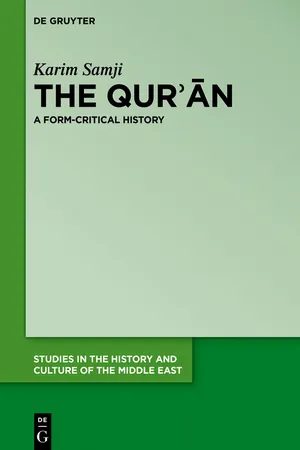
- 315 pages
- English
- ePUB (mobile friendly)
- Available on iOS & Android
eBook - ePub
About this book
Information
Chapter 1:Method
1.1Introduction
The present monograph examines the constructive application of genre criticism to the corpus coranicum.1 Hermann Gunkel (d. 1932) established the method in response to the problems endemic to psalm criticism and extended its scope to the entire Old Testament corpus.2 Before long his students Martin Dibelius (d. 1947) and Rudolf Bultmann (d. 1976) blazed a trail in the study of the New Testament.3 Particularly pertinent to this discussion of method is Johann Gottfried von Herder (d. 1803), whose formative influence on Gunkel was decisive.4 Dibelius positively asserts, “Herder was the pioneer of such movements in the sphere of biblical literature…he intuitively put forward many axioms, which only at a later date were to reach significance for criticism.”5 In point of fact, Herder set the stage and the tone when he endorsed the view that scripture as literature be treated historically.6 As a result, the shape of things to come is prefigured in Herder.7 Karl Barth (d. 1968) repeatedly stresses without exaggeration, “Without Herder, there is no Schleiermacher, no de Wette…Without Herder, there is no Erlangen school, no history of religion school.”8 Largely through Herder, the history of religion method had deep and manifold roots in the modern classical philology of Friedrich August Wolf (d. 1824), the nascent historical discipline of Leopold von Ranke (d. 1886),9 the emergent science of religion of Friedrich Max Müller (d. 1900),10 and the historical-critical method of Julius Wellhausen (d. 1918).11 For instance, the echo of Herder is heard in August Boeckh (d. 1867), who combined the philological and hermeneutical insights of Wolf and Friedrich Schleiermacher (d. 1834), respectively12 : “The highest task of genre criticism is to investigate whether content and form…are suitable for the inner aim of a genre….”13 Gunkel concurs that “aesthetic or literary quality is not merely superficial.”14 In other words, he holds that “aesthetic description can be scholarly.”15
Turning to the critique of the eponymous Wellhausen school, Gunkel opens with a simple disclaimer: Wellhausen is above reproach.16 Nonetheless, Gunkel asserts that an inadvertent consequence of higher criticism is the relative disregard for historical aesthetics.17 In tandem with Herder, he lays this inopportune development at the doorstep of Enlightenment rationalism.18 In this respect, Gunkel cites the proclivity of the Wellhausen school towards argumentum ex silentio and the legal dictum quod non est in actis, non est in mundo.19 Yet again, without fail, he denies Wellhausen’s complicity in the matter.20 However, Gunkel takes to task historical criticism, which is premised exclusively on written rather than mixed transmission.21 He criticizes the Wellhausen school for its failure to recognize the cataloguing of genres as the primary task of research.22 As is so often the case in history, Gunkel’s ideas were poorly received, and even met stern resistance.23 It was none other than Carl Heinrich Becker (d. 1933) who promoted members of the history of religion school, and most prominently, Gunkel.24 In concert with the “little Göttingen faculty,” Gunkel promulgated his conception, in which the history of religion works hand in hand with the history of literature.25 Henning Reventlow (d. 2010) reflects on Gunkel’s place in intellectual history26 :
One could say that Gunkel blazed new paths in every field in which he worked, and in many cases methodologically broke new ground. Against a generation that had been represented by Wellhausen, he led scholarship to a completely altered outlook, especially in Old Testament research.
In sum, James Muilenburg (d. 1974) emphasizes, “the first and most obvious achievement of genre criticism is that it supplied a much-needed corrective to literary and historical criticism.”27 Having laid a basis for discussion, let us now turn to scholarly approaches to the Qurʾān.28
1.2Critical Approaches
Reception Criticism
In Theodor Nöldeke’s summative article “The Koran” (1891), commentaries (sing. tafsīr) stand alongside scripture.29 Otherwise, he reasonably explains, “we should still be helpless without the exegetical literature.”30 This tendency casts a long shadow over John Wansbrough’s Qurʾānic Studies: Sources and Methods of Scriptural Interpretation (1977).31 In fact, Wansbrough clearly states, “the manner in which the concept of authority was progressively articulated by means of these exegetical types is the formative principle and the purpose of my exposition….”32 Reaching its zenith in the second half of the last century, this viewpoint generated a lively discussion rooted in “a stark dichotomy of method.”33 Although this set the tenor of the field to the present, the denunciation of “the priority of history” set its course.34 In direct opposition to Ranke and Wellhausen, Wansbrough adjudges, “all such efforts at historical reconstruction (wie es eigentlich gewesen) tend to be reductive….”35 For that reason, Andrew Rippin (d. 2016) considers “the attempt at reconstructing the history of the reception of the text as the most valuable and most interesting approach.”36 Both corpora (Qurʾān and Tafsīr) are viewed as a bounded whole subject to joint analysis.37 Furthermore, Mehdi Azaiez identifies a pair of concordant sources: the Qurʾān and the extra-qurʾānic tradition (i. e., tafsīr, sīra-maghāzī, ḥadīth).38 To elaborate, as a subset of reception criticism, the history of interpretation takes a broad chronological perspective on exegetical (i. e., tafsīr) and quasi-exegetical (e. g., sīra-maghāzī, ḥadīth) literature and then narrows in on the interpretive strategies and “polyvalent readings” of commentators such as Muqātil b. Sulaymān (d. 150/767), al-Ṭabarī (d. 310/923), al-Thaʿlabī (d. 427/1035), al-Zamakhsharī (d. 538/1143), Fakhr al-Dīn al-Rāzī (d. 606/1210), al-Bayḍāwī (d. 685/1286), al-Zarkashī (d. 794/1392), and al-Suyūṭī (d. 911/1505).39
Then again, Mustansir Mir attests, “most of them are, in respect of their orientation, premises, and structure, works of theology rather than of literary criticism….”40 And so, Daniel Madigan specifies, “the issues of historical context and ‘original meaning’ apply no ...
Table of contents
- Cover
- Title Page
- Copyright
- Contents
- Abbreviations
- Chapter 1: Method
- Chapter 2: Prayer
- Chapter 3: Liturgy
- Chapter 4: Wisdom
- Chapter 5: Narrative
- Chapter 6: Proclamation
- Chapter 7: Conclusion
- Bibliography
- Subject Index
Trusted by 375,005 students
Access to over 1.5 million titles for a fair monthly price.
Study more efficiently using our study tools.
Frequently asked questions
Yes, you can cancel anytime from the Subscription tab in your account settings on the Perlego website. Your subscription will stay active until the end of your current billing period. Learn how to cancel your subscription
No, books cannot be downloaded as external files, such as PDFs, for use outside of Perlego. However, you can download books within the Perlego app for offline reading on mobile or tablet. Learn how to download books offline
Perlego offers two plans: Essential and Complete
- Essential is ideal for learners and professionals who enjoy exploring a wide range of subjects. Access the Essential Library with 800,000+ trusted titles and best-sellers across business, personal growth, and the humanities. Includes unlimited reading time and Standard Read Aloud voice.
- Complete: Perfect for advanced learners and researchers needing full, unrestricted access. Unlock 1.5M+ books across hundreds of subjects, including academic and specialized titles. The Complete Plan also includes advanced features like Premium Read Aloud and Research Assistant.
We are an online textbook subscription service, where you can get access to an entire online library for less than the price of a single book per month. With over 1.5 million books across 990+ topics, we’ve got you covered! Learn about our mission
Look out for the read-aloud symbol on your next book to see if you can listen to it. The read-aloud tool reads text aloud for you, highlighting the text as it is being read. You can pause it, speed it up and slow it down. Learn more about Read Aloud
Yes! You can use the Perlego app on both iOS and Android devices to read anytime, anywhere — even offline. Perfect for commutes or when you’re on the go.
Please note we cannot support devices running on iOS 13 and Android 7 or earlier. Learn more about using the app
Please note we cannot support devices running on iOS 13 and Android 7 or earlier. Learn more about using the app
Yes, you can access The Qur'ān by Karim Samji in PDF and/or ePUB format, as well as other popular books in History & Islamic Theology. We have over 1.5 million books available in our catalogue for you to explore.