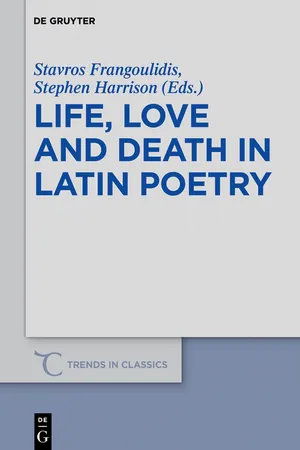
Inspired by Theodore Papanghelis' Propertius: A Hellenistic Poet on Love and Death (1987), this collective volume brings together seventeen contributions, written by an international team of experts, exploring the different ways in which Latin authors and some of their modern readers created narratives of life, love and death. Taken together the papers offer stimulating readings of Latin texts over many centuries, examined in a variety of genres and from various perspectives: poetics and authorial self-fashioning; intertextuality; fiction and 'reality'; gender and queer studies; narratological readings; temporality and aesthetics; genre and meta-genre; structures of the narrative and transgression of boundaries on the ideological and the formalistic level; reception; meta-dramatic and feminist accounts-the female voice. Overall, the articles offer rich insights into the handling and development of these narratives from Classical Greece through Rome up to modern English poetry.
eBook - ePub
Life, Love and Death in Latin Poetry
- 345 pages
- English
- ePUB (mobile friendly)
- Available on iOS & Android
eBook - ePub
Life, Love and Death in Latin Poetry
About this book
Information
Index
Literature
Part I:Roman Elegy
Roy Gibson
Propertius and the Unstructured Self 1
Propertius: A Hellenistic Poet on Love and Death was published by Cambridge University Press in 1987. Professor Papanghelis’s powerful first monograph urges us to take the Roman poet seriously: Propertius is resolute in his purpose to communicate his sensuous experience of ‘love’ as ‘death’. Fundamental to the development of the argument is a consistent focus on the artistic sensibility of Propertius, and a concern with the poet’s ‘temperament’ and ‘imaginative disposition’. The book is a study, ultimately, of the poet’s ‘character’. Yet clear limits are recognized for any investigation of Propertius in this mode: ‘Poets whose main strength lies in their sensuousness should perhaps not be expected to excel in the serio-problematic treatment of moral, social and existential issues’. 2 Like Professor Papanghelis, I wish to take the poetic ‘person’ of Propertius seriously. I trust he will grant me license if I nevertheless shift focus from character to psyche and attempt to draw out some of those existential issues –at least as raised by the elegist’s presentation of his poetic self.
1The Structured Self
Christopher Gill’s recent monograph, The Structured Self in Hellenistic and Roman Thought, deals with ancient conceptions of the self and emotion and reason, and concentrates on the radically different analyses of the self offered by Stoic and Epicurean thought on the one hand, and Platonic-Aristotelian sources on the other. The Structured Self raises a question about Propertius, at least potentially: within which philosophical framework, if any, are the self and the psychological processes portrayed in the poet best analysed and understood? Is the elegist most productively interpreted within a Stoic-Epicurean or a Platonic-Aristotelian framework? Or both? Or neither? 3
Why such questions should be asked at all is perhaps best understood by offering a brief overview of Gill’s book and outlining some of the interpretative gains that it offers for contextualizing manifestations of the self in Latin poetry. The monograph is ‘concerned with ancient thought about what is important about us as human beings or psychophysical wholes or as instantiations of psyche, rather than about what it is to be a (uniquely) particular person or to be me’. 4 One key question concerns the novelty and distinctiveness of Stoic and Epicurean ideas about the psyche as compared with older Platonic and Aristotelian notions. In Platonic-Aristotelian thought, the development of the self takes place in two stages, a ‘habituative phase, often closely tied to involvement with family or communal values’, and a rational phase, explicitly theoretical in character, ‘centred on the dialectical analysis of ideas of value’, where the phasing in two parts is ‘explicitly linked with the division of the psyche into rational and irrational (or non-rational) parts’. 5 In other words, Platonic-Aristotelian thought posits a part-based psyche, where the rational part must develop and learn to control the less rational parts over time. This pattern is rejected in both Epicurean and Stoic thought. Epicureans sought to erase the idea that ‘a human life has a natural shape or narrative, centered on the evolving stages of youth, maturity, and old age’, and instead aimed ‘to create a unified life, consisting in a continuous state of freedom from distress (ataraxia)’. 6
The Stoics rejected Platonic-Aristotelian thought on a different ground: 7
the rational stage of development is not conceived as a distinct, reflective or dialectical one, superimposed on the basis of a habituated set of attitudes and beliefs. Rationality is expressed in the form of ‘selection’, a practical activity, directed at obtaining the primary natural goods …
Both Stoics and Epicureans had to produce some sort of explanation for the difference between youth and maturity. They appear to have done so, at least in the case of Stoics, by positing a ‘sharp and radical distinction’ around the age of fourteen between childhood and the fully rational state of adulthood. 8 From this point on a ‘holistic’ view is taken of adult character and rationality that is in clear contrast with Platonic-Aristotelian ideas of psychological processes: 9
[In the Platonic-Aristotelian picture] the non-rational, or less rational, parts represent continuing dimensions in the psychological life of adult humans; hence, they need to be shaped (or ‘harmonized’) by habituation in the first phase, to provide a foundation for the development of the distinct part, reason, in the second phase. … In the Stoic pattern, reason is not a ‘part’ in this sense, but – at least – a set of structured capabilities which shape the whole of the adult’s psychological life, that is, her impressions, assents, and impulses. … emotions, whether good are bad, are fundamentally rational responses (impulses) and not functions of a distinct or quasi-distinct part of the psyche. They are also conceived holistically, in so far as they are seen as expressing the totality of a person’s belief-set at the relevant time.
There is one importance consequence of this contrast between 1) a Platonic-Aristotelian ‘part-based’ approach, where ethical virtue is a matter of reason’s control over the emotions; and 2) the Stoic-Epicurean preference for a ‘holistic’ model which denies the existence of distinct psychic ‘parts’. In Platonic-Aristotelian thought ‘there can be stable, though defective, states of character as regards emotion and desire’. 10 For example, in Aristotle, akrasia (‘weakness of will’) is a seriously defective condition characterized by inconsistency and internal conflict, to be distinguished from potentially more stable states such as akolasia (‘intemperance’). In Stoic-Epicurean thought, by contrast, ‘stress is laid on the idea that only the normative wise person is coherent and stable, and that the character and lives of non-wise people are marked by inconsistency and inner conflict’. 11 In fact, for Stoics, ‘all states of passion are conceived as being, in effect, ‘akratic’ ones, a point linked with the belief that all human beings are constitutively capable of achieving full wisdom’. 12
These, in sum, are the main differences between the two schools: a part-based approach to the self, with varying degrees of ethical coherence and stability admitted; versus a holistic model that distinguishes the ethical coherence of the elite ‘wise’ from the chaos and instability of the majority of the ‘non-wise’.
2The Structured Self in Vergil, Seneca and Plutarch
In a final chapter of The Structured Self, Gill seeks to trace the influence of these two very different approaches to the self, reason and emotion in texts beyond those of the philosophical schools, including the Lives of Plutarch, the Tragedies of Seneca and Vergil’s Aeneid. He establishes, as might be anticipated, a broadly Platonic-Aristotelian mode of thinking in Plutarch’s Lives and a more thoroughly Stoic mode in Seneca. 13 As for the Aeneid, Gill argues for a sophisticated ‘layered’ model: the epic allows both Platonic-Aristotelian and Stoic-Epicurean readings of the behaviour of Dido and Aeneas, but ultimately the Stoic-Epicurean approach explains more about the ethical lapses of the characters as Vergil portrays them.
In Plutarch’s Lives, for example, we routinely encounter a ‘part-based psychological model and the assumption that ethical development depends on a combination of inborn nature, habituation and reason’, where the subject’s ‘character (and happiness or misery) is [also] viewed in relation to the unfolding narrative’ of that subject’s life. 14 On this model, sudden lapses or late-revealed inconsistency in character require careful explanation: once character is formed by habituation and reason, it ought in theory to remain relatively unchanged. Plutarch has various types of explanation, all of them perhaps related to one another. An overarching explanation may be that the subject in fact failed over time to ‘develop – or to develop fully - the stability and coherence of character that depend on virtue’. Included within this broad explanation may be instances where a previously stable character breaks down under the pressure of exceptional events or circumstances, so that ‘reason’ now loses control over the psychologically distinct ‘anger’ or ‘spirit’. 15 Also perhaps included are instances where qualities or faults that were previously covered up or unrecognized are belatedly revealed. These explanations are compatible with the Platonic-Aristotelian psychological model to which Plutarch elsewhere expresses commitment. 16
Lapses in character receive a rather different explanation in Stoic-Epicurean thought: they are the symptoms of the incoherence and instability from which only the wise are exempt. 17 Gill brings out the difference by contrasting Seneca’s Phaedra with her Eurpidean forerunner. The Phaedra of Euripides conceptualizes herself as a principled individual making an effort to conceal or control a passionate love (eros or Kupris) that has invaded her psyche. Seneca’s Phaedra ‘engages herself more fully with her passion and acts on it, while still being conscious of its wrongfulness. As a result, ambivalence enters more deeply into Phaedra’s motivation and agency in Seneca’s play than in Euripides’ [play]’. 18 The ethical model shaping Seneca’s portrait includes not only the idea that all non-wise people are relati...
Table of contents
- Cover
- Title Page
- Copyright
- Prologue
- Contents
- Introduction
- Part I: Roman Elegy
- Part II: Augustan and Neronian Epic
- Part III: Historiography-Lyric Poetry, Erotic Epistolography and Epigram
- Part IV: Roman Drama and Novel
- Part V: Reception
- Publications by Theodore D. Papanghelis
- Contributors
- General Index
- Index Locorum
Trusted by 375,005 students
Access to over 1.5 million titles for a fair monthly price.
Study more efficiently using our study tools.
Frequently asked questions
Yes, you can cancel anytime from the Subscription tab in your account settings on the Perlego website. Your subscription will stay active until the end of your current billing period. Learn how to cancel your subscription
No, books cannot be downloaded as external files, such as PDFs, for use outside of Perlego. However, you can download books within the Perlego app for offline reading on mobile or tablet. Learn how to download books offline
Perlego offers two plans: Essential and Complete
- Essential is ideal for learners and professionals who enjoy exploring a wide range of subjects. Access the Essential Library with 800,000+ trusted titles and best-sellers across business, personal growth, and the humanities. Includes unlimited reading time and Standard Read Aloud voice.
- Complete: Perfect for advanced learners and researchers needing full, unrestricted access. Unlock 1.5M+ books across hundreds of subjects, including academic and specialized titles. The Complete Plan also includes advanced features like Premium Read Aloud and Research Assistant.
We are an online textbook subscription service, where you can get access to an entire online library for less than the price of a single book per month. With over 1.5 million books across 990+ topics, we’ve got you covered! Learn about our mission
Look out for the read-aloud symbol on your next book to see if you can listen to it. The read-aloud tool reads text aloud for you, highlighting the text as it is being read. You can pause it, speed it up and slow it down. Learn more about Read Aloud
Yes! You can use the Perlego app on both iOS and Android devices to read anytime, anywhere — even offline. Perfect for commutes or when you’re on the go.
Please note we cannot support devices running on iOS 13 and Android 7 or earlier. Learn more about using the app
Please note we cannot support devices running on iOS 13 and Android 7 or earlier. Learn more about using the app
Yes, you can access Life, Love and Death in Latin Poetry by Stavros Frangoulidis, Stephen J. Harrison, Stavros Frangoulidis,Stephen J. Harrison, Stavros Frangoulidis, Stephen Harrison in PDF and/or ePUB format, as well as other popular books in Literature & Ancient & Classical Literary Criticism. We have over 1.5 million books available in our catalogue for you to explore.