Single Variable Calculus
eBook - ePub

Single Variable Calculus

A First Step

  1. 424 pages
  2. English
  3. ePUB (mobile friendly)
  4. Available on iOS & Android
eBook - ePub

Single Variable Calculus

A First Step

About this book

The book is a comprehensive yet compressed entry-level introduction on single variable calculus, focusing on the concepts and applications of limits, continuity, derivative, defi nite integral, series, sequences and approximations. Chapters are arranged to outline the essence of each topic and to address learning diffi culties, making it suitable for students and lecturers in mathematics, physics and engineering.

Contents
Prerequisites for calculus
Limits and continuity
The derivative
Applications of the derivative
The definite integral
Techniques for integration and improper integrals
Applications of the definite integral
Infinite series, sequences, and approximations
Frequently asked questions

Yes, you can cancel anytime from the Subscription tab in your account settings on the Perlego website. Your subscription will stay active until the end of your current billing period. Learn how to cancel your subscription.
No, books cannot be downloaded as external files, such as PDFs, for use outside of Perlego. However, you can download books within the Perlego app for offline reading on mobile or tablet. Learn more here.
Perlego offers two plans: Essential and Complete
  • Essential is ideal for learners and professionals who enjoy exploring a wide range of subjects. Access the Essential Library with 800,000+ trusted titles and best-sellers across business, personal growth, and the humanities. Includes unlimited reading time and Standard Read Aloud voice.
  • Complete: Perfect for advanced learners and researchers needing full, unrestricted access. Unlock 1.4M+ books across hundreds of subjects, including academic and specialized titles. The Complete Plan also includes advanced features like Premium Read Aloud and Research Assistant.
Both plans are available with monthly, semester, or annual billing cycles.
We are an online textbook subscription service, where you can get access to an entire online library for less than the price of a single book per month. With over 1 million books across 1000+ topics, we’ve got you covered! Learn more here.
Look out for the read-aloud symbol on your next book to see if you can listen to it. The read-aloud tool reads text aloud for you, highlighting the text as it is being read. You can pause it, speed it up and slow it down. Learn more here.
Yes! You can use the Perlego app on both iOS or Android devices to read anytime, anywhere — even offline. Perfect for commutes or when you’re on the go.
Please note we cannot support devices running on iOS 13 and Android 7 or earlier. Learn more about using the app.
Yes, you can access Single Variable Calculus by Yunzhi Zou, Beijing World Publishing Corporation in PDF and/or ePUB format, as well as other popular books in Mathematics & Calculus. We have over one million books available in our catalogue for you to explore.

Information

Publisher
De Gruyter
Year
2018
eBook ISBN
9783110527858
Edition
1

1Prerequisites for calculus

1.1Overview of calculus

In this chapter, you will:
see a big picture of calculus;
review the definition of a function;
review properties of a function;
review basic functions and form new functions using basic functions.
When first introduced to calculus, one probably will ask questions such as “what is calculus?” and “what can calculus do?”. This book has answers to these questions. To begin, we start with two problems, the area problem and the tangent problem.
The area problem
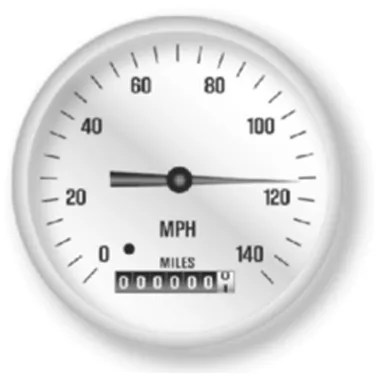
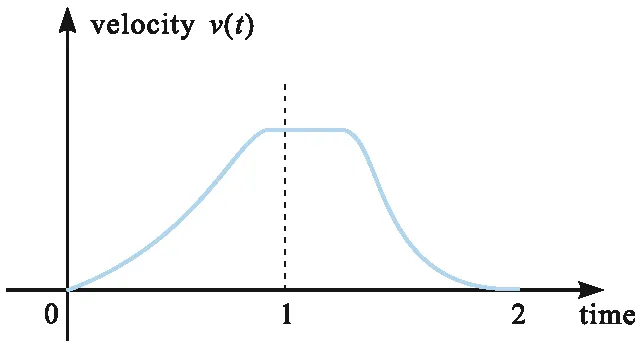
We start with an example. Many students start their school day by traveling in cars or buses from their homes to their schools. We will simplify our discussion by assuming such a trip is along a straight road of 100 km and the trip duration is 2 hours. If you kept looking at the speedometer (see Figure 1.1.1), then you would be able to sketch an approximate speed/velocity versus time graph.
The velocity graph in Figure 1.1.2 shows a period of acceleration, followed by a brief period of constant velocity and then a period of deceleration.
Figure 1.1.1: A speedometer.
Figure 1.1.2: Velocity versus time graph.
How do we know the distance traveled up to time = 1 hour? We note that
distance traveled=speed×time.
However, the problem here is that the speed/velocity on this trip is not constant, and in order to determine the distance traveled, we subdivide the time interva...

Table of contents

  1. Cover
  2. Title Page
  3. Copyright
  4. Preface
  5. Contents
  6. 1 Prerequisites for calculus
  7. 2 Limits and continuity
  8. 3 The derivative
  9. 4 Applications of the derivative
  10. 5 The definite integral
  11. 6 Techniques for integration and improper integrals
  12. 7 Applications of the definite integral
  13. 8 Infinite series, sequences, and approximations

  14. Index