- 307 pages
- English
- ePUB (mobile friendly)
- Available on iOS & Android
eBook - ePub
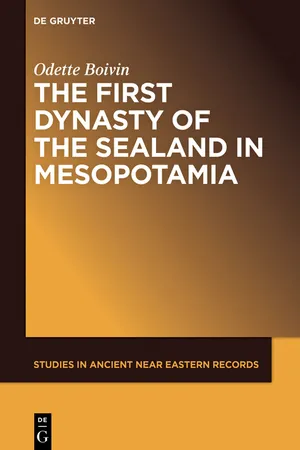
The First Dynasty of the Sealand in Mesopotamia
About this book
Studies in Ancient Near Eastern Records (SANER) is a peer-reviewed series devoted to the publication of monographs pertaining to all aspects of the history, culture, literature, religion, art, and archaeology of the Ancient Near East, from the earliest historical periods to Late Antiquity. The aim of this series is to present in-depth studies of the written and material records left by the civilizations and cultures that populated the various areas of the Ancient Near East: Anatolia, Arabia, Egypt, Iran, the Levant, Mesopotamia, and Syria. Thus, SANER is open to all sorts of works that have something new to contribute and which are relevant to scholars and students within the continuum of regions, disciplines, and periods that constitute the field of Ancient Near Eastern studies, as well as to those in neighboring disciplines, including Biblical Studies, Classics, and Ancient History in general.
Information
Topic
HistoriaSubtopic
Historia antigua1Introduction
Our knowledge of second millennium Babylonia is one in stark contrasts. A wealth of archival documents—epistolary, legal, and administrative—in the first few centuries (the Old Babylonian period) illuminates several aspects of private affairs and state administration in minute detail. Due to a substantial number of tablets, we also have for the same period a fairly good grasp of other scribal activity, for instance in mathematics, divination, and literature. In addition, we learn through the royal Mari archives of many an episode in the intricacies of supra-regional politics that marked the complex relations between the small, ever competing Amorite states; for the Middle Babylonian (Kassite) period in the second half of the millennium, some more limited information comes from the Amarna correspondence. But these relatively solid areas of knowledge coexist with several gray zones. For instance, the absolute chronology of the greater part of the millennium remains an extremely contentious issue. Also, the entire transition from the Old to the Middle Babylonian period is fraught with uncertainties and, it seems, more questions than answers because of the general ebbing of written and material sources. The situation is perhaps best captured in the words of Charpin describing the late Old Babylonian period, and of Brinkman discussing the early Kassite period: the former concludes that “il est impossible d’[en] écrire une histoire politique un tant soit peu continue” (Charpin 2004: 367), while the latter observes that “no amount of theorizing can compensate for the lack of clear and trustworthy evidence” (Brinkman 1976: 13).
It is indeed not only a political Zwischenzeit between periods of unified rule in Babylonia—Amorite, then Kassite –, it is an altogether dark age for which we are at a loss to describe and understand with anything approaching confidence most aspects of the demographic, economic, environmental, cultural, and political processes and events. This phase of high uncertainty in our understanding of Babylonian history sets in earlier for southern Babylonia. Indeed, if we trust the available material and written evidence—or rather the lack thereof –, the region appears to turn more or less into a wasteland after the rebellion against Samsuiluna, and to remain so until Kassite (re‐)settlement. To fill this hiatus historians had until very recently barely more to go on than a handful of references to the enigmatic dynasty of Eurukug, also called Sealand, scattered in later king lists and chronicles and early on associated with southern Mesopotamia. The term commonly translated as Sealand is associated in Mesopotamian historiographic sources with three distinct dynasties;1 it is the first one, coeval with the late Old Babylonian and the early Kassite periods, which is investigated here. In the last years, primary sources from their kingdom have finally surfaced and allowed for a thorough re-examination of the question. The present work presents the results of this undertaking.
It is nonetheless worthwhile to take a step back and trace the major steps in our understanding of Sealand history, more particularly of its first dynasty and kingdom, as some questions raised in early discussions are still valid. I will therefore review the main contributions in order to follow the evolution of the idea of Sealand in Assyriology from the 1880s to the present.
1.1Review of previous scholarship
The sole historical study entirely dedicated to the Sealand dates as far back as 1932 (Dougherty 1932). This is not very surprising since until recently little new evidence had become available to encourage any serious attempt to revisit this part of Mesopotamian history. Accordingly, the history of southernmost Mesopotamia in the middle of the second millennium usually remains confined to a few paragraphs in chapters about the Old Babylonian or the Kassite dynasty. The dire lack of sources has also resulted in conflicting, sometimes irreconcilable views and speculations on the Sealand. To cite but two on intellectual history, at opposite ends of the spectrum: Hallo (1975: 199; 201) suggested, before any directly relevant literary texts had surfaced, that scholars of Sumerian who fled to the Sealand after the fall of the Amorite dynasty were responsible for “a final flowering of Sumerian literature, or rather of bilingual texts;” a few years later, with the same evidence at hand, Civil et al. (1979: 8) considered that the “occupation of Nippur by the Sealand tribes was quite different from previous conquests by the more ‘civilized’ Larsa and Babylonian kings, and seems to have put an end to all scribal activities.”
1.1.1First discussions on the Sealand
As early as 1886, Tiele (1886: passim) discussed the “Dynastie Šisku (Uruku?)” and the “Dynastie Seelands” mentioned in the Babylonian King List A published some years earlier. Without concluding, he proposed that the “Seeland” was a land along the Persian shore or around an inner sea. The association between the Sealand and the Persian Gulf was embraced by other scholars and in 1904 Hommel (1904: passim) assumed that the “Meerland” extended along the Persian coast from Bīt Jakīn in southern Babylonia down to where Bahrein lies. He also posited that Karduniaš might be synonym of “Meerland.” Along similar lines, Hüsing (1906: 663‒65) suggested that Karduniaš might be the Elamite word for “Meerland.”
Other scholars, however, did not associate Karduniaš and the Sealand, and the idea of a separate political entity co-existing with the first dynasty of Babylon emerged. Johns (1913: 83) discussed the conflicts between Abī-ešuḫ and “Iluma-ilu, king of the Sealand” of the “Uru-azagga” dynasty. He considered the Sealand to have been located in “inaccessible swamps.”
A first attempt to write a history of the Sealand was made by King (1915: 197ff.), who in 1915 dedicated a full chapter to “The Close of the First Dynasty of Babylon and the Kings from the Country of the Sea” as part of his reconstruction of Babylonian political history. He drew from the chronicles he had published a few years earlier to write, from a Babylonian point of view, the history of the “Sea-Country.” King situated the Sea-Country mainly in the marshy area in the south-east of Babylonia, a region offering a natural barrier against invaders, also a region which had constituted a sanctuary to Sumerian refugees displaced by the Amorite invasion. King considered that the southern rebellion during Samsu-iluna’s reign was led by Rīm-Sîn (I) of Larsa, by then very old, who had bided his time since Hammurapi’s conquest but seized the opportunity to strike Babylon when it was beginning to struggle with Kassite invasions. Following Samsu-iluna’s brief success in crushing the rebellion, the revolt of “all the lands” had in King’s opinion been caused by Sea-Country leader “Iluma-ilum.” Basing himself on the fairly recent publication of legal and business documents from Nippur that used date formulae of the latter, King concluded that central Babylonia had passed into Sea-Country hands in Samsu-iluna’s twenty-ninth year, a view that is still valid. He discussed Abī-ešuḫ’s unsuccessful efforts to regain control of the south and the construction of shrines at Babylon, reproducing cult places which had passed under Sea-Country control—a phenomenon also observed by contemporary assyriologists. King believed that, before his fall at the hands of the Kassites, the last Sea-Country king had unsuccessfully attempted to invade Elam. He also discussed the reasons motivating the inclusion of the Sea-Country rulers in the Babylonian King List, positing that, following the Hittite raid, it was probably the sole stable power in the region; reflecting on the same problem, Thureau-Dangin (1927: 184) surmised that the dynasty was included in the list because at least one of its rulers reigned at Babylon (he considers that in fact two kings may have reigned there).
1.1.2Dougherty’s “The Sealand of Ancient Arabia”
A turning point in scholarship about the Sealand was Dougherty’s publication of The Sealand of Ancient Arabia in 1932. In his book, Dougherty (1932: passim; in particular 4‒10) created the idea of the Sealand as a long-lived polity, in fact even as a nation. Basing himself on written sources, including works of literature, he placed the formation of the Sealand in the third millennium, around 2500, on the basis of three main elements: his reading of a partly reconstructed passage of a chronicle of early kings (ABC 20 A); a Neo-Assyrian omen collection possibly referring to a ma-a-ti A.AB.BA, which Sargon would have crossed to bring back booty from the Levant; and a firm belief that the second millennium Sealand, being a separate nation with its own cultural identity and some military power,2 had to be the result of a long process of formation. Dougherty considered that the Sealand stretched along the northern and western (down to Dilmun) shores of the Persian Gulf,3 but also situated a large portion of it in the Arabian peninsula, which he saw as the logical route for Sargon after his western conquests. He (ibid: 24) also considered that Sealand kings had to control a very large territory since they represented at times a strong military power and were granted a place in king lists; the Sealand could hence not have been confined only to southernmost Mesopotamia.
After an episode of Kassite domination and the short-lived second Sealand dynasty, Dougherty (ibid.: passim; in particular 102‒05) depicted a ninth century political landscape characterized by an alliance between Assyria and the Babylonian portion of Karduniaš. Both faced strong rebellion from an Arabian district of Karduniaš that comprised Chaldea and the Sealand, here understood as possibly partly overlapping territories. In the Sealand, a strong dynasty was founded by Yakînu, to which belonged Marduk-apla-iddina (II), who was considered to have extended his rule from the Arabian peninsula into Sumer and Akkad in the late eighth century. The Neo-Babylonian dynasty was seen by Dougherty (ibid.: 145) as in continuity, either in direct descent or at least linked ideologically, with the Sealand dynasty founded by Yakînu. Dougherty hence viewed the Sealand as a nation enduring over two millennia and whose history was reflected almost exclusively in external sources.
1.2Later research on the Sealand I dynasty
1.2.1The reassessment of sources pertaining to the Sealand
After assyriologists began distancing themselves from a more literalistic interpretation of sources, in particular literary sources, which characterized scholarship in the nineteenth and early twentieth century, the main conclusions of Dougherty’s research were no longer regarded as valid. It is indeed interesting to note that many later considerations on the Sealand do not derive from the discovery of new evidence but from a re-interpretation of sources known for several decades. The assessment of their trustworthiness and historical meaning remains a delicate and contentious exercise.
In his work on second millennium chronology, Goetze (1957: 66) posited that a Sealand king reigned in Babylon, otherwise the first Sealand dynasty would not have been included in Babylonian king lists. He assumed that this occupation of the Babylonian throne by a Sealand ruler took place immediately after the Hittite raid on Babylon, when the Kassites and the Sealanders were both likely contenders. The Sealand kings being however listed before the Kassites, Goetze inferred that a Sealand king occupied the throne first. Basing himself on known synchronisms for previous kings and on the reign lengths provided by the Babylonian King List A, Goetze identified Gulkišar as the most likely candidate. He estimated that, following Gulkišar, the first Sealand dynasty endured another 142 years, here again basing himself on king lists. As for Ulam-Buriaš, known from a chronicle (ABC 20B) as the victor over Ea-gāmil, Goetze (1964: 99) argued that he was a (Kassite) king of the Sealand who did not necessarily reign at Babylon but may have conquered the Sealand on behalf of his father Burna-Buriaš.
Landsberger (1954: 70 n.181) proceeded differently and established synchronisms between Sealand I kings and Old Babylonian, then Kassite kings; he suggested that the reign lengths attributed to Sealand kings in the Babylonian King List A were adjusted by scribes to make the first Sealand dynasty match in length its Babylonian counterparts. He also purported that Babylonian scholars had probably fled to the Sealand at the fall of the first Babylonian dynasty, kept alive scribal traditions there, then went back to Babylon under or after Agum II (after almost two centuries in his computation). Hence in his view the scribes responsible for the transmission of Sealand’s history in the Babylonian chronographic tradition were in fact Sealand scribes. Going further, Hallo (1983: 12) suggested that the kings of the first Sealand dynasty “aspired to restore Sumerian traditions” in continuity with the first Isin dynasty and that they may have commissioned a first version of King List A to that effect. As for Sealand geography, Roux (1960: 27‒38) suggested that Tell Abu Salabikh in the Hammar district may have been the capital of the Sealand kingdom.
In his succinct but informative entry “Meerland” in the Reallexikon, Brinkman (1993‒97) presented the first summary of all textual sources relevant to the Sealand since Dougherty’s book; like the latter, he covered all periods ...
Table of contents
- Cover
- Title Page
- Copyright
- Preface
- Contents
- Tables and Figures
- Conventions and Abbreviations
- 1 Introduction
- 2 The Sealand I in Babylonian historiography
- 3 Geographical and chronological considerations
- 4 A political history of the Sealand kingdom
- 5 The Sealand I palatial economy
- 6 The Sealand I panthea and religious history
- 7 Conclusion
- Appendix 1: BKL A and Babylon I – Sealand I synchronism
- Appendix 2: Sealand I year names
- Appendix 3: Text numbers corresponding to Table 8
- Bibliography
- Indexes
Trusted by 375,005 students
Access to over 1.5 million titles for a fair monthly price.
Study more efficiently using our study tools.
Frequently asked questions
Yes, you can cancel anytime from the Subscription tab in your account settings on the Perlego website. Your subscription will stay active until the end of your current billing period. Learn how to cancel your subscription
No, books cannot be downloaded as external files, such as PDFs, for use outside of Perlego. However, you can download books within the Perlego app for offline reading on mobile or tablet. Learn how to download books offline
Perlego offers two plans: Essential and Complete
- Essential is ideal for learners and professionals who enjoy exploring a wide range of subjects. Access the Essential Library with 800,000+ trusted titles and best-sellers across business, personal growth, and the humanities. Includes unlimited reading time and Standard Read Aloud voice.
- Complete: Perfect for advanced learners and researchers needing full, unrestricted access. Unlock 1.5M+ books across hundreds of subjects, including academic and specialized titles. The Complete Plan also includes advanced features like Premium Read Aloud and Research Assistant.
We are an online textbook subscription service, where you can get access to an entire online library for less than the price of a single book per month. With over 1.5 million books across 990+ topics, we’ve got you covered! Learn about our mission
Look out for the read-aloud symbol on your next book to see if you can listen to it. The read-aloud tool reads text aloud for you, highlighting the text as it is being read. You can pause it, speed it up and slow it down. Learn more about Read Aloud
Yes! You can use the Perlego app on both iOS and Android devices to read anytime, anywhere — even offline. Perfect for commutes or when you’re on the go.
Please note we cannot support devices running on iOS 13 and Android 7 or earlier. Learn more about using the app
Please note we cannot support devices running on iOS 13 and Android 7 or earlier. Learn more about using the app
Yes, you can access The First Dynasty of the Sealand in Mesopotamia by Odette Boivin in PDF and/or ePUB format, as well as other popular books in Historia & Historia antigua. We have over 1.5 million books available in our catalogue for you to explore.