eBook - PDF
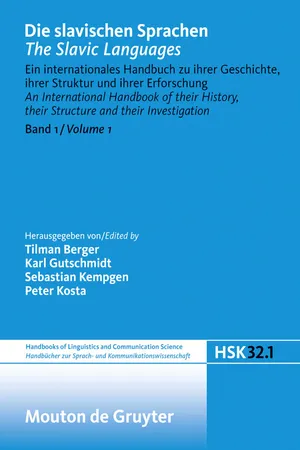
Die slavischen Sprachen / The Slavic Languages. Halbband 1
- 1,194 pages
- English
- PDF
- Available on iOS & Android
eBook - PDF
Die slavischen Sprachen / The Slavic Languages. Halbband 1
About this book
No detailed description available for "SLAVISCHE SPRACHEN (BERGER U.A.) HSK 32.1 E-BOOK".
Information
Table of contents
- Frontmatter
- Inhaltsverzeichnis / Contents
- 1. Phonetik, Phonologie, Orthographie, Flexionsmorphologie
- 2. Artikulatorische Phonetik
- 3. Accommodation (Assimilation, Dissimilation, Reduction)
- 4. Segmental Clusters in the Slavic Languages
- 5. Moscow and St. Petersburg Schools in Phonology
- 6. The Orthographic Principles in the Slavic Languages: Phonetic/Phonological
- 7. Fester Akzent (Formen und Funktionen)
- 8. Freier Akzent (Flexion)
- 9. Melodischer Akzent (Flexion)
- 10. Sentence and Phrase Intonation
- 11. Synthetismus und Analytismus im Slavischen
- 12. Nominale Kategorien: Genus
- 13. Animacy, Personhood
- 14. Nominale Kategorien: Kasus
- 15. Definiteness (synchrony)
- 16. Nominale Kategorien: Steigerung
- 17. Periphrastic Constructions
- 18. Verbale Kategorien: Aspekt und Aktionsart
- 19. Die Kategorien Tempus, Person und Numerus im Slavischen
- 20. Imperative Mood
- 21. Der sogenannte Renarrativ
- 22. Der Resultativ in den slavischen Sprachen
- 23. The Conditional
- 24. Targets, Theory and Methods of Slavic Generative Syntax: Minimalism, Negation and Clitics
- 25. Gegenstände der funktionalen Syntax
- 26. Principles of Generative Syntax
- 27. Morphosyntaktische Relationen und Struktur des Syntagmas
- 28. Agreement
- 29. Case Assignment in Quantified Phrases
- 30. Morphosyntaktische Markierung sekundärer Prädikate
- 31. Satzglieder und impersonale Konstruktionen im Slavischen
- 32. Unaccusativity
- 33. Negation and Clause Structure
- 34. Modals (Modalauxiliare)
- 35. Satzmodus
- 36. Imperativsatz
- 37. The Conjunctive (Conditional)
- 38. Aspekt und Tempus im Slavischen
- 39. Aspekt und Tempus im Satz: Tschechisch
- 40. L1- vs. L2-Erwerb/Bilingualismus
- 41. Argument - Prädikat - Struktur und Dezentrierung
- 42. Komplexe Satzmuster
- 43. Zur Syntax der Koordination
- 44. Juxtaposition
- 45. On the Syntax of Ellipsis and Conjunct Reduction
- 46. Sentence Equivalents
- 47. Word Order in Slavic
- 48. Grammatik und Informationsstruktur
- 49. Discourse, Sentence Intonation, and Word Order
- 50. Scrambling
- 51. Clitics in Slavic
- 52. Struktur des Lexikons
- 53. Verfahren und Mittel der Nomination
- 54. Wortbildungsbedeutung
- 55. Diminutiva/Augmentativa und Kollektiva
- 56. Phraseologie
- 57. Phraseologische Einheiten
- 58. Word Frequency in Slavic (with an Emphasis on Russian)
- 59. Moscow Semantic School
- 60. Prototypensemantik und Stereotypen
- 61. The Theory of the Mental Lexicon
- 62. Semantik der Eigennamen
- 63. Connotation (in Linguistic Semantics)
- 64. Die Beziehung von lexikalischer Bedeutungund innerer Form
- 65. Die Semantik der Partikeln und derso genannten Diskurswörter
- 66. Die Semantik der logischen Wörter
- 67. Typen semantischer Relationen
- 68. Zum Verhältnis von lexikalischer Semantik und syntaktischer Struktur
- 69. Zum Verhältnis von Semantik und Pragmatik
- 70. Textkohärenz
- 71. Anaphorische Mittel
- 72. Anaphorische Mittel: Konnexion
- 73. Funktionalstile
- 74. Textsorten
- 75. Lokaldeixis
- 76. Anredesysteme
- 77. Gesprächsanalyse
- 78. Höflichkeit
- 79. Speech Acts in Slavic Languages
- 80. Geschlechtsspezifischer Sprachgebrauch
- 81. Der institutionell determinierte politische Diskurs in (post)kommunistischen Staaten Mittel- und Osteuropas
Trusted by 375,005 students
Access to over 1.5 million titles for a fair monthly price.
Study more efficiently using our study tools.
Frequently asked questions
Yes, you can cancel anytime from the Subscription tab in your account settings on the Perlego website. Your subscription will stay active until the end of your current billing period. Learn how to cancel your subscription
No, books cannot be downloaded as external files, such as PDFs, for use outside of Perlego. However, you can download books within the Perlego app for offline reading on mobile or tablet. Learn how to download books offline
Perlego offers two plans: Essential and Complete
- Essential is ideal for learners and professionals who enjoy exploring a wide range of subjects. Access the Essential Library with 800,000+ trusted titles and best-sellers across business, personal growth, and the humanities. Includes unlimited reading time and Standard Read Aloud voice.
- Complete: Perfect for advanced learners and researchers needing full, unrestricted access. Unlock 1.5M+ books across hundreds of subjects, including academic and specialized titles. The Complete Plan also includes advanced features like Premium Read Aloud and Research Assistant.
We are an online textbook subscription service, where you can get access to an entire online library for less than the price of a single book per month. With over 1.5 million books across 990+ topics, we’ve got you covered! Learn about our mission
Look out for the read-aloud symbol on your next book to see if you can listen to it. The read-aloud tool reads text aloud for you, highlighting the text as it is being read. You can pause it, speed it up and slow it down. Learn more about Read Aloud
Yes! You can use the Perlego app on both iOS and Android devices to read anytime, anywhere — even offline. Perfect for commutes or when you’re on the go.
Please note we cannot support devices running on iOS 13 and Android 7 or earlier. Learn more about using the app
Please note we cannot support devices running on iOS 13 and Android 7 or earlier. Learn more about using the app
Yes, you can access Die slavischen Sprachen / The Slavic Languages. Halbband 1 by Sebastian Kempgen, Peter Kosta, Tilman Berger, Karl Gutschmidt, Sebastian Kempgen,Peter Kosta,Tilman Berger,Karl Gutschmidt in PDF and/or ePUB format, as well as other popular books in Languages & Linguistics & Languages. We have over 1.5 million books available in our catalogue for you to explore.