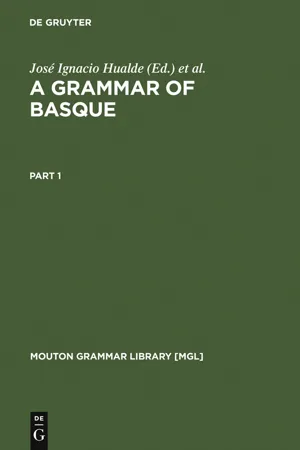
As the only surviving pre-Indo-European language of western Europe, Basque has often attracted the interest of linguists. Whereas, traditionally, descriptive work on Basque has primarily focused on morphological features, including its complex system of verb-argument agreement and its strict ergative pattern of inflection, during the last two decades a new generation of Basque linguists has produced very sophisticated, theoretically-informed work on many aspects of the syntax, morphology and phonology of the language, revealing, for instance, a process of focalization with many interesting properties and the existence in some dialects of an accentual system strikingly similar to that of standard Japanese. The book, bringing together this accumulated knowledge on the structure of Basque, is considerably more complete than any other existing grammar of the language. Another interesting feature of this grammar is that the description is illustrated with fully-glossed examples extracted from a great number of written sources. Although the focus is the modern standard language, dialectal features are considered in detail and examples are taken from all dialects and periods.
eBook - PDF
A Grammar of Basque
- 976 pages
- English
- PDF
- Available on iOS & Android
eBook - PDF
A Grammar of Basque
About this book
Information
Table of contents
- 1 Introduction (J.I. Hualde)
- 1.1. The Basque language and its name
- 1.2. The Basque language today: number of speakers, geographical distribution, official status, sociolinguistic aspects
- 2 Phonology
- 2.1. Segmental phonology (J.I. Hualde)
- 2.2. Accentuation (J.I. Hualde)
- 2.3. Intonation (G. Elordieta)
- 3. Morphology
- 3.1. The Noun Phrase: nouns, determiners and modifiers; pronouns and names (R.L. Trask)
- 3.2. Case and number inflection of noun phrases (J.I. Hualde)
- 3.3. Postpositions (J.I. Hualde)
- 3.4. Adverbs (J.I. Hualde)
- 3.5. Verbs (J.I. Hualde, B. Oyharçabal and J. Ortiz de Urbina)
- 3.5.1. Nonfinite forms (J.I. Hualde)
- 3.5.2. Finite forms
- 3.5.3. Structural analysis of basic verbal paradigms (J.I. Hualde)
- 3.5.4. Tense, aspect and mood (B. Oyharçabal)
- 3.5.5. Periphrastic constructions (J. Ortiz de Urbina)
- 3.5.6. Semiauxiliary verbs (J. Ortiz de Urbina)
- 3.5.7. Modal particles
- 3.6. Conjunctions and connectors (J.I. Hualde)
- 3.7. Derivation (J.I. Hualde)
- 3.8. Compounds (J.I. Hualde)
- 4 Syntax
- 4.1. Valency and argument structure in the Basque verb (R. Etxepare)
- 4.1.1. Valency and the auxiliary system: an outline
- 4.1.2. Intransitive monovalent structures
- 4.1.3. Intransitive Bivalent Structures (dative-absolutive constructions)
- 4.1.4. Transitive Structures
- 4.1.5. Ditransitive Structures
- 4.1.6. Possessive constructions
- 4.1.7. Verbs of saying, thinking and judging
- 4.2. Nominal Predication: copulative sentences and secondary predication (I. Zabala)
- 4.3. Word order (J. Ortiz de Urbina)
- 4.4. Focalization (R. Etxepare & J. Ortiz de Urbina)
- 4.5. Negation (R. Etxepare)
- 4.6. Exclamatives (R. Etxepare)
- 4.7. Impersonal clauses (J. Ortiz de Urbina)
- 4.8. Causatives (J. Ortiz de Urbina)
- 4.9. Reciprocal and reflexive constructions (X. Artiagoitia)
- 4.10. Subordination (X. Artiagoitia, B. Oyharçabal, J.I. Hualde & J. Ortiz de Urbina)
- 4.10.1. Complementation (noun clauses) (X. Artiagoitia)
- 4.10.2. Adjunct subordination (X. Artiagoitia)
- 4.10.3. Relatives (B. Oyharçabal)
- 4.10.4. Comparative constructions (J.I. Hualde & J. Ortiz de Urbina)
- 4.11. Coordination (I. Amundarain)
- 5 Texts
- 5.1. Text 1
- 5.2. Text 2
- 5.3. Text 3
- 5.4. Text 4
- 5.5. Text 5
- Sources of examples
- References
- Index
Trusted by 375,005 students
Access to over 1.5 million titles for a fair monthly price.
Study more efficiently using our study tools.
Frequently asked questions
Yes, you can cancel anytime from the Subscription tab in your account settings on the Perlego website. Your subscription will stay active until the end of your current billing period. Learn how to cancel your subscription
No, books cannot be downloaded as external files, such as PDFs, for use outside of Perlego. However, you can download books within the Perlego app for offline reading on mobile or tablet. Learn how to download books offline
Perlego offers two plans: Essential and Complete
- Essential is ideal for learners and professionals who enjoy exploring a wide range of subjects. Access the Essential Library with 800,000+ trusted titles and best-sellers across business, personal growth, and the humanities. Includes unlimited reading time and Standard Read Aloud voice.
- Complete: Perfect for advanced learners and researchers needing full, unrestricted access. Unlock 1.5M+ books across hundreds of subjects, including academic and specialized titles. The Complete Plan also includes advanced features like Premium Read Aloud and Research Assistant.
We are an online textbook subscription service, where you can get access to an entire online library for less than the price of a single book per month. With over 1.5 million books across 990+ topics, we’ve got you covered! Learn about our mission
Look out for the read-aloud symbol on your next book to see if you can listen to it. The read-aloud tool reads text aloud for you, highlighting the text as it is being read. You can pause it, speed it up and slow it down. Learn more about Read Aloud
Yes! You can use the Perlego app on both iOS and Android devices to read anytime, anywhere — even offline. Perfect for commutes or when you’re on the go.
Please note we cannot support devices running on iOS 13 and Android 7 or earlier. Learn more about using the app
Please note we cannot support devices running on iOS 13 and Android 7 or earlier. Learn more about using the app
Yes, you can access A Grammar of Basque by José Ignacio Hualde, Jon Ortiz de Urbina, José Ignacio Hualde,Jon Ortiz de Urbina in PDF and/or ePUB format, as well as other popular books in Languages & Linguistics & Linguistics. We have over 1.5 million books available in our catalogue for you to explore.