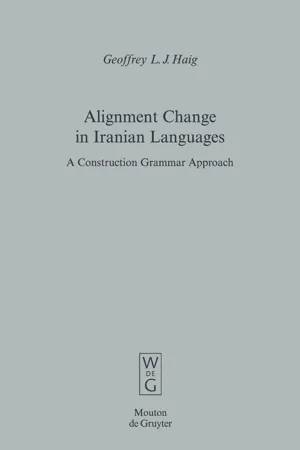
The Iranian languages, due to their exceptional time-depth of attestation, constitute one of the very few instances where a shift from accusative alignment to split-ergativity is actually documented. Yet remarkably, within historical syntax, the Iranian case has received only very superficial coverage. This book provides the first in-depth treatment of alignment change in Iranian, from Old Persian (5 C. BC) to the present. The first part of the book examines the claim that ergativity in Middle Iranian emerged from an Old Iranian agented passive construction. This view is rejected in favour of a theory which links the emergence of ergativity to External Possession. Thus the primary mechanisms involved is not reanalysis, but the extension of a pre-existing construction. The notion of Non-Canonical Subjecthood plays a pivotal role, which in the present account is linked to the semantics of what is termed Indirect Participation. In the second part of the book, a comparative look at contemporary West Iranian is undertaken. It can be shown that throughout the subsequent developments in the morphosyntax, distinct components such as agreement, nominal case marking, or the grammar of cliticisation, in fact developed remarkably independently of one another. It was this de-coupling of sub-systems of the morphosyntax that led to the notorious multiplicity of alignment types in Iranian, a fact that also characterises past-tense alignments in the sister branch of Indo-European, Indo-Aryan. Along with data from more than 20 Iranian languages, presented in a manner that renders them accessible to the non-specialist, there is extensive discussion of more general topics such as the adequacy of functional accounts of changes in case systems, discourse pressure and the role of animacy, the notion of drift, and the question of alignment in early Indo-European.
- 380 pages
- English
- PDF
- Available on iOS & Android
eBook - PDF
About this book
Information
Table of contents
- Frontmatter
- Contents
- Abbreviations
- Chapter 1. Introduction
- Chapter 2. Alignment in Old Iranian
- Chapter 3. Western Middle Iranian
- Chapter 4. Case systems in West Iranian
- Chapter 5. Kurdish (Northern Group)
- Chapter 6. The Central group
- Chapter 7. Conclusions
- Backmatter
Trusted by 375,005 students
Access to over 1.5 million titles for a fair monthly price.
Study more efficiently using our study tools.
Frequently asked questions
Yes, you can cancel anytime from the Subscription tab in your account settings on the Perlego website. Your subscription will stay active until the end of your current billing period. Learn how to cancel your subscription
No, books cannot be downloaded as external files, such as PDFs, for use outside of Perlego. However, you can download books within the Perlego app for offline reading on mobile or tablet. Learn how to download books offline
Perlego offers two plans: Essential and Complete
- Essential is ideal for learners and professionals who enjoy exploring a wide range of subjects. Access the Essential Library with 800,000+ trusted titles and best-sellers across business, personal growth, and the humanities. Includes unlimited reading time and Standard Read Aloud voice.
- Complete: Perfect for advanced learners and researchers needing full, unrestricted access. Unlock 1.5M+ books across hundreds of subjects, including academic and specialized titles. The Complete Plan also includes advanced features like Premium Read Aloud and Research Assistant.
We are an online textbook subscription service, where you can get access to an entire online library for less than the price of a single book per month. With over 1.5 million books across 990+ topics, we’ve got you covered! Learn about our mission
Look out for the read-aloud symbol on your next book to see if you can listen to it. The read-aloud tool reads text aloud for you, highlighting the text as it is being read. You can pause it, speed it up and slow it down. Learn more about Read Aloud
Yes! You can use the Perlego app on both iOS and Android devices to read anytime, anywhere — even offline. Perfect for commutes or when you’re on the go.
Please note we cannot support devices running on iOS 13 and Android 7 or earlier. Learn more about using the app
Please note we cannot support devices running on iOS 13 and Android 7 or earlier. Learn more about using the app
Yes, you can access Alignment Change in Iranian Languages by Geoffrey L.J. Haig in PDF and/or ePUB format, as well as other popular books in Languages & Linguistics & Languages. We have over 1.5 million books available in our catalogue for you to explore.