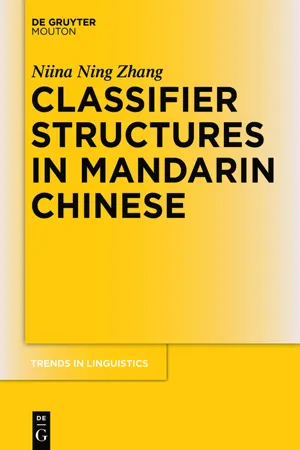
This monograph addresses fundamental syntactic issues of classifier constructions, based on a thorough study of a typical classifier language, Mandarin Chinese. It shows that the contrast between count and mass is not binary. Instead, there are two independently attested features: Numerability, the ability of a noun to combine with a numeral directly, and Delimitability, the ability of a noun to be modified by a delimitive modifier, such as size, shape, or boundary modifier. Although all nouns in Chinese are non-count nouns, there is still a mass/non-mass contrast, with mass nouns selected by individuating classifiers and non-mass nouns selected by individual classifiers. Some languages have the counterparts of Chinese individuating classifiers only, some languages have the counterparts of Chinese individual classifiers only, and some other languages have no counterpart of either individual or individuating classifiers of Chinese. The book also reports that unit plurality can be expressed by reduplicative classifiers in the language. Moreover, for the constituency of a numeral expression, an individual, individuating, or kind classifier combines with the noun first and then the numeral is integrated; but a partitive or collective classifier, like a measure word, combines with the numeral first, before the noun is integrated into the whole nominal structure. Furthermore, the book identifies the syntactic positions of various uses of classifiers in the language. A classifier is at a functional head position that has a dependency with a numeral, or a position that has a dependency with a generic or existential quantifier, or a position that represents the singular-plural contrast, or a position that licenses a delimitive modifier when the classifier occurs in a compound.
- 332 pages
- English
- PDF
- Available on iOS & Android
eBook - PDF
Classifier Structures in Mandarin Chinese
About this book
Information
Table of contents
- Acknowledgments
- Abbreviations
- Chapter 1: Introduction
- Chapter 2: Classifiers and countability
- Chapter 3: Classifiers and quantifiers
- Chapter 4: Classifiers and plurality
- Chapter 5: The syntactic constituency of numeral expressions
- Chapter 6: The syntactic positions of classifiers
- Chapter 7: Noun-classifier compounds
- Chapter 8: Conclusions
- References
- Subject index
- Language index
Trusted by 375,005 students
Access to over 1.5 million titles for a fair monthly price.
Study more efficiently using our study tools.
Frequently asked questions
Yes, you can cancel anytime from the Subscription tab in your account settings on the Perlego website. Your subscription will stay active until the end of your current billing period. Learn how to cancel your subscription
No, books cannot be downloaded as external files, such as PDFs, for use outside of Perlego. However, you can download books within the Perlego app for offline reading on mobile or tablet. Learn how to download books offline
Perlego offers two plans: Essential and Complete
- Essential is ideal for learners and professionals who enjoy exploring a wide range of subjects. Access the Essential Library with 800,000+ trusted titles and best-sellers across business, personal growth, and the humanities. Includes unlimited reading time and Standard Read Aloud voice.
- Complete: Perfect for advanced learners and researchers needing full, unrestricted access. Unlock 1.5M+ books across hundreds of subjects, including academic and specialized titles. The Complete Plan also includes advanced features like Premium Read Aloud and Research Assistant.
We are an online textbook subscription service, where you can get access to an entire online library for less than the price of a single book per month. With over 1.5 million books across 990+ topics, we’ve got you covered! Learn about our mission
Look out for the read-aloud symbol on your next book to see if you can listen to it. The read-aloud tool reads text aloud for you, highlighting the text as it is being read. You can pause it, speed it up and slow it down. Learn more about Read Aloud
Yes! You can use the Perlego app on both iOS and Android devices to read anytime, anywhere — even offline. Perfect for commutes or when you’re on the go.
Please note we cannot support devices running on iOS 13 and Android 7 or earlier. Learn more about using the app
Please note we cannot support devices running on iOS 13 and Android 7 or earlier. Learn more about using the app
Yes, you can access Classifier Structures in Mandarin Chinese by Niina Ning Zhang in PDF and/or ePUB format, as well as other popular books in Languages & Linguistics & Linguistics. We have over 1.5 million books available in our catalogue for you to explore.