eBook - PDF
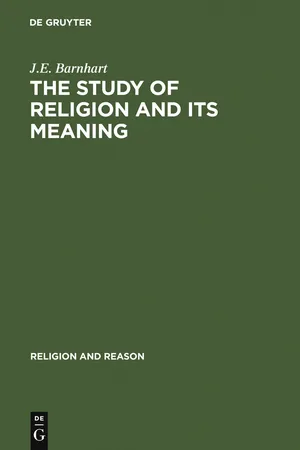
The Study of Religion and its Meaning
New Explorations in Light of Karl Popper and Emile Durkheim
- 232 pages
- English
- PDF
- Available on iOS & Android
eBook - PDF
The Study of Religion and its Meaning
New Explorations in Light of Karl Popper and Emile Durkheim
About this book
No detailed description available for "The Study of Religion and its Meaning".
Trusted by 375,005 students
Access to over 1.5 million titles for a fair monthly price.
Study more efficiently using our study tools.
Information
Topic
Theology & ReligionSubtopic
Biblical StudiesTable of contents
- PREFACE
- CHAPTER 1: PROBLEMS IN DEFINING ‘RELIGION’
- A. Expecting too much from one definition
- B. The problem of an evaluative definition
- C. The problem of a diluted definition
- D. The problem of an expanded definition
- E. The problem of the true religion
- F. The preliminary definition of ‘religion’
- G. Explicating core-concern with finitude
- H. Religion and magic
- I. Dimensions of religion
- CHAPTER 2: RESPONSES TO THE CONCERN WITH FINITUDE
- A. The response definition of ‘religion’
- B. Reductionism
- C. Rational thinking develops its own problems
- D. The issue of objectivity
- E. Empirical testing
- F. The question of consistency
- G. What to do with contradiction
- H. On seeing contradictions
- I. On protecting one’s central beliefs
- J. Seeking out threatening challenges to belief
- K. Hypocrisy and contradiction
- CHAPTER 3: THE EMOTIONAL DIMENSION OF RELIGIOUS RESPONSES
- A. Response to loss and defeat
- B. Frustration and anger
- C. The study of covert and overt behaviors
- D. Preventive religion
- E. The religion of the insiders
- F. Religion and separation
- G. Balancing the need for unity and separateness
- CHAPTER 4: THE MORAL DIMENSION OF RELIGION
- A. The impact of Positivism
- B. The problem of moral conventionalism
- C. The procedure of moral appeal and inquiry
- D. On transcending convention
- E. Moral authority
- F. The interchange between communities
- G. The gift of nature
- H. The animal and primitive roots of society
- I. Sources of social and moral transcendence
- J. Religious commitment to the society perceived as protector
- K. Born again
- L. Theological ethics
- M. From involvement to moral commitment
- N. The quest for a rock-bottom ethical foundation
- O. The risk of involvement
- CHAPTER 5: RELIGIOUS EDUCATION
- A. The myth of the neutral point of view
- B. Required courses – A Church-State problem?
- C. Presenting a variety of viewpoints
- D. The Religion of the Republic and its ‘Sunday School’
- E. A serious threat to the plan
- F. Christianity and the Religion of the Republic
- G. The influence of the Religion of the Republic
- H. The secular outlook and the Religion of the Republic
- I. Conclusion
- CHAPTER 6: THE MYSTIC AND GOD
- A. Mysticism and oneness
- B. Mysticism and ineffability
- C. Observing the ‘inner’ world
- D. The social construction of reality
- E. More than eliminating external stimuli
- F. The mystic’s ‘knowledge’ of God
- CHAPTER 7: CORE-DEPRIVATION AND THE PROMISE OF FULFILLMENT
- A. Theology: problem or solution?
- B. Perfect being as perfect solution
- C. Core-concern and universal reconciliation
- D. Reconciliation of desires
- E. ‘Original’ conflict and ‘ultimate’ solution
- F. All perfections are finite states
- G. Pride and guilt
- H. Rising expectation in religion
- I. Teaching people to fall into despair
- J. The right to life after death
- K. Naturalism and Christian hybris
- L. Freeing imagination from conviction
- M. The sin of desiring to be infinitely sinful
- CHAPTER 8: Is GOD VERIFIABLE?
- A. The verification criterion
- B. Confusion regarding God-talk
- C. Social tolerance does not entail loss of epistemological rigor
- D. Eschatological verification
- E. Indefinite postponement of verification
- F. Infinite regress and empty conclusion
- G. Hell – The Achilles’ heel of Hick’s argument
- H. The problem of induction
- CHAPTER 9: RELATIVISM AND CONTRADICTION
- A. What epistemological relativism entails
- B. No universal criterion of truth
- C. The method of internal criticism
- D. God-talk without theism
- E. Contradiction as a test of falsity
- F. An example of embarrassment over contradiction
- G. The role of dogmatism
- H. The pressure of contradiction
- I. Expansion of the belief-system
- J. Summary
- CHAPTER 10: DAVID HUME’S THREAT TO FAITH
- A. Karl Popper – Opponent of verificationism
- B. Hume’s position
- C. The radical implications of Hume’s argument
- D. New conjectures and inspiration
- E. Doubt and belief
- F. Science and religion – Some differences and similarities
- G. Faith in rational inquiry
- H. Two meanings of ‘Rational’
- I. From faith to faith
- J. From conjecture to conjecture
- CHAPTER 11: MEANING IN THEOLOGY
- A. Careful about procedures
- B. The question of meaning
- C. Do theological statements have cognitive meaning?
- D. Extending the boundaries of theological meaning
- E. Theology as a distinct reality
- F. Theology and transcendent objective reference
- G. The problem of translating from one language game to another
- H. Transforming one language game into another
- I. Will God-talk talk itself to death?
- J. Tillich’s transitional linguistics
- K. What does God-talk talk itself into?
- L. Who are the opponents of God-talk?
- CHAPTER 12: THE-MEANING-OF-LIFE QUESTION
- A. More than cognitive meaning
- B. Meaning through a cosmic goal
- C. Meaning through finite sources of enjoyment
- D. Meaning through belonging to a significant group
- E. Meaning through recognition
- F. Meaning through satisfaction of strong expectations
- G. Meaning through a sense of control and personal wholeness
- H. Meaning through a sense of aesthetic completeness
- I. Meaning through orientation
- J. Meaning through service to others
- K. Conclusion
- BIBLIOGRAPHY
- INDEX OF NAMES
- SUBJECT INDEX
Frequently asked questions
Yes, you can cancel anytime from the Subscription tab in your account settings on the Perlego website. Your subscription will stay active until the end of your current billing period. Learn how to cancel your subscription
No, books cannot be downloaded as external files, such as PDFs, for use outside of Perlego. However, you can download books within the Perlego app for offline reading on mobile or tablet. Learn how to download books offline
We are an online textbook subscription service, where you can get access to an entire online library for less than the price of a single book per month. With over 1.5 million books across 990+ topics, we’ve got you covered! Learn about our mission
Look out for the read-aloud symbol on your next book to see if you can listen to it. The read-aloud tool reads text aloud for you, highlighting the text as it is being read. You can pause it, speed it up and slow it down. Learn more about Read Aloud
Yes! You can use the Perlego app on both iOS and Android devices to read anytime, anywhere — even offline. Perfect for commutes or when you’re on the go.
Please note we cannot support devices running on iOS 13 and Android 7 or earlier. Learn more about using the app
Please note we cannot support devices running on iOS 13 and Android 7 or earlier. Learn more about using the app
Yes, you can access The Study of Religion and its Meaning by J.E. Barnhart in PDF and/or ePUB format, as well as other popular books in Theology & Religion & Biblical Studies. We have over 1.5 million books available in our catalogue for you to explore.