In der Reihe werden herausragende monographische Untersuchungen und Sammelbände zu allen Aspekten der Philosophie Kants veröffentlicht, ebenso zum systematischen Verhältnis seiner Philosophie zu anderen philosophischen Ansätzen in Geschichte und Gegenwart. Veröffentlicht werden Studien, die einen innovativen Charakter haben und ausdrückliche Desiderate der Forschung erfüllen. Die Publikationen repräsentieren damit den aktuellsten Stand der Forschung.
eBook - PDF
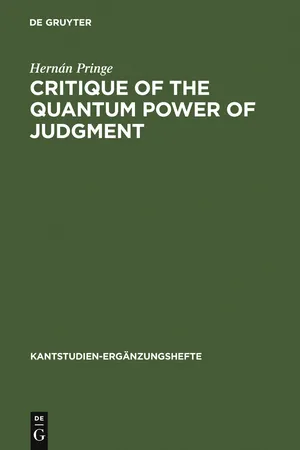
Critique of the Quantum Power of Judgment
A Transcendental Foundation of Quantum Objectivity
- 264 pages
- English
- PDF
- Available on iOS & Android
eBook - PDF
Critique of the Quantum Power of Judgment
A Transcendental Foundation of Quantum Objectivity
About this book
Information
Table of contents
- Introduction
- Part I Kantian Preliminaries
- 1 Kant on the Concepts of Analogy and Symbol
- 1.1 Analogies of Experience
- 1.2 Symbolic Analogies
- 1.3 Conclusions
- Part II The Conceptual Development of Bohr’s Thought
- 2 Correspondence
- 2.1 The Germ of Correspondence: The Hydrogen Atom
- 2.2 The Development of Correspondence: Multiperiodic Systems
- 2.3 The Crisis of Correspondence: The Bohr-Kramers-Slater Theory
- 2.4 Conclusions
- 3 Complementarity
- 3.1 Quantum Objects Are Not Directly Presentable in Intuition
- 3.2 Quantum Objects Are Indirectly Presentable in Intuition
- 3.3 Uncertainty Relations, Complementarity and Symbolism
- 3.4 Measurement and Definition
- 3.5 Matrix and Wave Mechanics
- 3.6 Conclusions
- 4 The Symbolic Character of Quantum Theory and the EPR Paper
- 4.1 The EPR Argument
- 4.2 The Insufficiency of Operationalism
- 4.3 An Example: A Position Measurement
- 4.4 The Ambiguity of EPR’s Realism
- 4.5 Bohr’s Criterion of Reality
- 4.6 Objective Validity and Objective Reality of the Concept of a Quantum Object
- 4.7 The Completeness of Quantum Theory
- 4.8 Conclusions
- 5. Between Kant and Bohr: Harald Høffding
- 5.1 Bohr on Symbolic Knowledge
- 5.2 Symbol in the Broad Sense
- 5.3 Symbol in the Strict Sense
- 5.4 Conclusions
- Part III A Transcendental Foundation of Quantum Objectivity
- 6 Critique of the Quantum Power of Judgment
- 6.1 Analytic of the Quantum Power of Judgment
- 6.2 Dialectic of the Quantum Power of Judgment
- 6.3 Methodology of the Quantum Power of Judgment
- 6.4 Appendix: Bohr on Purposiveness and Complementarity
- 6.5 Conclusions
- 7 On Other Transcendental Approaches to Quantum Mechanics
- 7.1 Cassirer’s Concept of Symbol and Quantum Theory
- 7.2 Hermanns Fragmentation of Truth
- 7.3 Mittelstaedt’s Non-Objectively Real Objects
- 7.4 Bitbol’s Pragmatic-Transcendental Approach
- 7.5 Petitot’s Transcendental Aesthetic of Hilbert Space
- 7.6 Strohmeyer, Infinite Judgments and the Principle of Complete Determination
- 7.7 Von Weizsäcker’s Transcendental Foundation of Quantum Theory
- 7.8 Conclusions
- Epilogue
- Bibliography
- Author index
Trusted by 375,005 students
Access to over 1.5 million titles for a fair monthly price.
Study more efficiently using our study tools.
Frequently asked questions
Yes, you can cancel anytime from the Subscription tab in your account settings on the Perlego website. Your subscription will stay active until the end of your current billing period. Learn how to cancel your subscription
No, books cannot be downloaded as external files, such as PDFs, for use outside of Perlego. However, you can download books within the Perlego app for offline reading on mobile or tablet. Learn how to download books offline
We are an online textbook subscription service, where you can get access to an entire online library for less than the price of a single book per month. With over 1.5 million books across 990+ topics, we’ve got you covered! Learn about our mission
Look out for the read-aloud symbol on your next book to see if you can listen to it. The read-aloud tool reads text aloud for you, highlighting the text as it is being read. You can pause it, speed it up and slow it down. Learn more about Read Aloud
Yes! You can use the Perlego app on both iOS and Android devices to read anytime, anywhere — even offline. Perfect for commutes or when you’re on the go.
Please note we cannot support devices running on iOS 13 and Android 7 or earlier. Learn more about using the app
Please note we cannot support devices running on iOS 13 and Android 7 or earlier. Learn more about using the app
Yes, you can access Critique of the Quantum Power of Judgment by Hernán Pringe in PDF and/or ePUB format, as well as other popular books in Philosophy & Epistemology in Philosophy. We have over 1.5 million books available in our catalogue for you to explore.