eBook - PDF
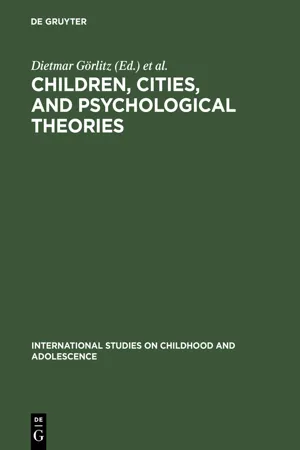
Children, Cities, and Psychological Theories
Developing Relationships
- 700 pages
- English
- PDF
- Available on iOS & Android
eBook - PDF
Children, Cities, and Psychological Theories
Developing Relationships
About this book
No detailed description available for "Children, Cities, and Psychological Theories".
Information
Table of contents
- Keynote
- Foreword
- How it all began – Background to this book
- Part I. Prelude and dedication
- Themes in the relation between children and the city
- Children’s life worlds in urban environments
- Toward a functional ecology of behavior and development: The legacy of Joachim F. Wohlwill
- Part II. Exposition of theoretical perspectives
- Introduction
- A. Levels of relationship – As they appear in different cultures
- Introduction
- A dialectical/transactional framework of social relations: Children in secondary territories
- Comment: Proving philosophy!?
- Authors’ response: Translating a world view
- A contextualist perspective on child-environment relations
- Comment: Clarifying fusion
- Child development and environment: A constructivist perspective
- Comment: Constructivist potentialities and limitations
- Author’s response: Following Aristotle
- Integration: What environment? Which relationship?
- B. Transactional, holistic, and relational-developmental perspectives on children in the cities
- Introduction
- Transactionalism
- Comment: Transactionalism – What could it be?
- Author’s response: Is Lang going beyond?
- A holistic, developmental, systems-oriented perspective: Child-environment relations
- Comment: Werner augmented
- Relational-developmental theory: A psychological perspective
- Comment: From the general to the individual or from the individual to the general?
- Author’s response: General and individual – A relation
- Integration: Dimensions of a conceptual space – But for what?
- C. Modern versions of Barker’s ecological psychology and the phenomenological perspective
- Introduction
- Children’s environments: The phenomenological approach
- Comment: Don’t forget the subjects – An approach against environmentalism
- Authors’ response: Reading a text – A case study in perspectivity
- Commentators’ reply: Seductive sciences
- Behavior settings in macroenvironments: Implications for the design and analysis of places
- Comment: Behavior setting revitalized
- Behavior settings as vehicles of children’s cultivation
- Comment: Behavior settings forever!
- Integration: Ecological psychology and phenomenology – Their commonality, differences, and interrelations
- D. Sociobiology, attachment theory, and ecological psychology – Marching towards the city
- Introduction
- Exploratory behavior, place attachment, genius loci, and childhood concepts: Elements of understanding children’s interactions with their environments
- Comment: Gender are two
- Author’s response: ... but different ones
- Children in cities: An ethological/sociobiological approach
- Comment: And ethology?
- Author’s response: Adaptive variations and the individual
- Street traffic, children, and the extended concept of affordance as a means of shaping the environment
- Comment: Children as perceivers and actors – The view from ecological realism
- Authors’ response: Environmental design means the design of affordances
- Commentator’s reply: The extended concept reconsidered
- Integration: The path to integration is not straight
- Reflections: What has happened in treading the path toward a psychological theory of children and their cities
- Part III. The Finale
- Integrating youth- and context-focused research and outreach: A developmental contextual model
- The young and the old in the city: Developing intergenerational relationships in urban environments
- Where we are – A discussion
- Appendix
- Biographical notes
- Subject index
- Author index
Trusted by 375,005 students
Access to over 1.5 million titles for a fair monthly price.
Study more efficiently using our study tools.
Frequently asked questions
Yes, you can cancel anytime from the Subscription tab in your account settings on the Perlego website. Your subscription will stay active until the end of your current billing period. Learn how to cancel your subscription
No, books cannot be downloaded as external files, such as PDFs, for use outside of Perlego. However, you can download books within the Perlego app for offline reading on mobile or tablet. Learn how to download books offline
Perlego offers two plans: Essential and Complete
- Essential is ideal for learners and professionals who enjoy exploring a wide range of subjects. Access the Essential Library with 800,000+ trusted titles and best-sellers across business, personal growth, and the humanities. Includes unlimited reading time and Standard Read Aloud voice.
- Complete: Perfect for advanced learners and researchers needing full, unrestricted access. Unlock 1.5M+ books across hundreds of subjects, including academic and specialized titles. The Complete Plan also includes advanced features like Premium Read Aloud and Research Assistant.
We are an online textbook subscription service, where you can get access to an entire online library for less than the price of a single book per month. With over 1.5 million books across 990+ topics, we’ve got you covered! Learn about our mission
Look out for the read-aloud symbol on your next book to see if you can listen to it. The read-aloud tool reads text aloud for you, highlighting the text as it is being read. You can pause it, speed it up and slow it down. Learn more about Read Aloud
Yes! You can use the Perlego app on both iOS and Android devices to read anytime, anywhere — even offline. Perfect for commutes or when you’re on the go.
Please note we cannot support devices running on iOS 13 and Android 7 or earlier. Learn more about using the app
Please note we cannot support devices running on iOS 13 and Android 7 or earlier. Learn more about using the app
Yes, you can access Children, Cities, and Psychological Theories by Dietmar Görlitz, Hans Joachim Harloff, Günter Mey, Jaan Valsiner, Dietmar Görlitz,Hans Joachim Harloff,Günter Mey,Jaan Valsiner in PDF and/or ePUB format, as well as other popular books in Social Sciences & Developmental Psychology. We have over 1.5 million books available in our catalogue for you to explore.