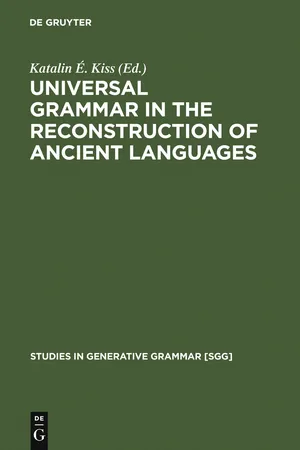
Philologists aiming to reconstruct the grammar of ancient languages face the problem that the available data always underdetermine grammar, and in the case of gaps, possible mistakes, and idiosyncracies there are no native speakers to consult. The authors of this volume overcome this difficulty by adopting the methodology that a child uses in the course of language acquisition: they interpret the data they have access to in terms of Universal Grammar (more precisely, in terms of a hypothetical model of UG). Their studies, discussing syntactic and morphosyntactic questions of Older Egyptian, Coptic, Sumerian, Akkadian, Biblical Hebrew, Classical Greek, Latin, and Classical Sanskrit, demonstrate that descriptive problems which have proved unsolvable for the traditional, inductive approach can be reduced to the interaction of regular operations and constraints of UG. The proposed analyses also bear on linguistic theory. They provide crucial new data and new generalizations concerning such basic questions of generative syntax as discourse-motivated movement operations, the correlation of movement and agreement, a shift from lexical case marking to structural case marking, the licensing of structural case in infinitival constructions, the structure of coordinate phrases, possessive constructions with an external possessor, and the role of event structure in syntax. In addition to confirming or refuting certain specific hypotheses, they also provide empirical evidence of the perhaps most basic tenet of generative theory, according to which UG is part of the genetic endowment of the human species - i.e., human languages do not "develop" parallel with the development of human civilization. Some of the languages examined in this volume were spoken as much as 5000 years old, still their grammars do not differ in any relevant respect from the grammars of languages spoken today.
- 532 pages
- English
- PDF
- Available on iOS & Android
eBook - PDF
Universal Grammar in the Reconstruction of Ancient Languages
About this book
Information
Table of contents
- Introduction
- The correlation between word order alternations, grammatical agreement and event semantics in Older Egyptian
- The nominal cleft construction in Coptic Egyptian
- Genitive constructions in Coptic
- Left-dislocated possessors in Sumerian
- Complex predicate structure and pluralised events in Akkadian
- VSO and left-conjunct agreement: Biblical Hebrew vs. Modern Hebrew
- IE *weid- as a root with dual subcategorization features in the Homeric poems
- The syntax of Classical Greek infinitive
- Latin object and subject infinitive clauses
- Latin word order in generative perspective: An explanatory proposal within the sentence domain
- Some firm points on Latin word order: The left periphery
- Classical Sanskrit, “wild trees”, and the properties of free word order languages
- A particular coordination structure of Indo-European flavour
- Index
- List of contributors
Trusted by 375,005 students
Access to over 1.5 million titles for a fair monthly price.
Study more efficiently using our study tools.
Frequently asked questions
Yes, you can cancel anytime from the Subscription tab in your account settings on the Perlego website. Your subscription will stay active until the end of your current billing period. Learn how to cancel your subscription
No, books cannot be downloaded as external files, such as PDFs, for use outside of Perlego. However, you can download books within the Perlego app for offline reading on mobile or tablet. Learn how to download books offline
Perlego offers two plans: Essential and Complete
- Essential is ideal for learners and professionals who enjoy exploring a wide range of subjects. Access the Essential Library with 800,000+ trusted titles and best-sellers across business, personal growth, and the humanities. Includes unlimited reading time and Standard Read Aloud voice.
- Complete: Perfect for advanced learners and researchers needing full, unrestricted access. Unlock 1.5M+ books across hundreds of subjects, including academic and specialized titles. The Complete Plan also includes advanced features like Premium Read Aloud and Research Assistant.
We are an online textbook subscription service, where you can get access to an entire online library for less than the price of a single book per month. With over 1.5 million books across 990+ topics, we’ve got you covered! Learn about our mission
Look out for the read-aloud symbol on your next book to see if you can listen to it. The read-aloud tool reads text aloud for you, highlighting the text as it is being read. You can pause it, speed it up and slow it down. Learn more about Read Aloud
Yes! You can use the Perlego app on both iOS and Android devices to read anytime, anywhere — even offline. Perfect for commutes or when you’re on the go.
Please note we cannot support devices running on iOS 13 and Android 7 or earlier. Learn more about using the app
Please note we cannot support devices running on iOS 13 and Android 7 or earlier. Learn more about using the app
Yes, you can access Universal Grammar in the Reconstruction of Ancient Languages by Katalin É. Kiss in PDF and/or ePUB format, as well as other popular books in Languages & Linguistics & Languages. We have over 1.5 million books available in our catalogue for you to explore.