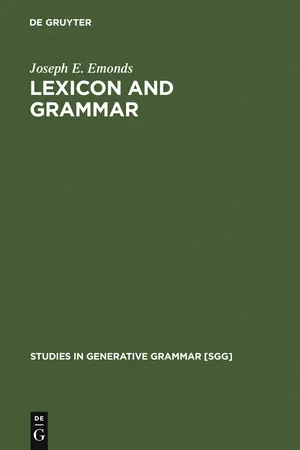
- 496 pages
- English
- PDF
- Available on iOS & Android
eBook - PDF
About this book
No detailed description available for "Lexicon and Grammar".
Trusted by 375,005 students
Access to over 1.5 million titles for a fair monthly price.
Study more efficiently using our study tools.
Information
Table of contents
- Preface
- Acknowledgments
- Author’s academic biography
- Chapter 1. Categories and feature inventories of Universal Grammar
- 1.1 A theory and practice of well-formed lexical entries
- 1.2 Types of syntactic categories and features
- 1.3 A theory of phrase structure as Extended Projections
- 1.4 The interplay among derivations, the Lexicon, and Economy Principles
- 1.5 An excursus into IP reference and economy at the LF Interface
- Chapter 2. Subcategorization: Syntax as the material basis of semantics
- 2.1 Advantages of classical subcategorization
- 2.2 Extending and restricting subcategorization to syntactic features
- 2.3 Syntactic vs. semantic selection: sisterhood is powerful
- 2.4 Determining Theta Roles by interpretive principles
- 2.5 Indeterminacy of object roles: the LOCATION feature on V
- 2.6 Indeterminacy of subject roles: variation in principal role
- 2.7 A Gedanken Experiment for learning lexical entries
- Chapter 3. Subcategorization inside words: Morphology as grammatical compounding
- 3.1 Marked and unmarked headedness: English vs. Japanese
- 3.2 The independence of head directionality and domain size: French word order
- 3.3 Combining word-internal and phrasal trees
- 3.4 Conflating syntactic and morphological subcategorization
- 3.5 Where it’s at: Morphology as a special case of compounding
- 3.6 Relating morphological typology to free form properties
- 3.7 Dictionary and Syntacticon: a new slant on lexical research
- Chapter 4. Multi-level lexical insertion: Explaining Inflection and Derivation
- 4.1 The bifurcated lexical model: Dictionary and Syntacticon
- 4.2 Levels of lexical insertion
- 4.3 Defining and dividing morphology
- 4.4 Inflectional morphology as late insertion
- 4.5 Alternative Realization on free morphemes
- 4.6 Derivational morphology: the arguments of lexically derived forms
- 4.7 English nominalizations: confirming the Syntacticon model
- 4.8 Expanded list of differences between the Dictionary and the Syntacticon
- Chapter 5. Passive syntactic structures
- 5.1 The common syntax of Verbal and Adjectival passives
- 5.2 Differences between Verbal and Adjectival passives
- 5.3 Two insertion levels in syntax: two types of passive Adjectives
- 5.4 The Verbal (inflectional) passive
- 5.5 Cross-linguistic variation in impersonal passives
- 5.6 The strange Case of perfect participles
- Chapter 6. The genesis of flat structures: Linking verbs, “light” verbs and “restructuring”
- 6.1 Surprising consequences of higher empty heads
- 6.2 Flatter lexical projections for predicate adjectives and participles
- 6.3 Flatter lexical projections induced by “light” verbs
- 6.4 Theoretical limits on possible flat structures
- 6.5 Differing lexical projections induced by restructuring verbs
- 6.6 The excess content of integrating syntax and morphology
- Appendix to chapter 6. Causative and perception verb “clause union”
- A.1 Burzio’s parallels between causatives and restructuring
- A.2 Kayne’s three patterns of Romance causatives
- A.3 Implications of a generalized definition of subject
- A.4 The syntax of internal arguments which are LF Subjects
- A.5 Revising the SSC and Principle A: Local Binding in LF
- Chapter 7. Subcategorization across syntactic empty heads
- 7.1 A review of Revised Classical Subcategorization
- 7.2 The source of intermediate empty heads
- 7.3 The Deep Case Filter: a basis for articulated structure and recursion
- 7.4 The range and genesis of adjunct constructions
- 7.5 Empty inflectional heads and economy of non-finite clauses
- 7.6 Present participles and the Revised Theta Criterion
- Chapter 8. The restricted complement space of lexical frames
- 8.1 The range of single phrase complements
- 8.2 Limitations on multiple complements
- 8.3 The Case of predicate attributes
- 8.4 The restrictive Syntactic Lexicon confronts open-ended Conceptual Space
- Chapter 9. Licensing and identification of null complements
- 9.1 Syntactic identification and subcategorization
- 9.2 Three hypotheses for understood complements
- 9.3 Discourse identification: Grimshaw’s null complement anaphora
- 9.4 Rizzi’s generic null objects
- 9.5 The impotence of the lexical item
- Chapter 10. Understood subjects: Generalizing Pro
- 10.1 Subcategorization and obligatory control
- 10.2 Pragmatic control
- 10.3 Imperatives, direct and embedded
- 10.4 Understood agents in passive clauses
- 10.5 Nature’s bottleneck
- Summary of principles
- Sample Lexicon
- References
- Subject Index
Frequently asked questions
Yes, you can cancel anytime from the Subscription tab in your account settings on the Perlego website. Your subscription will stay active until the end of your current billing period. Learn how to cancel your subscription
No, books cannot be downloaded as external files, such as PDFs, for use outside of Perlego. However, you can download books within the Perlego app for offline reading on mobile or tablet. Learn how to download books offline
Perlego offers two plans: Essential and Complete
- Essential is ideal for learners and professionals who enjoy exploring a wide range of subjects. Access the Essential Library with 800,000+ trusted titles and best-sellers across business, personal growth, and the humanities. Includes unlimited reading time and Standard Read Aloud voice.
- Complete: Perfect for advanced learners and researchers needing full, unrestricted access. Unlock 1.5M+ books across hundreds of subjects, including academic and specialized titles. The Complete Plan also includes advanced features like Premium Read Aloud and Research Assistant.
We are an online textbook subscription service, where you can get access to an entire online library for less than the price of a single book per month. With over 1.5 million books across 990+ topics, we’ve got you covered! Learn about our mission
Look out for the read-aloud symbol on your next book to see if you can listen to it. The read-aloud tool reads text aloud for you, highlighting the text as it is being read. You can pause it, speed it up and slow it down. Learn more about Read Aloud
Yes! You can use the Perlego app on both iOS and Android devices to read anytime, anywhere — even offline. Perfect for commutes or when you’re on the go.
Please note we cannot support devices running on iOS 13 and Android 7 or earlier. Learn more about using the app
Please note we cannot support devices running on iOS 13 and Android 7 or earlier. Learn more about using the app
Yes, you can access Lexicon and Grammar by Joseph E. Emonds in PDF and/or ePUB format, as well as other popular books in Languages & Linguistics & Linguistics. We have over 1.5 million books available in our catalogue for you to explore.