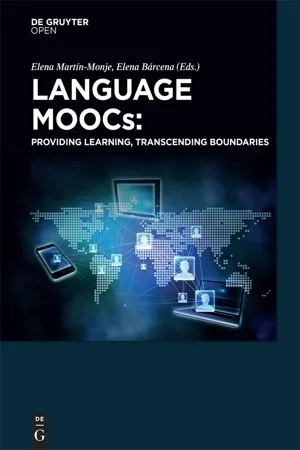
Language MOOCs (or LMOOCs) are dedicated Web-based online courses for second languages with unrestricted access and potentially unlimited participation. They are generating interest and expectation in the contexts of university education, lifelong learning and online training in general. This pioneering book presents an initial analysis of the theoretical and methodological issues underlying LMOOCs and presents empirical evidence of their potential for the development of language communicative competences, based upon previously unpublished research. It provides a mosaic-like view of LMOOC research, not only with respect to the geographical and institutional origin of its authors, but also to the heterogeneous nature of their respective academic backgrounds, and suggests directions for future development. As in other types of online language courses, the integration of the results of multidisciplinary research projects and teaching experiences related to LMOOCs is fundamental to make the field advance steadily and respond to some of the real challenges and problems faced by individuals working and living in competitive plurilingual societies today.
eBook - ePub
Language MOOCs
Providing Learning, Transcending Boundaries
- 185 pages
- English
- ePUB (mobile friendly)
- Available on iOS & Android
eBook - ePub
Language MOOCs
Providing Learning, Transcending Boundaries
About this book
Information
Subtopic
LanguagesElena Bárcena, Elena Martín-Monje
1 Introduction. Language MOOCs: an Emerging Field
Abstract: In this article the emerging field of Language MOOCs (LMOOCs) is presented. Firstly, the MOOC phenomenon is introduced as a revolutionary and challenging model within the related fields of formal education, lifelong learning and non-formal training, and its impact worldwide is analysed in the light of practical considerations. Secondly, the question of the suitability of different subject matters to be taught in the MOOC format is addressed, with special attention to languages. Thirdly, evidence of the presence of LMOOCs in the main platforms and providers worldwide is presented together with that of the existence of related research in the literature and in international congresses, all of which provides a context and a justification to the present text. Fourthly and finally, the contents of this text are briefly described, together with its intended audience and a few final remarks on the foreseeable research directions within the field of LMOOCs.
Keywords: second language learning, language MOOCs
1.1 Introduction
This book presents an initial analysis of theoretical and methodological issues underlying Language MOOCs (Massive Open Online Courses) and empirical evidence on their potential for the development of language communicative competences, based upon previously unpublished research. Language MOOCs (or LMOOCs) are dedicated Web-based online courses for second languages with unrestricted access and potentially unlimited participation. The ‘MOOC concept’ is far from new, since courses with such characteristics have been around for considerable time before Cormier explicitly used the term ‘MOOC’ in 2008 (Siemens, 2012). MOOCs are arguably the natural evolution of OERs (Open Educational Resources), which are freely accessible learning materials and media to be used for learning/teaching and assessment. Although the differences between MOOCs and OERs are self-evident, they are growing as new didactic approaches to the former appear, given the highly innovative and exploratory nature of the field. The much publicized objective of the MOOC educational model is to promote learning for a huge number of people with a shared interest, by removing most of the usual barriers for access and attendance (such as numerus clausus, deadlines, previous certifications and grades, and fees) (Lewin, 2012; Skiba, 2012), while preserving all/most of the defining features of an academic course (a subject matter, one or more learning goals, materials, a method with activities, tasks, etc., and, in some cases, the achievement of a certain number of credits and/or a certificate at the end). It is not surprising, therefore, that despite the conflict with the interests of formal educational institutions (and their seemingly opposite business model) and the criticisms expressed by some academicians (Romeo, 2012; Jackson, 2013), MOOCs are having a significant impact on the online educational community, with hundreds of thousands of people undertaking these courses worldwide. It is not only about the economic attractiveness or the flexibility of being able to come and go from a course at will. As potential student (that is to say, someone who wants to study something or undergo some sort of highly specific training to update his/her academic/professional capabilities in order to cope with current demands) numbers increase, possibly to more than 100 million by 2020, it will be simply impossible to attend such demand in standard universities and other similar educational establishments (Read & Bárcena, in press).
For the reasons highlighted above, MOOCs represent a challenge to the standard institutional model of education for authorities and particularly for course developers, curators and facilitators. At this moment, there are several well-established MOOC platforms containing thousands of teaching units (e.g., www.moocs.co) aimed at an extremely diverse public. They include topics coming from a wide range of academic disciplines such as modern astrophysics, the Spanish 1978 Constitution, to more skillbased subject matters like engineering mechanics and written Mandarin Chinese, professional training like inspiring leadership through emotional intelligence and an introduction to financial accounting, and other topics, such as, how to register in an American university, how to organize your time and money and, of course, MOOC design (www.mooc-list.com). Without attempting to belittle the enormous challenge involved in designing and undertaking certain MOOCs, there is currently no evidence of any topic that cannot be taught using this educational model. However, it must be acknowledged that, leaving aside the different quality levels in the instructional design of individual MOOCs, there are different degrees of success with which a given subject can be expected to be effectively taught in a MOOC per se, as certain reports have pointed out (Viswanathan, 2012; Bruff et al., 2013).
Before considering the theoretical suitability of MOOCs for learning second languages, the following aspects need to be taken into account: firstly, language learning is not only knowledge-based, in the sense that it requires the rather passive assimilation of vocabulary items and combinatory rules, but is mainly skill-based, in that it involves putting into practice an intricate array of receptive, productive and interactive verbal (and non-verbal) functional capabilities, whose role in the overall success of the communicative act is generally considered to be more prominent than that of the formal or organizational elements (Halliday, 1993; Whong, 2011). Secondly, and linked to the previous point, assuming that the goal of language learning is language use, it is only common sense to infer that the former should entail considerable practice of the latter, just like a student must play the piano to become a pianist or take photographs to become a photographer. Thirdly, all variables being equal, the mind that learns (a language) best is the proactive and engaged mind with its high order skills (relating, contrasting, criticising, inquiring, justifying, deducing, etc.) activated, rather than just memorization and mechanical reproduction. Finally, after infancy, one is generally assumed to gradually lose some of the innate language acquisition abilities and acquire a more rule-based cognitive profile (e.g., Meltzoff & Prinz, 2002). Hence, the language learner is likely to benefit from the well-known explicit type of learning model, something partly based on face-to-face/textual/visual explanations with illustrative examples followed by some interesting and creative form of practice. Part of this process will be more effective if undertaken individually, particularly for the improvement of certain areas of language, such as pronunciation or punctuation, as it provides the necessary flexibility and adaptation to personal learning styles, rhythms and circumstances, and enhances metacognitive processes.
Furthermore, if the successful language learner is expected to assume an active role in his/her own learning, since knowledge is generally self-constructed rather than transferred, s/he requires the opportunity to build strategies and connections that are significant for him/her at a given moment in time, in an adaptive manner. However, given the intrinsically social nature of verbal communication, negotiating meaning, engaging in group work, providing mutual assistance, and constructing and sharing new knowledge and skills collaboratively with others have all been widely praised in the second language learning literature (Nunan, 1992; Warschauer & Kern, 2000). Although learners’ production is bound to contain inaccuracies and the validity of peer feedback, therefore, may not always be reliable, language learning is no longer restricted to the idea of the ceaseless imitation of an ideal, the ‘flawless’ performance of a single teacher (and/or set of quality recognized materials). Nowadays, the ultimate objective of language learning is generally accepted to be proficient engagement in intelligible, empathic, and effective verbal performance, in a varied set of contexts and situations, with different types of interlocutors (Council of Europe, 2001; The National Capital Language Resource Center, 2003).
The authors claim that these, among other principles, underlie language learning, and that, on this basis, open online courses can be effectively designed to facilitate the development of communicative language capabilities for potentially massive and highly heterogeneous groups, whose only common goal is their desire to learn a given language. Although it is premature to claim that entire languages can be learnt effectively online, particularly when compared to classroom-based instruction, the vast amount of research that has been undertaken in the field of CALL (Computer Assisted Language Learning) for several decades now (e.g., Warschauer, 1993; Bax, 2003; Yang, 2010) has demonstrated the suitability of computer usage for enhancing features which, in turn, are generally accepted to promote language learning (such as an increase of exposure time to the language or interlocutor diversification) and also the development, practice and improvement of discrete language communicative competences. This is particularly the case in the age of digital communication (not only in the international professional environment but also at social and personal levels), which puts an end to the long-term debate about the inadequacy of computer-based communication for the development of cer...
Table of contents
- Cover
- Title
- Half Title
- Copyright
- Contents
- List of Contributing Authors
- 1 Introduction. Language MOOCs: an Emerging Field
- 2 What Constitutes an Effective Language MOOC?
- 3 A Proposal for the Methodological Design of Collaborative Language MOOCs
- 4 Motivation in a Language MOOC: Issues for Course Designers
- 5 Language Teaching in MOOCs: the Integral Role of the Instructor
- 6 The Architectonics of Language MOOCs
- 7 Accessibility in Language MOOCs
- 8 Ethical and Aesthetic Considerations in Language Moocs
- 9 Teaching Pronunciation and Comprehensibility in a Language MOOC
- 10 Conclusion. Reflections on Present and Future: towards an Ontological Approach to LMOOCs
- Index
- back
Trusted by 375,005 students
Access to over 1.5 million titles for a fair monthly price.
Study more efficiently using our study tools.
Frequently asked questions
Yes, you can cancel anytime from the Subscription tab in your account settings on the Perlego website. Your subscription will stay active until the end of your current billing period. Learn how to cancel your subscription
No, books cannot be downloaded as external files, such as PDFs, for use outside of Perlego. However, you can download books within the Perlego app for offline reading on mobile or tablet. Learn how to download books offline
Perlego offers two plans: Essential and Complete
- Essential is ideal for learners and professionals who enjoy exploring a wide range of subjects. Access the Essential Library with 800,000+ trusted titles and best-sellers across business, personal growth, and the humanities. Includes unlimited reading time and Standard Read Aloud voice.
- Complete: Perfect for advanced learners and researchers needing full, unrestricted access. Unlock 1.5M+ books across hundreds of subjects, including academic and specialized titles. The Complete Plan also includes advanced features like Premium Read Aloud and Research Assistant.
We are an online textbook subscription service, where you can get access to an entire online library for less than the price of a single book per month. With over 1.5 million books across 990+ topics, we’ve got you covered! Learn about our mission
Look out for the read-aloud symbol on your next book to see if you can listen to it. The read-aloud tool reads text aloud for you, highlighting the text as it is being read. You can pause it, speed it up and slow it down. Learn more about Read Aloud
Yes! You can use the Perlego app on both iOS and Android devices to read anytime, anywhere — even offline. Perfect for commutes or when you’re on the go.
Please note we cannot support devices running on iOS 13 and Android 7 or earlier. Learn more about using the app
Please note we cannot support devices running on iOS 13 and Android 7 or earlier. Learn more about using the app
Yes, you can access Language MOOCs by Elena Martín-Monje, Elena Bárcena, Elena Martín-Monje,Elena Bárcena in PDF and/or ePUB format, as well as other popular books in Languages & Linguistics & Languages. We have over 1.5 million books available in our catalogue for you to explore.