eBook - PDF
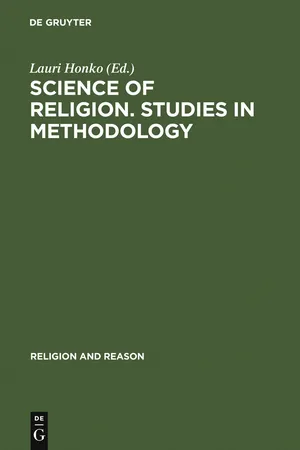
Science of Religion. Studies in Methodology
Proceedings of the Study Conference of the International Association for the History of Religions, held in Turku, Finland, August 27-31, 1973
- 668 pages
- English
- PDF
- Available on iOS & Android
eBook - PDF
Science of Religion. Studies in Methodology
Proceedings of the Study Conference of the International Association for the History of Religions, held in Turku, Finland, August 27-31, 1973
About this book
No detailed description available for "Science of Religion. Studies in Methodology".
Information
Topic
Theology & ReligionSubtopic
Biblical StudiesTable of contents
- PREFACE
- LIST OF PARTICIPANTS
- INTRODUCTION BY LAURI HONKO
- PART ONE: ORAL AND WRITTEN DOCUMENTATION OF RELIGIOUS TRADITION
- 1A. Preliterate Stages and Formation of the Canon in Book Religions
- Helmer Ringgren, Problems of the Formation and Function of a Canon
- M. Heerma van Voss, Methodology and the Egyptian Book of the Dead
- Commentary by Jan Bergman
- Commentary by Carl-Martin Edsman
- Discussion
- 1B. Taxonomy and Source Criticism of Oral Tradition
- Juha Pentikäinen, Taxonomy and Source Criticism of Oral Tradition
- Anna-Birgitta Rooth, On the Difficulty of Transcribing Synchronic Perception into Diachronic Verbalization
- Commentary by Leander Petzoldt
- Discussion
- 1C. Literary Source Criticism
- Joseph Kitagawa, Early Shinto: A Case Study
- Kurt Rudolph, The Position of Source Research in Religious Studies
- Commentary by Ileana Chirassi-Colombo
- Commentary by William Klassen
- Commentary by Eric Segelberg
- Discussion
- PART TWO: THE FUTURE OF THE PHENOMENOLOGY OF RELIGION
- 2A. Evaluation of Previous Methods
- Haralds Biezais, Typology of Religion and the Phenomenological Method
- Carsten Colpe, Symbol Theory and Copy Theory as Basic Epistemological and Conceptual Alternatives in Religious Studies
- Commentary by C.J. Bleeker
- Commentary by Walter H. Capps
- Commentary by H.-J. Klimkeit
- Commentary by Reinhard Pummer
- Commentary by Eric J. Sharpe
- Discussion
- 2B. Religio-ecological Approach
- Åke Hultkrantz, Ecology of Religion: Its Scope and Methodology
- Svein Bjerke, Ecology of Religion, Evolutionism and Comparative Religion
- Commentary by Manfred Büttner
- Commentary by Asok K. Ghosh
- Commentary by C. G. Oosthuizen
- Commentary by Edmund Perry
- Commentary by Zygmunt Poniatowski
- Discussion
- 2C. Religio-anthropological Approach
- Ugo Bianchi, The History of Religions and the ‘Religioanthropological Approach’
- Melford E. Spiro, Symbolism and Functionalism in the Anthropological Study of Religion
- Commentary by Horst Cain
- Commentary by Hans H. Penner
- Commentary by Robert F. Spencer
- Commentary by Annemarie de Waal Malefijt
- Discussion
- PART THREE: RELIGION AS EXPRESSIVE CULTURE
- 3A. Theories Concerning the Ritual Process
- Lauri Honko, Theories Concerning the Ritual Process: An Orientation
- James Peacock, Notes on a Theory of the Social Evolution of Ritual
- Commentary by G. J. F. Bouritius
- Commentary by Jacques H. Kamstra
- Commentary by Anthony Jackson
- Discussion
- 3B. The Language of Religion
- James Barr, The Language of Religion
- Jacques Waardenburg, The Language of Religion, and the Study of Religions as Sign Systems
- Commentary by Aili Nenola-Kallio
- Commentary by Ninian Smart
- Commentary by Hans Wissman
- Discussion
- 3C. Depth Structures of Religious Expression
- J. van Baal, The Scandal of Religion
- Kurt Goldammer, Is There a Method of Symbol Research Which Offers Hermeneutic Access to Depth-Dimensions of Religious Experience?
- Commentary by Th. P. van Baaren
- Commentary by Ulf Drobin
- Commentary by Michael Pye
- Commentary by R.J. Zwi Werblowsky
- Discussion
- INDEX OF PERSONAL NAMES
- INDEX OF SUBJECTS
Trusted by 375,005 students
Access to over 1.5 million titles for a fair monthly price.
Study more efficiently using our study tools.
Frequently asked questions
Yes, you can cancel anytime from the Subscription tab in your account settings on the Perlego website. Your subscription will stay active until the end of your current billing period. Learn how to cancel your subscription
No, books cannot be downloaded as external files, such as PDFs, for use outside of Perlego. However, you can download books within the Perlego app for offline reading on mobile or tablet. Learn how to download books offline
Perlego offers two plans: Essential and Complete
- Essential is ideal for learners and professionals who enjoy exploring a wide range of subjects. Access the Essential Library with 800,000+ trusted titles and best-sellers across business, personal growth, and the humanities. Includes unlimited reading time and Standard Read Aloud voice.
- Complete: Perfect for advanced learners and researchers needing full, unrestricted access. Unlock 1.5M+ books across hundreds of subjects, including academic and specialized titles. The Complete Plan also includes advanced features like Premium Read Aloud and Research Assistant.
We are an online textbook subscription service, where you can get access to an entire online library for less than the price of a single book per month. With over 1.5 million books across 990+ topics, we’ve got you covered! Learn about our mission
Look out for the read-aloud symbol on your next book to see if you can listen to it. The read-aloud tool reads text aloud for you, highlighting the text as it is being read. You can pause it, speed it up and slow it down. Learn more about Read Aloud
Yes! You can use the Perlego app on both iOS and Android devices to read anytime, anywhere — even offline. Perfect for commutes or when you’re on the go.
Please note we cannot support devices running on iOS 13 and Android 7 or earlier. Learn more about using the app
Please note we cannot support devices running on iOS 13 and Android 7 or earlier. Learn more about using the app
Yes, you can access Science of Religion. Studies in Methodology by Lauri Honko in PDF and/or ePUB format, as well as other popular books in Theology & Religion & Biblical Studies. We have over 1.5 million books available in our catalogue for you to explore.