eBook - PDF
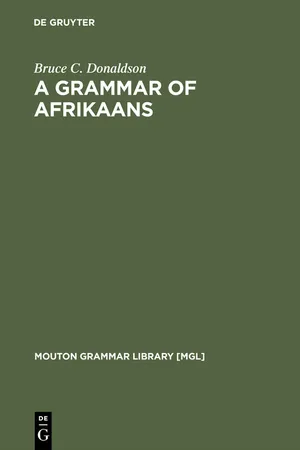
A Grammar of Afrikaans
About this book
No detailed description available for "A Grammar of Afrikaans".
Information
Table of contents
- Preface
- Abbreviations
- 1 Pronunciation
- 1.1 The short vowels
- 1.2 The long vowels
- 1.3 The diphthongs
- 1.4 The consonants
- 1.5 The phonology of international loanwords
- 1.6 Pronunciation of Afrikaans names
- 1.7 Pronunciation of South African and foreign place names
- 1.8 Insertion of svarabhakti vowels to break up consonant clusters
- 1.9 Assimilation
- 1.10 Stress
- 2 Spelling
- 2.1 The alphabet
- 2.2 The Afrikaanse Woordelys en Spelreëls
- 2.3 Syllabification
- 2.4 Spelling changes in derived forms
- 2.5 The use of diacritic marks in Afrikaans orthography
- 2.6 Use of the apostrophe
- 2.7 Use of the hyphen
- 2.8 Capital letters
- 2.9 Spelling of loanwords
- 2.10 Punctuation
- 3 Articles
- 3.1 The definite article
- 3.2 The indefinite article
- 4 Nouns
- 4.1 Pluralisation of nouns
- 4.2 Diminutisation of nouns
- 4.3 Feminising endings
- 4.4 Possession
- 4.5 Proper nouns
- 4.6 Nominalisation of adjectives
- 4.7 Nominalisation of infinitives
- 4.8 Formation of nouns
- 5 Pronouns
- 5.1 Personal pronouns
- 5.2 Demonstrative pronouns
- 5.3 Relative pronouns
- 5.4 Reflexive pronouns
- 5.5 The reciprocal pronoun mekaar ‘each other’
- 5.6 Indefinite pronouns
- 5.7 Interrogative pronouns
- 6 Adjectives
- 6.1 Adjectives that take -e
- 6.2 Adjectives that don’t take -e
- 6.3 Nominalised adjectives
- 6.4 Adjectives derived from past participles
- 6.5 Adjectival inflection in -s
- 6.6 The comparative of the adjective
- 6.7 The superlative of the adjective
- 6.8 Adjectival intensifiers
- 6.9 Formation of adjectives
- 6.10 Colours
- 6.11 Adjectives followed by a fixed preposition
- 6.12 Prenominal adjectival phrases
- 6.13 Some adjectival idiosyncrasies
- 7 Adverbs
- 7.1 Adverbial use of adjectives
- 7.2 Adverbs of degree that qualify adjectives
- 7.3 Adverbs of time
- 7.4 Adverbs of manner
- 7.5 Adverbs of place
- 7.6 Adverbial use of prepositions
- 7.7 Adverbs of modality
- 7.8 Conjunctional adverbs
- 7.9 Interrogative adverbs
- 7.10 Formation of adverbs
- 8 Verbs
- 8.1 Paradigm of the present and past tenses of a typical verb
- 8.2 Alternative forms of the stem of a verb
- 8.3 Progressive or continuous constructions
- 8.4 Vestiges of the imperfect
- 8.5 The perfect tense
- 8.6 The historic present
- 8.7 The pluperfect
- 8.8 The conditional tense
- 8.9 The imperative
- 8.10 The future and future perfect tenses
- 8.11 Wees ‘to be’
- 8.12 He ‘to have’
- 8.13 Modal auxiliary verbs
- 8.14 The passive voice
- 8.15 Separable and inseparable verbs
- 8.16 The infinitive
- 8.17 The present participle
- 8.18 Irregular past participles
- 8.19 Verbs that take a prepositional object
- 8.20 Reflexive verbs
- 8.21 Order of verbs
- 8.22 Transitive versus intransitive verbs
- 9 Conjunctions
- 9.1 Co-ordinating conjunctions
- 9.2 Adverbial conjunctions
- 9.3 Correlative conjunctions
- 9.4 Subordinating conjunctions
- 9.5 Interrogatives
- 9.6 Conjunctions which introduce infinitive clauses
- 10 Interrogatives
- 10.1 Word order in interrogative clauses
- 10.2 Interrogatives in infinitive clauses
- 10.3 Whatever, whenever etc
- 11 Prepositions
- 11.1 List of prepositions
- 11.2 Prepositional stranding
- 11.3 Met > mee, tot > toe and vir > voor
- 11.4 Compound prepositions in -kant
- 11.5 Adverbial functions of prepositions
- 11.6 Assimilation of the definite article to a preceding preposition
- 11.7 Adjectives and verbs followed by a fixed preposition
- 11.8 Omission of prepositions
- 11.9 Insertion of prepositions where none is required in English
- 11.10 Postpositioned prepositions
- 11.11 Double prepositions
- 11.12 Circumpositioned prepositions in prepositional phrases
- 11.13 Prepositional phrases
- 11.14 Adverbial qualifiers of prepositions
- 11.15 Prepositional phrases consisting of with + noun + it/them
- 12 Word order
- 12.1 Order of verbs
- 12.2 Nominal and adjectival/adverbial adjuncts that can behave like separable prefixes
- 12.3 Order of objects, adjectives and adverbs qualifying verbs in the continuous constructions formed from lê, loop, sit and staan
- 12.4 Position of nominal and pronominal direct and indirect objects
- 12.5 Position of reflexive pronouns
- 12.6 Position of adverbs
- 12.7 Placing of various parts of speech at the beginning of a sentence for emphasis
- 12.8 Prepositional stranding
- 12.9 Position in an infinitive clause of a preposition dependent on a predicative adjective or verb
- 12.10 Position of adjectives that take a fixed preposition
- 12.11 Independent prepositions rendering preposition + ‘it/them’
- 12.12 Idiomatic expressions consisting of two elements with the reverse order to English
- 13 Negation
- 13.1 The negators
- 13.2 Rules for the use and position of the scope marker
- 13.3 Use of the scope marker with the negators geen/g’n ‘no, not any’, nêrens ‘nowhere’, niemand ‘no-one’, niks ‘nothing’, nooit ‘never’
- 13.4 Position of the negator
- 13.5 Geen/g’n ‘no, not a, not any’
- 13.6 Me eens/eers ‘not even,’ nooit eens/eers ‘never even’
- 13.7 Glad / hoegenaamd nie ‘not/no ... at all’
- 13.8 So nie ‘if not’, al dan nie ‘or not’, nie so seer nie ‘not so much’
- 13.9 Eers ‘not until’
- 13.10 Net nie ‘simply not’, nie net ‘not only/just’
- 13.11 Moenie/moet + nie in imperatives
- 13.12 Nie- (non- + noun)
- 13.13 Use of wel to reverse a negative
- 13.14 Use of nè, nie waar nie and is dit nie
- 13.15 Negation in rhetorical questions
- 13.16 Non-negator negatives
- 13.17 Assimilation of nie to preceding consonants
- 14 Numerals
- 14.1 Cardinal numerals
- 14.2 Ordinal numerals
- 14.3 Fractions
- 14.4 Arithmetic
- 14.5 Telling the time
- 14.6 Telephone numbers
- 14.7 Dates
- 14.8 Age
- 14.9 Currency and measurement
- 14.10 School marks
- 14.11 School class levels
- 15 Word formation
- 15.1 Vestiges of historical structures in word formation
- 15.2 Formation of nouns
- 15.3 Formation of adjectives
- 15.4 Formation of adverbs
- 15.5 Formation of verbs
- 15.6 Derivatives of numerals
- 15.7 Reduplication
- Appendix 1: Texts
- Appendix 2: Letter writing
- Appendix 3: Greetings, apologies, swearing etc
- Glossary
- Bibliography
- Index
Trusted by 375,005 students
Access to over 1.5 million titles for a fair monthly price.
Study more efficiently using our study tools.
Frequently asked questions
Yes, you can cancel anytime from the Subscription tab in your account settings on the Perlego website. Your subscription will stay active until the end of your current billing period. Learn how to cancel your subscription
No, books cannot be downloaded as external files, such as PDFs, for use outside of Perlego. However, you can download books within the Perlego app for offline reading on mobile or tablet. Learn how to download books offline
Perlego offers two plans: Essential and Complete
- Essential is ideal for learners and professionals who enjoy exploring a wide range of subjects. Access the Essential Library with 800,000+ trusted titles and best-sellers across business, personal growth, and the humanities. Includes unlimited reading time and Standard Read Aloud voice.
- Complete: Perfect for advanced learners and researchers needing full, unrestricted access. Unlock 1.5M+ books across hundreds of subjects, including academic and specialized titles. The Complete Plan also includes advanced features like Premium Read Aloud and Research Assistant.
We are an online textbook subscription service, where you can get access to an entire online library for less than the price of a single book per month. With over 1.5 million books across 990+ topics, we’ve got you covered! Learn about our mission
Look out for the read-aloud symbol on your next book to see if you can listen to it. The read-aloud tool reads text aloud for you, highlighting the text as it is being read. You can pause it, speed it up and slow it down. Learn more about Read Aloud
Yes! You can use the Perlego app on both iOS and Android devices to read anytime, anywhere — even offline. Perfect for commutes or when you’re on the go.
Please note we cannot support devices running on iOS 13 and Android 7 or earlier. Learn more about using the app
Please note we cannot support devices running on iOS 13 and Android 7 or earlier. Learn more about using the app
Yes, you can access A Grammar of Afrikaans by Bruce C. Donaldson in PDF and/or ePUB format, as well as other popular books in Languages & Linguistics & Linguistics. We have over 1.5 million books available in our catalogue for you to explore.