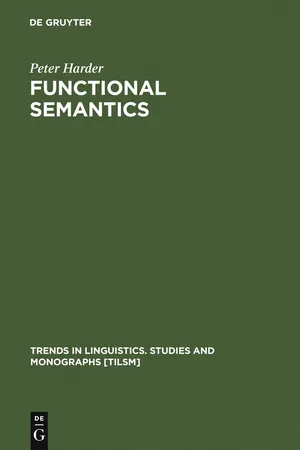
- 604 pages
- English
- PDF
- Available on iOS & Android
eBook - PDF
About this book
No detailed description available for "Functional Semantics".
Information
Table of contents
- Preface
- Part One: Meaning
- 1. Introduction
- 2. Meaning and the pursuit of knowledge: the world behind the word
- 2.1. Introduction
- 2.2. Plato on language and ideas
- 2.3. Aristotle: words and categories
- 2.4. Language and metaphysics in Plato and Aristotle
- 2.5. From classical to modern ontology: logic and the "linguistic turn"
- 2.6. The rise and fall of logical reconstruction
- 2.7. Logical and linguistic semantics
- 3. Meaning and cognition
- 3.1. Introduction
- 3.2. The "classical" computational approach
- 3.3. Language and meaning in the "classical" view
- 3.4. Intentionality, mental content and rules
- 3.5. Intentionality and information
- 3.6. The second cognitive revolution: cognitive linguistics and connectionism
- 3.7. Pan-cognitivism: turning behaviourism on its head
- 3.8. Continuity and differentiation: a delicate balance
- 3.9. Cognition: the differentiation and interrelation of skills
- 3.10. Problems with the word "conceptual" as used in cognitive linguistics
- 3.11. Conclusion: conceptual meaning — and why it is not enough
- 4. Meaning in a functional perspective
- 4.1. Introduction
- 4.2. The intellectual history of the functional perspective on language
- 4.3. What is "function" (if anything)?
- 4.4. Types of functional contexts
- 4.5. A functional account of language and meaning
- 4.6. Meaning and representation: procedural semantics
- 4.7. Concepts and conceptual linguistic meaning in the procedural perspective
- 4.8. Searle on representation and interaction
- 5. Semantics and pragmatics in a functional theory of meaning
- 5.1. Introduction
- 5.2. Pragmatics, truth, and Plato
- 5.3. Coded functions and utterance function
- 5.4. The principle of sense
- 5.5. Relevance versus sense: translating interaction into information
- 5.6. Final remarks
- Part Two: Structure
- 1. Introduction
- 2. The functional basis of linguistic structure
- 2.1. Introduction
- 2.2. The ontology of levels
- 2.3. Component-based and function-based structure
- 2.4. Saussurean structuralism: a functional reconstruction
- 2.5. Structure and substance — arbitrariness and motivation
- 2.6. American structuralism: the Bloomfield-Chomsky tradition
- 2.7. Autonomy in generative thinking: the Pygmalion effect revisited
- 2.8. Generative autonomy: empty or absurd?
- 2.9. Underlying structure I: significant generalizations and the naming fallacy
- 2.10. Underlying structure II: distribution vs semantics
- 2.11. Autonomy: final remarks
- 3. Clause structure in a functional semantics
- 3.1. Introduction
- 3.2. On content and expression in syntax
- 3.3. The nature of content elements
- 3.4. Scope and layered clause structure
- 3.5. Process and product in syntactic description The clause as recipe for interpretive action
- 3.6. The nature of syntax: cognitive and evolutionary perspectives
- 3.7. The relation between expression and content syntax
- 3.8. Differences in relation to standard Functional Grammar
- 3.9. Semantic clause structure and grammatical universals
- 4. Conceptual meaning in a functional clause structure
- 4.1. Introduction
- 4.2. Language structure in Cognitive Grammar
- 4.3. Cognitive Grammar and the distinction between clause meaning and interpretation
- 4.4. Conceptualization embedded in interaction: the top-down aspect of syntactic structure
- 4.5. A closer look at non-conceptual meaning
- 4.6. Two forms of incompleteness: functional and conceptual dependence
- 4.7. Relations between functional and conceptual aspects of "element" meanings
- 4.8. Dependence and the division of labour between coded and uncoded meaning
- 4.9. Scope, function and semantic relations: the multidimensionality of semantic structure
- 5. Summary: function, structure, and autonomy
- Part Three: Tense
- 1. Introduction
- 2. The meanings of tenses
- 2.1. Some central positions and concepts
- 2.2. Individual content elements: the deictic tenses
- 2.3. The future
- 2.4. The perfect
- 2.5. The place of tense meanings in the general theory of semantic clause structure
- 3. Tense & Co: time reference in the simple clause
- 3.1. Introduction
- 3.2. Logical vs. functional operators
- 3.3. Time-referential formulae as emerging from meaning plus structure
- 3.4. Reference time: a family resemblance concept
- 3.5. Tense time, adverbial time and topic time
- 3.6. Adverbials in complex tenses
- 4. Beyond the simple clause
- 4.1. Tense in subclauses: general remarks
- 4.2. Indirect speech
- 4.3. Tense in conditionals
- 4.4. Functional content syntax and "normal" syntax
- 4.5. Tense and discourse
- 5. Conclusion
- 5.1. Overview
- 5.2. Meaning
- 5.3. Structure
- 5.4. Survey of times
- 5.5. Conceptualization embedded in interaction
- 5.6. Semantics and pragmatics
- Notes
- References
- Index of names
- Index of subjects
Trusted by 375,005 students
Access to over 1.5 million titles for a fair monthly price.
Study more efficiently using our study tools.
Frequently asked questions
Yes, you can cancel anytime from the Subscription tab in your account settings on the Perlego website. Your subscription will stay active until the end of your current billing period. Learn how to cancel your subscription
No, books cannot be downloaded as external files, such as PDFs, for use outside of Perlego. However, you can download books within the Perlego app for offline reading on mobile or tablet. Learn how to download books offline
Perlego offers two plans: Essential and Complete
- Essential is ideal for learners and professionals who enjoy exploring a wide range of subjects. Access the Essential Library with 800,000+ trusted titles and best-sellers across business, personal growth, and the humanities. Includes unlimited reading time and Standard Read Aloud voice.
- Complete: Perfect for advanced learners and researchers needing full, unrestricted access. Unlock 1.5M+ books across hundreds of subjects, including academic and specialized titles. The Complete Plan also includes advanced features like Premium Read Aloud and Research Assistant.
We are an online textbook subscription service, where you can get access to an entire online library for less than the price of a single book per month. With over 1.5 million books across 990+ topics, we’ve got you covered! Learn about our mission
Look out for the read-aloud symbol on your next book to see if you can listen to it. The read-aloud tool reads text aloud for you, highlighting the text as it is being read. You can pause it, speed it up and slow it down. Learn more about Read Aloud
Yes! You can use the Perlego app on both iOS and Android devices to read anytime, anywhere — even offline. Perfect for commutes or when you’re on the go.
Please note we cannot support devices running on iOS 13 and Android 7 or earlier. Learn more about using the app
Please note we cannot support devices running on iOS 13 and Android 7 or earlier. Learn more about using the app
Yes, you can access Functional Semantics by Peter Harder in PDF and/or ePUB format, as well as other popular books in Languages & Linguistics & Linguistics. We have over 1.5 million books available in our catalogue for you to explore.