Verbs denoting 'to give' have developed grammatical meanings in many languages of the world. The present study analyses the grammaticalization of give in causative and modal constructions in the closely related Slavic languages Russian, Polish and Czech.
Adopting a corpus driven approach, it takes departure from a detailed analysis of the use of these constructions in large reference corpora. This synchronic approach is supplemented by an analysis of the use of these constructions in Old Church Slavonic and by diachronic corpus-based accounts of the developments in Czech and Polish.
The study provides thorough descriptions of the syntax and semantics of causative constructions, ranging from permissive (letting someone do something) and reflexive permissive (letting something be done to oneself) to factitive causative (having something done by someone). It traces the development and synchronic status of modals that have developed out of reflexive permissives in Polish and Czech. General issues discussed in the study include polarity sensitivity in causatives, types of causee coding, the emergence of non-agreeing diathesis structures in Polish and the role of language contact with German.
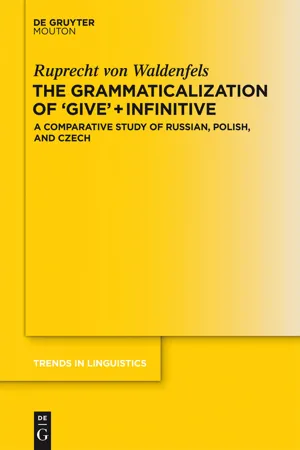
eBook - PDF
The Grammaticalization of 'Give' + Infinitive
A Comparative Study of Russian, Polish, and Czech
- 346 pages
- English
- PDF
- Available on iOS & Android
eBook - PDF
The Grammaticalization of 'Give' + Infinitive
A Comparative Study of Russian, Polish, and Czech
About this book
Information
Table of contents
- Acknowledgements
- Conventions
- 1 Introduction, overview and theoretical framework
- 2 da(va)t+inf in Russian
- 3 da(va)t+inf in Polish
- 4 da(va)t+inf in Czech
- 5 Czech, Polish and Russian in parallel
- 6 da(va)t+inf in OCS and earlier stages of Polish and Czech
- 7 Conclusions and directions for further research
- Notes
- Bibliography
- Index
Trusted by 375,005 students
Access to over 1.5 million titles for a fair monthly price.
Study more efficiently using our study tools.
Frequently asked questions
Yes, you can cancel anytime from the Subscription tab in your account settings on the Perlego website. Your subscription will stay active until the end of your current billing period. Learn how to cancel your subscription
No, books cannot be downloaded as external files, such as PDFs, for use outside of Perlego. However, you can download books within the Perlego app for offline reading on mobile or tablet. Learn how to download books offline
We are an online textbook subscription service, where you can get access to an entire online library for less than the price of a single book per month. With over 1.5 million books across 990+ topics, we’ve got you covered! Learn about our mission
Look out for the read-aloud symbol on your next book to see if you can listen to it. The read-aloud tool reads text aloud for you, highlighting the text as it is being read. You can pause it, speed it up and slow it down. Learn more about Read Aloud
Yes! You can use the Perlego app on both iOS and Android devices to read anytime, anywhere — even offline. Perfect for commutes or when you’re on the go.
Please note we cannot support devices running on iOS 13 and Android 7 or earlier. Learn more about using the app
Please note we cannot support devices running on iOS 13 and Android 7 or earlier. Learn more about using the app
Yes, you can access The Grammaticalization of 'Give' + Infinitive by Ruprecht Waldenfels in PDF and/or ePUB format, as well as other popular books in Languages & Linguistics & Historical & Comparative Linguistics. We have over 1.5 million books available in our catalogue for you to explore.