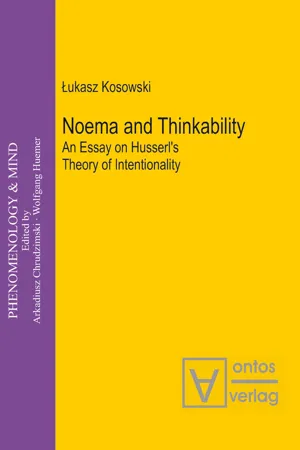
The years of study on Husserl's theory of intentionality have led to a number of non-equivalent interpretations. The present work attempts to investigate the most prominent of these by presenting both their advantages and difficulties. However, its key point is specifically the analysis of Husserl's theory. This is made in several stages that are concerned with the relation between noesis and noema: whether it is one-to-one or many-to-one, the kind of transcendency and dependency between them, and whether noema supervenes on noesis. Moreover, Husserl's theory is also examined in—usually ignored—instances of contradiction, nonsense and intentional conflict. The outcome is a fresh reading in which noema occurs as the possibly thinkable content capable of constituting multi-objective references and composed of pure X explained in terms of syntactic matter and form.
- 210 pages
- English
- PDF
- Available on iOS & Android
eBook - PDF
About this book
Information
Topic
PhilosophySubtopic
Philosophical HermeneuticsTable of contents
- ABBREVIATIONS
- ACKNOWLEDGMENTS
- INTRODUCTION
- Chapter I
- Chapter II
- Chapter III
- Chapter IV
- SUMMARY
- BIBLIOGRAPHY
- INDEX
- Blank Page
Trusted by 375,005 students
Access to over 1.5 million titles for a fair monthly price.
Study more efficiently using our study tools.
Frequently asked questions
Yes, you can cancel anytime from the Subscription tab in your account settings on the Perlego website. Your subscription will stay active until the end of your current billing period. Learn how to cancel your subscription
No, books cannot be downloaded as external files, such as PDFs, for use outside of Perlego. However, you can download books within the Perlego app for offline reading on mobile or tablet. Learn how to download books offline
We are an online textbook subscription service, where you can get access to an entire online library for less than the price of a single book per month. With over 1.5 million books across 990+ topics, we’ve got you covered! Learn about our mission
Look out for the read-aloud symbol on your next book to see if you can listen to it. The read-aloud tool reads text aloud for you, highlighting the text as it is being read. You can pause it, speed it up and slow it down. Learn more about Read Aloud
Yes! You can use the Perlego app on both iOS and Android devices to read anytime, anywhere — even offline. Perfect for commutes or when you’re on the go.
Please note we cannot support devices running on iOS 13 and Android 7 or earlier. Learn more about using the app
Please note we cannot support devices running on iOS 13 and Android 7 or earlier. Learn more about using the app
Yes, you can access Noema and Thinkability by Lukasz Kosowski in PDF and/or ePUB format, as well as other popular books in Philosophy & Philosophical Hermeneutics. We have over 1.5 million books available in our catalogue for you to explore.