"The Roots of Modern Biochemistry ist eine gute Einführung in die moderne Biochemie, und als Einstieg sehr zu empfehlen."
Prof. Dr. Hans Fritz, Ludwig-Maximilians-Universität München
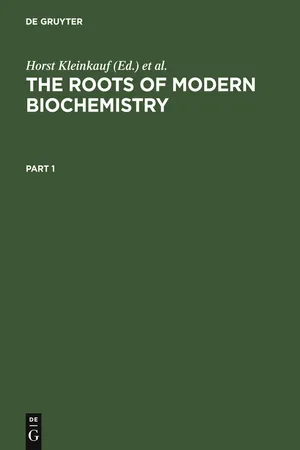
eBook - PDF
The Roots of Modern Biochemistry
Fritz Lippmann's Squiggle and its Consequences
- 1,012 pages
- English
- PDF
- Available on iOS & Android
eBook - PDF
The Roots of Modern Biochemistry
Fritz Lippmann's Squiggle and its Consequences
About this book
Information
Topic
BiowissenschaftenSubtopic
BiochemieTable of contents
- 1 Fritz Lipmann 1899–1986
- Life with Fritz
- A Long Life in Times of Great Upheaval
- Fritz Lipmann: In Memoriam
- Lipmann’s Remarkably Fulfilled Life as a Researcher
- Fritz Lipmann: June 12, 1899–July 24, 1986
- Fritz Lipmann Molding the Design of Molecular Bioenergetics
- Recollections of Fritz Lipmann, 1941–1945
- In Celebration of the Scientific Genius of Fritz Lipmann
- Lipmann and “Not Strictly Biochemistry”
- Communication in Metabolic Control. Intuition and Method in Biochemistry: Four Years each with Krebs and Lipmann
- Fritz Lipmann: Squiggle to Protein Sulfation
- Fritz Lipmann (1899–1986), Honorary Member of the Leopoldina Academy
- Dahlem in the Late Nineteen Twenties
- Our Apprenticeship
- The Kaiser-Wilhelm-Institutes in Berlin-Dahlem in the Late 1930ies and Early 1940ies: Reminiscences of a Student of Biochemistry
- On the Origin of the Squiggle (~)
- 2 Biochemistry Comes of Age
- The History of Metabolites Isolated from Urine
- The Pentose Phosphate Pathway
- Glycolysis and the Dawn of Modern Biochemistry
- Energy-Rich Bonds and Enzymatic Peptide Synthesis
- A Nostalgic View of the TCA Cycle in Bacteria
- The Role of Vitamins and their Carrier Proteins in Citrate Fermentation
- Lipmann’s Influence on Firefly Luminescence
- Sulfur in Biomimetic Peptide Syntheses
- The Function of Teichoic Acids in Walls and Membranes of Bacteria
- The Amidotransferases: Origins of the Concept of Affinity Labeling of Enzymes
- Intracellular Protein Degradation: Past, Present and Future
- Lipmann’s Squiggle and the Unification of Cellular Structure and Function
- The Historical Intermingling of Biochemistry and Cell Biology
- Regulation of Function of Membrane Proteins by Phosphorylation and Dephosphorylation
- Molecular Biology of Brain Peptides and their Cognate Receptors
- The Biological Activity of Tuftsin, Thr-Lys-Pro-Arg
- Biosynthesis of Linear Gramicidin, Pentadeca Peptide, is Tight Linked to Serine Metabolism and to Membranous Phosphoglyceride
- From Phosphoenolpyruvate Carboxykinase to Sporulation: Personal Reflections on Dr. F. Lipmann
- Research on Nonribosomal Systems: Biosynthesis of Peptide Antibiotics
- Metabolism of Carnosine and Related Peptides
- 3 Molecular Biology Sharpens its Tools
- DNA Repair in Human Cells: Molecular Cloning of cDNAs Coding for Enzymes Related to Repair
- Acyl~ Phosphate Intermediates in Oxidative DNA Sugar Damage by Antibiotics
- Rts1: A Multiphenotypic, Unusual Temperature Sensitive Drug Resistance Factor
- Human Prostatic Growth Factor on Steroid Hormones in Stimulating Thymidine Incorporation into DNA
- Developmentally Regulated Gene Amplification in Rhynchosciara
- Fritz Lipmann, a Few Personal Memories, and: What Else Came Out of the High-Energy Phosphate Bond?
- Regulation of Gene Expression by Posttranslational Modification of Transcription Factors
- How Does the Arginine Repressor Regulate the Synthesis of Arginine Biosynthetic Enzymes?
- The Biochemistry and Molecular Biology of the Terminal Reactions of Methionine Biosynthesis in Escherichia coli
- The Wheat Embryo, Then and Now
- Mechanism of Cytotoxic Action and Structures of Thiadiazolo-pyrimidines
- Architecture of Ribosomal Particles as Investigated by Image Reconstruction and X-Ray Crystallographic Studies
- Initiation of Protein Synthesis: Early Participation and Recent Revisit
- Structure of Ribosomal RNA Genes of Eukaryotes: Some Solved and Unsolved Questions
- Energetics and Dynamics of the Protein-Synthesizing Machinery
- Expression
- Punctuation in the Genetic Code: A Plausible Basis for the Degeneracy of the Code to Initiate Translation
- Reconstruction of Translation: Role of EF-P in Regulation of Peptide Bond Formation
- On the Role of Spermine in Protein Synthesis
- 4 Functional Dynamics
- 4.1 The Squiggle-Symbol of Bioenergetics
- Energy-Rich Compounds and Work
- Squiggle Phosphate of Inorganic Pyrophosphate and Polyphosphates
- Enzymology of 3ʹ-Squiggled Nucleotides
- Pyridine Nucleotides as Group Transfering Coenzymes
- The Nature of Squiggle in Oxidative Phosphorylation
- Motional Dynamics of Fatty Acids: Advantages of 15N and Deuterium Substituted Fatty Acid Spin Labels for Studies of Lipid-Protein Interactions and Motion in Membrane Bilayers
- Thyroid Hormones and Oxidative Phosphorylation
- Structure-Activity Relationships of Natural and Synthetic. E-β-Methoxyacrylates of the Strobilurin and Oudemansin Series
- The Intracellular Mechanism of Insulin Action
- Unity and Diversity in Biological Redox Catalysis: Comparative Enzymology of Some Microbial Oxidoreductases Showing Variation in Cofactor Identity
- Ammonia-Forming, Dissimilatory Nitrite Reductases as a Homologous Group of Hexaheme C-Type Cytochromes in Metabolically Diverse Bacteria
- Halorhodopsin
- Control of Futile Transmembrane Potassium Cycling in Escherichia coli
- Bioenergetics of Protein Transport into Mitochondria: Role of Δψ and of Nucleoside Triphosphates
- Some Recent Functional and Structural Contributions to the Molecular Mechanism of Photosynthesis
- Salt Toxicity and Mineral Deficiency in Plants: Cytoplasmic Ion Homeostasis, a Necessity for Growth and Survival Under Stress
- 4.2 Molecular Recognition and Communication
- Dawn of Ca Research: Regulation of Muscle Contraction
- Comparative Aspects of the Mechanisms of Energy Transduction in Sarcoplasmic Reticulum Between Rabbit and Frog Skeletal Muscle
- Caltrin: A Versatile Regulator of Calcium Transport in Spermatozoa
- Protein Kinase C, the Structural Heterogeneity and Differential Expression in Rat Brain
- Regulation of Erythrocyte Membrane Cytoskeletal Protein Interactions by Phosphorylation
- A Kinase Splitting Membranal Proteinase: Use in the Study of Receptors Involved in the Cellular Response to Hormones
- Fritz Lipmann, Phosphoproteins and Regulation of Aromatic Amino Acid Hydroxylase Activity
- The Regulation of Hepatic Phenylalanine Hydroxylase by Phosphorylation-Dephosphorylation
- Catabolite Inactivation and Adenylate Cyclase in Yeast
- Protein Modification by Tyrosine-Sulfation: Possible Functional Implications
- Proteoglycans and Connective Tissue Pathobiochemistry
- Acylation of Myelin Proteolipid Protein: A Link to the Past
- The Unusual Regulation of the Adenylyl Cyclase of Amphibian Oocytes by Progesterone. – A Review
- Sterol Synergism, A Tool for Studies on Sterol Function
- Chemical Modification of Benzodiazepine Receptors of Cortical P2 Membranes
- Dual Pathways for the Catabolism of γ-Hydroxy-butyrate: Cytosolic and Mitochondrial Mechanisms
- 5 Evolution
- Prebiotic Syntheses and the Mechanism of Early Chemical Evolution
- Prebiotic Roots of Informed Protein Synthesis: Nature of the Lipmann Connection
- A Case for an Additional RNA Base Pair in Early Evolution
- Inorganic Pyrophosphate in Cellular Energetics and Evolution
- Selforganization in Biosystems
- List of Contributors
- Acknowledgements
- Lipmann’s Coworkers at Massachusetts General Hospital, Boston, and the Rockefeller University, New York
- Bibliography 1924–1985
- Index
Trusted by 375,005 students
Access to over 1.5 million titles for a fair monthly price.
Study more efficiently using our study tools.
Frequently asked questions
Yes, you can cancel anytime from the Subscription tab in your account settings on the Perlego website. Your subscription will stay active until the end of your current billing period. Learn how to cancel your subscription
No, books cannot be downloaded as external files, such as PDFs, for use outside of Perlego. However, you can download books within the Perlego app for offline reading on mobile or tablet. Learn how to download books offline
Perlego offers two plans: Essential and Complete
- Essential is ideal for learners and professionals who enjoy exploring a wide range of subjects. Access the Essential Library with 800,000+ trusted titles and best-sellers across business, personal growth, and the humanities. Includes unlimited reading time and Standard Read Aloud voice.
- Complete: Perfect for advanced learners and researchers needing full, unrestricted access. Unlock 1.5M+ books across hundreds of subjects, including academic and specialized titles. The Complete Plan also includes advanced features like Premium Read Aloud and Research Assistant.
We are an online textbook subscription service, where you can get access to an entire online library for less than the price of a single book per month. With over 1.5 million books across 990+ topics, we’ve got you covered! Learn about our mission
Look out for the read-aloud symbol on your next book to see if you can listen to it. The read-aloud tool reads text aloud for you, highlighting the text as it is being read. You can pause it, speed it up and slow it down. Learn more about Read Aloud
Yes! You can use the Perlego app on both iOS and Android devices to read anytime, anywhere — even offline. Perfect for commutes or when you’re on the go.
Please note we cannot support devices running on iOS 13 and Android 7 or earlier. Learn more about using the app
Please note we cannot support devices running on iOS 13 and Android 7 or earlier. Learn more about using the app
Yes, you can access The Roots of Modern Biochemistry by Horst Kleinkauf, Hans von Döhren, Lothar Jaenicke, Horst Kleinkauf,Hans von Döhren,Lothar Jaenicke in PDF and/or ePUB format, as well as other popular books in Biowissenschaften & Biochemie. We have over 1.5 million books available in our catalogue for you to explore.