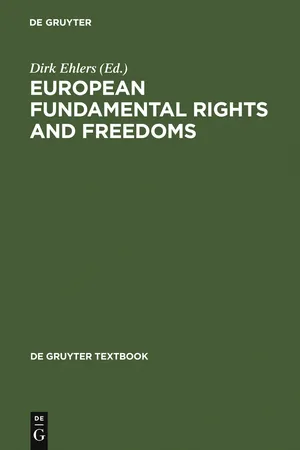
The ever increasing relevance of European law which involves replacement or supplementation of and interaction with national law not only affects the states in Europe but also, and foremost, the citizens. The rights of the citizens in Europe are protected by the European Fundamental Rights and Freedoms. The aim of this textbook is to grasp and illustrate the meaning of these rights and to integrate it into a coherent system. For this purpose the book not only deals with the pertinent law of the European Union and the European Community, but also with the European Convention for the Protection of Human Rights and Fundamental Freedoms which, too, is becoming more and more important. In addition, regard is had to the Charter of Fundamental Rights of the Union which forms part of the Treaty establishing a Constitution for Europe. Although the Charter is not yet legally binding since the Constitution has not been ratified by all EU Member States, the Community Courts already make reference to it as a concentrate of the constitutional traditions common to the Member States. It therefore does not seem entirely unlikely that the Charter might be included into the existing Treaties irrespective of the future constitutional developments on the EU level. On a similar anticipatory basis the book also takes into account those Protocols to the European Convention for the Protection of Human Rights and Fundamental Freedoms that have not yet entered into force.
eBook - PDF
European Fundamental Rights and Freedoms
- 644 pages
- English
- PDF
- Available on iOS & Android
eBook - PDF
European Fundamental Rights and Freedoms
About this book
Information

gards
the
future
state
of
the
law
cf
Article
III-365(4)
DC
(individuals
will,
inter
alia
,
be
able
to
institute
proceedings
against
a
regulatory
act
which
is
of
direct
concern
to
the
in-
dividual
and
does
not
require
implementing
measures).
2.
Protection
of
the
Fundamental
Freedoms
through
Proceedings
Instituted
by
the
Commission
or
by
the
Member
States
Not
only
individuals
personally
affected
by
a
violation
but
also
the
Commission
can
en-
sure
the
observance
of
the
fundamental
freedoms
on
the
part
of
the
Member
States
by
instituting
an
infringement
procedure
under
Article
226
of
the
TEC
(Article
III-360
DC).
Similarly,
the
Member
States
are
able
to
bring
an
action
before
the
ECJ
(Article
227
TEC/Article
III-361
DC)
if
they
consider
that
another
Member
State
has
violated
the
fundamental
freedoms.
The
institutions
of
the
EC
as
well
as
the
Member
States
can
also
bring
an
action
for
annulment
under
Article
230(2)
and
(3)
of
the
TEC
(Article
III-364(2)
and
(3)
DC).
General
Principles
§
7
VIII
2
225
104
Table of contents
- Table of Contributors and Outline Table of Contents
- Contents
- Table of Abbreviations
- PART I. The Notion of European Fundamental Rights and Freedoms
- § 1 History and Development of European Fundamental Rights and Fundamental Freedoms
- I. International and European Human Rights Protection
- II. History and Development of Human Rights Protection in the Context of the Council of Europe and the European Convention on HumanRights
- III. History and Development of Human Rights Protection within the EC/EU
- IV. The Fundamental Freedoms of European Community Law
- V. Consequences of the Treaty Establishing a Constitution for Europe
- VI. Summary: Protection of Fundamental Rights and Fundamental Freedoms in a Multi-Layered Europe
- PART II. The European Convention for the Protection of Human Rights and Fundamental Freedoms
- § 2 General Principles
- I. The Position and Status of the Convention within the Structure of International and National Law
- II. Functions of the Convention Rights
- III. Interpretation of the Convention
- IV. Beneficiaries of the Convention Rights
- V. Entities Bound by the Convention Rights
- VI. Territorial scope
- VII. Temporal scope
- VIII. Guarantees and Limitations of the Convention Rights
- IX. Judicial protection
- § 3 Personal Rights and the Prohibition of Discrimination
- I. Protection of Privacy
- II. Right to Personal Integrity
- III. Prohibition of Discrimination
- § 4 Freedom of Expression, Freedom of Assembly and Association
- I. Freedom of Communication within the European Human Rights System
- II. Freedom of Opinion and Freedom of Information
- III. Freedom of Assembly
- IV. Freedom of Association
- V. Freedom to Form and Join Trade Unions
- VI. Conclusions
- § 5 Economic Fundamental Rights
- I. Introduction
- II. Protection of Property
- III. Other Guarantees under Economic Law
- IV. Influence of the European Social Charter
- § 6 Fundamental Judicial and Procedural Rights
- I. The Protection of Liberty (Article 5 ECHR)
- II. Fundamental Judicial Rights in Connection with Proceedings before Courts
- III. Procedural Safeguards Relating to Expulsion of Aliens
- IV. The Right to an Effective Remedy
- PART III. The Fundamental Freedoms of the European Communities
- § 7 General Principles
- I. The Nature and Position of the Fundamental Freedoms within the Structure of European Community Law
- II. Functions of the Fundamental Freedoms
- III. Beneficiaries of the Fundamental Freedoms
- IV. Entities Bound by the Fundamental Freedoms
- V. Territorial Scope of the Fundamental Freedoms
- VI. Temporal Scope of the Fundamental Freedoms
- VII. Scope of Protection, Interferences, Justification
- VIII. Judicial Protection
- § 8 Free Movement of Goods
- I. Scope of Protection
- II. Interference
- III. Justification
- § 9 Freedom of Movement for Workers
- I. Scope of Protection
- II. Interference
- III. Justification
- § 10 Freedom of Establishment
- I. Introduction
- II. Scope of Protection
- III. Interference
- IV. Justification
- V. The Application of the Freedom of Establishment to Legal Persons According to Article 48 of the TEC (Article III-142 DC)
- § 11 The Free Movement of Services
- I. Introduction
- 1. The General Relevance of the Principle of the Freedom to Provide Services
- 2. The Structure of the Freedom to Provide Services in the Community Law
- 3. The Free Movement of Services beyond the Treaty
- 4. Liberalisation of the Freedom to Provide Services and Secondary Legislation
- 5. The New Strategy for the Internal Market
- II. The Scope of Protection
- III. Interference
- IV. Justification
- § 12 Freedom of Movement of Capital and Payments
- I. Scope of Protection
- II. Prohibition on Restrictions
- III. Justification of Restrictions within the Community: The Subjects Protected by Article 58 of the TEC (Article III-158 DC) and the Mandatory Requirements
- IV. Regulatory Fields
- V. Additional Restrictions With Regard to Third Countries
- VI. Conclusion
- § 13 Prohibition of Discrimination Due to Nationality
- I. Sources of Law and Systematic Classification
- II. Structure of Review
- PART IV. The Fundamental Rights of the European Union
- § 14 General Principles
- I. The Character and Position of the Fundamental Rights of the European Union within the Structure of International and National Law
- II. Functions of the Fundamental Rights of the Union
- III. Beneficiaries of the Fundamental Rights of the Union
- IV. Entities Bound by the Fundamental Rights of the Union
- V. Territorial and Temporal Scope of the Fundamental Rights of the Union
- VI. Guarantees of / Interferences with the Fundamental Rights of the Union
- VII. Judicial Protection
- VIII. Other Forms of Protection of Fundamental Rights in the EU
- § 15 Human Dignity, Fundamental Rights of Personality and Communication
- I. Dignity of Man
- II. Protection of the Personality
- III. The Protection of Communication
- IV. Freedom and Security - Outlook
- § 16 The Right to Pursue a Freely Chosen Occupation
- I. Scope of Protection
- II. Infringement
- III. Justification
- § 17 The Fundamental Right to Property
- I. Position and Relevance of the Fundamental Right to Property in Community Law
- II. The Derivation and Dogmatic Structure of the Fundamental Right to Property under Community Law
- III. The European Fundamental Right to Property in Detail
- IV. Conclusion
- § 18 Basic Rights of Equality and Social Rights
- I. Rights to Equality
- II. Social Rights
- § 19 Judicial and Procedural Fundamental Rights
- I. Overview
- II. Fundamental Procedural Rights in Relation to the Community Institutions
- III. Requirements of Community Procedural Fundamental Rights for Member States
- IV. Particular Problems in ‘Tiered’ Proceedings und ‘Mixed’ Decisions between National Authorities and EC-Commission
- V. Summary
- § 20 The Charter of Fundamental Rights of the European Union
- I. Introduction
- II. Contents and Restrictions of Fundamental Rights
- III. On the Area of Application of the Charter of Fundamental Rights of the European Union
- IV. On the Legally Binding Nature of the Charter of Fundamental Rights of the European Union prior to the European Constitution Coming into Effect
- V. The European Agency for Fundamental Rights
- VI. Prospect
- PART V. Citizenship Rights in Europe
- § 21 European Citizenship Rights
- I. Introduction
- II. Union Citizenship as a Matter of the European Union
- III. Nationality, National Citizenship and Citizenship of the Union
- IV. European Citizenship Rights
- V. Concluding Remarks
- Decisions of the European Court of Human Rights
- Decisions of the European Court of Justice
- Table of Model Cases
- Index
Trusted by 375,005 students
Access to over 1.5 million titles for a fair monthly price.
Study more efficiently using our study tools.
Frequently asked questions
Yes, you can cancel anytime from the Subscription tab in your account settings on the Perlego website. Your subscription will stay active until the end of your current billing period. Learn how to cancel your subscription
No, books cannot be downloaded as external files, such as PDFs, for use outside of Perlego. However, you can download books within the Perlego app for offline reading on mobile or tablet. Learn how to download books offline
Perlego offers two plans: Essential and Complete
- Essential is ideal for learners and professionals who enjoy exploring a wide range of subjects. Access the Essential Library with 800,000+ trusted titles and best-sellers across business, personal growth, and the humanities. Includes unlimited reading time and Standard Read Aloud voice.
- Complete: Perfect for advanced learners and researchers needing full, unrestricted access. Unlock 1.5M+ books across hundreds of subjects, including academic and specialized titles. The Complete Plan also includes advanced features like Premium Read Aloud and Research Assistant.
We are an online textbook subscription service, where you can get access to an entire online library for less than the price of a single book per month. With over 1.5 million books across 990+ topics, we’ve got you covered! Learn about our mission
Look out for the read-aloud symbol on your next book to see if you can listen to it. The read-aloud tool reads text aloud for you, highlighting the text as it is being read. You can pause it, speed it up and slow it down. Learn more about Read Aloud
Yes! You can use the Perlego app on both iOS and Android devices to read anytime, anywhere — even offline. Perfect for commutes or when you’re on the go.
Please note we cannot support devices running on iOS 13 and Android 7 or earlier. Learn more about using the app
Please note we cannot support devices running on iOS 13 and Android 7 or earlier. Learn more about using the app
Yes, you can access European Fundamental Rights and Freedoms by Dirk Ehlers, Ulrich Becker, Et al., Dirk Ehlers,Ulrich Becker,Et al., Dirk Ehlers in PDF and/or ePUB format, as well as other popular books in Law & Civil Rights in Law. We have over 1.5 million books available in our catalogue for you to explore.