In a career extending over almost six decades, Nicholas Rescher has conducted researches in almost every principal area of philosophy, historical and systematic alike. In this extraordinary volume, two dozen scholars join in offering penetrating discussions of various facets of Rescher's investigations. The result is an instructively critical panorama of the many-faceted contributions of this important American philosopher.
Born in Germany in 1928, Nicholas Rescher came to the U.S. at the age of nine. He is University Professor of Philosophy at the University of Pittsburgh where he has also served as Chairman of the Philosophy Department and as director (and currently chairman) of the Center for Philosophy of Science. In a productive research career extending over six decades, he has established himself as a systematic philosopher of the old style. His work represents a many-sided approach to fundamental philosophical issues that weaves together threads of thought from continental idealism and American pragmatism. And apart from this larger program Rescher has made various specific contributions to logic (the conception autodescriptive systems of many-sided logic), the history of logic (the medieval Arabic theory of modal syllogistic), to the theory of knowledge (epistemetrics as a quantitative approach in theoretical epistemology), and to the philosophy of science (the theory of a logarithmic retardation of scientific progress). Rescher has also worked in the area of futuristics, and along with Olaf Helmer and Norman Dalkey is co-inaugurator of the so-called Delphi method of forecasting. Ten books about Rescher's philosophy have been published in four languages.
Rescher earned his doctorate at Princeton in 1951 while still at the age of twenty-two—a record for Princeton's Department of Philosophy. He has served as a President of the American Philosophical Association, of the American Catholic Philosophy Association, of the American G. W. Leibniz Society, of the C. S. Peirce Society, and of the American Metaphysical Society. He was the founder of the American Philosophical Quarterly. An honorary member of Corpus Christi College, Oxford, he has been elected to membership in the European Academy of Arts and Sciences (Academia Europaea), the Royal Society of Canada, the Institut International de Philosophie, and several other learned academies. Having held visiting lectureships at Oxford, Constance, Salamanca, Munich, and Marburg, he has been awarded fellowships by the Ford, Guggenheim, and National Science Foundations. Author of some hundred books ranging over many areas of philosophy, over a dozen of them translated from English into other languages, he is the recipient of eight honorary degrees from universities on three continents. He was awarded the Alexander von Humboldt Prize for Humanistic Scholarship in 1984, the Belgian Prix Mercier in 2005, and the Aquinas Medal of the American Catholic Philosophical Association in 2007.
eBook - PDF
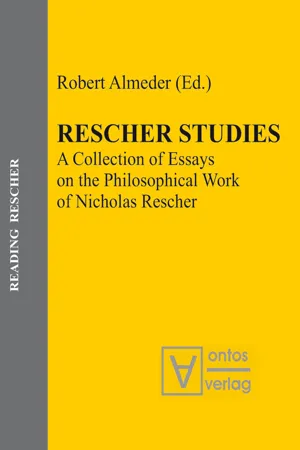
Rescher Studies
A Collection of Essays on the Philosophical Work of Nicholas Rescher
- 583 pages
- English
- PDF
- Available on iOS & Android
eBook - PDF
About this book
Information
Topic
FilosofiaSubtopic
Decostruzione in filosofiaTable of contents
- CONTENTS
- Preface: ROBERT Almeder
- The Limits of Science, Realism,and IdealismRobert Almeder
- On Possibilities and Thought ExperimentsDiderik Batens
- Coherentism and Coherence Truth in thePhilosophy of Nicholas RescherBryson Brown
- Philosophical AnthropologyJames W. Felt
- Pluralism and ConsensusLenn E. Goodman
- Meditations, Wagers, and ExistentialIssues: Nicholas Rescher on Religionand PhilosophyJohn Haldane
- Rescher’s MetaphysicsWilliam Jaworski
- The Limits of Science ReconsideredUlrich Majer
- ConceivabilityDiego Marconi1. RESCHER AND POSSIBILITY
- Weird WorldsRobert K MeyerINTRODUCTION
- Nicholas Rescher on Greek Philosophy andthe SyllogismJürgen MittelstrassPeter Schroeder-Heister
- Rescher’s Evolutionary EpistemologyJesús Mosterín
- Common SenseJoseph C. Pitt
- Systematic Philosophy and TheoreticalFramework on Nicholas Rescher’s A Systemof Pragmatic IdealismLorenz B. Puntel
- On Rescher’s View of Idealism(and Pragmatism)Tom Rockmore
- Rescher on Arabic LogicTony Street
- Philosophy in the FutureAvrum Stroll
- Rescher on Explanation and PredictionBas C. van Fraassen
- Nicholas Rescher on Scientific Progress:Science in the Face of Limited Cognitive andTechnological ResourcesTheodor LeiberRoland Wagner-Döbler
- Rescher on Dialog Systems, Argumentation,and Burden of ProofDouglas WaltonDavid M. Godden
- Rescher on Process ThoughtMichel Weber
- How is Scientific Knowledge EconomicallyPossible?: Nicholas Rescher’s Contributionsto an Economic Understanding of ScienceJames R. Wible
- Possibility, Plenitude, and the OptimalWorld: Rescher on Leibniz’s CosmologyCatherine Wilson
- Rescher on Aporetics and ConsistencyJohn Woods
- Responses to the Contributed Essays
- Work by and about Nicholas Rescher
Trusted by 375,005 students
Access to over 1.5 million titles for a fair monthly price.
Study more efficiently using our study tools.
Frequently asked questions
Yes, you can cancel anytime from the Subscription tab in your account settings on the Perlego website. Your subscription will stay active until the end of your current billing period. Learn how to cancel your subscription
No, books cannot be downloaded as external files, such as PDFs, for use outside of Perlego. However, you can download books within the Perlego app for offline reading on mobile or tablet. Learn how to download books offline
Perlego offers two plans: Essential and Complete
- Essential is ideal for learners and professionals who enjoy exploring a wide range of subjects. Access the Essential Library with 800,000+ trusted titles and best-sellers across business, personal growth, and the humanities. Includes unlimited reading time and Standard Read Aloud voice.
- Complete: Perfect for advanced learners and researchers needing full, unrestricted access. Unlock 1.5M+ books across hundreds of subjects, including academic and specialized titles. The Complete Plan also includes advanced features like Premium Read Aloud and Research Assistant.
We are an online textbook subscription service, where you can get access to an entire online library for less than the price of a single book per month. With over 1.5 million books across 990+ topics, we’ve got you covered! Learn about our mission
Look out for the read-aloud symbol on your next book to see if you can listen to it. The read-aloud tool reads text aloud for you, highlighting the text as it is being read. You can pause it, speed it up and slow it down. Learn more about Read Aloud
Yes! You can use the Perlego app on both iOS and Android devices to read anytime, anywhere — even offline. Perfect for commutes or when you’re on the go.
Please note we cannot support devices running on iOS 13 and Android 7 or earlier. Learn more about using the app
Please note we cannot support devices running on iOS 13 and Android 7 or earlier. Learn more about using the app
Yes, you can access Rescher Studies by Robert Almeder in PDF and/or ePUB format, as well as other popular books in Filosofia & Decostruzione in filosofia. We have over 1.5 million books available in our catalogue for you to explore.