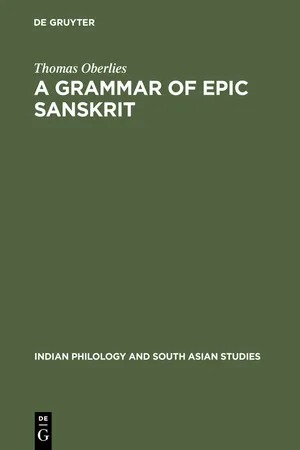
The two great epics of (old) India, the Mahabharata and the Ramayana, are written in a language, which differs from so-called classical Sanskrit in many details. Both texts still are of an enormous importance in India and other countries. Because of this, a grammar describing all the different characteristics of epic Sanskrit has been missed until now. The Grammar of Epic Sanskrit will now close this gap.
eBook - PDF
A Grammar of Epic Sanskrit
About this book
Information
Table of contents
- Introduction
- I. Sandhi
- 1.1. Absence of sandhi
- 1.2. Special cases of sandhi
- 1.3.Sandhi of pragṛhya-vowels
- 1.4. Sandhi of eṣa(ḥ)
- 1.5. Sandhi of /-ar/
- 1.6. -ai ’- < /-ai a-/
- 1.7. -au ’- < /-au a-/
- 1.8. Double sandhi
- 1.9. Consonantal sandhi
- 1.10. (Non)-cerebralisation of n and s
- II. The nominal system
- 2.1. a-stems
- 2.2. ā-stems
- 2.3. i- and u-stems
- 2.4. sakhi-
- 2.5. pati-
- 2.6. (f.) i- and u-stems
- 2.7. (n.) u-stems
- 2.8. (°)bhrū-
- 2.9. strī-
- 2.10. ī- and ū-stems
- 2.11. tandrī-
- 2.12. ṛ-stems
- 2.13. (Kinship) ṛ-stems
- 2.14. (m. / f.) ā-/ī-/ū-stems
- 2.15. go-
- 2.16. (n.) °as-stems
- 2.17. (m.) °as-stems
- 2.18. Present participles in °ant-
- 2.19. Reduplicated and ‘aerodynamic’ participles
- 2.20. mahānt-
- 2.21. °mant-stems
- 2.22. °an-stems
- 2.23. (n.) ̣ºan-stems
- 2.24. °(C)m/van-stems
- 2.25. maghavan- / yuvan-
- 2.26. °in-stems
- 2.27. Comparative in °īyāṃs-
- 2.28. Perfect Participle
- 2.29. ahar-
- 2.30. path-
- 2.31. ap-
- 2.32. puṃs-
- 2.33. anaḍuh-
- 2.34. div-
- 2.35. °han-
- 2.36. pūṣan-
- III. Transfer of stem
- 3.1. ºi-stem ← ºī-stem(f.)
- 3.2. ºi-stem ← ºī-stem (m.)
- 3.3. ºstem ← ºi-stem
- 3.4. ºin-stem ← ºi-stem
- 3.5. ºū-stem ← ºū-stem(f.)
- 3.6. ºa-stem ← ºṛ-stem
- 3.7. ºā-stem ← ºṛ-stem
- 3.8. º(ār)a-stem ← ṛ-stem
- 3.9. ºan-stem ← ºa-stem
- 3.10. º(m)a-stem ← º(m)an-stem
- 3.11. º(m)ā-stem ← º(m)an-stem
- 3.12. ºāna-stem ← ºan-stem
- 3.13. ºa-stem ← ºas-stem
- 3.14. ºā-stem ← ºas-stem
- 3.15. ºasa-stem ← ºas-stem
- 3.16. ºasā-stem ← ºas-stem
- 3.17. ºas-stem ← ºas-stem
- 3.18. ºi-stem ← ºin-stem
- 3.19. ºi-stem ← ºis-stem
- 3.20. ºu-stem ← ºus-stem
- 3.21. ºma-/ ºva-stem ← ºmant-/ ºvant-stem
- 3.22. Thematicization of consonant stems
- IV. Pronouns
- 4.1. Personal pronouns: First person singular
- 4.2. Personal pronouns: Second person singular
- 4.3. Personal pronouns: First person dual (āvām as genitive)
- 4.4. Personal pronouns: Second person dual (vām as nom.)
- 4.5. Personal pronouns: First person plural
- 4.6. Personal pronouns: Second person plural
- 4.7. Three-gender pronouns
- V. Numerals
- 5.1. Cardinals
- 5.2. Ordinals
- VI. The Verbal System (I)
- 6.1. The use of the voices
- 6.2. Use of modes and tenses
- 6.3. The verbal endings
- 6.4. The augment
- 6.5. Constructions with mā
- 6.6. Present classes
- 6.7. Crossings of roots
- 6.8. Secondary roots
- VII. The Verbal System (II): Aberrant forms of the individual present classes
- VIII. The verbal system (III): Non-present tenses and moods
- 8.1. The perfect
- 8.2. The aorist
- 8.3. The precative
- 8.4. The future
- 8.5. The periphrastic future
- 8.6. The conditional
- 8.7. The passive
- 8.8. The causative
- 8.9. The desiderative
- 8.10. The intensive
- 8.11. The denominative
- IX. The verbal system (IV): The verbum infinitum
- 9.1. The present participle
- 9.2. The future participle
- 9.3. The perfect participle
- 9.4. The verbal adjective
- 9.5. The gerundive
- 9.6. Infinitive
- 9.7. The absolutive
- X. Syntax
- 10.1. The use of the numbers
- 10.2. Syntactical irregularities
- 10.3. Syntax of cases
- 10.4. Excursus: Nominal composition
- 10.5. Pre- and postpositions of Epic Sanskrit
- 10.6. Absolutives used as pre- and postpositions
- XI. The roots and verb forms specific to Epic Sanskrit
- XII. Abbreviations and literature
- XIII. Indices and concordances
Trusted by 375,005 students
Access to over 1.5 million titles for a fair monthly price.
Study more efficiently using our study tools.
Frequently asked questions
Yes, you can cancel anytime from the Subscription tab in your account settings on the Perlego website. Your subscription will stay active until the end of your current billing period. Learn how to cancel your subscription
No, books cannot be downloaded as external files, such as PDFs, for use outside of Perlego. However, you can download books within the Perlego app for offline reading on mobile or tablet. Learn how to download books offline
Perlego offers two plans: Essential and Complete
- Essential is ideal for learners and professionals who enjoy exploring a wide range of subjects. Access the Essential Library with 800,000+ trusted titles and best-sellers across business, personal growth, and the humanities. Includes unlimited reading time and Standard Read Aloud voice.
- Complete: Perfect for advanced learners and researchers needing full, unrestricted access. Unlock 1.5M+ books across hundreds of subjects, including academic and specialized titles. The Complete Plan also includes advanced features like Premium Read Aloud and Research Assistant.
We are an online textbook subscription service, where you can get access to an entire online library for less than the price of a single book per month. With over 1.5 million books across 990+ topics, we’ve got you covered! Learn about our mission
Look out for the read-aloud symbol on your next book to see if you can listen to it. The read-aloud tool reads text aloud for you, highlighting the text as it is being read. You can pause it, speed it up and slow it down. Learn more about Read Aloud
Yes! You can use the Perlego app on both iOS and Android devices to read anytime, anywhere — even offline. Perfect for commutes or when you’re on the go.
Please note we cannot support devices running on iOS 13 and Android 7 or earlier. Learn more about using the app
Please note we cannot support devices running on iOS 13 and Android 7 or earlier. Learn more about using the app
Yes, you can access A Grammar of Epic Sanskrit by Thomas Oberlies in PDF and/or ePUB format, as well as other popular books in Languages & Linguistics & Languages. We have over 1.5 million books available in our catalogue for you to explore.