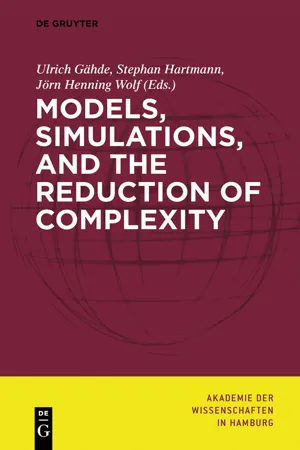
Modern science is, to a large extent, a model-building activity. But how are models contructed? How are they related to theories and data? How do they explain complex scientific phenomena, and which role do computer simulations play here? These questions have kept philosophers of science busy for many years, and much work has been done to identify modeling as the central activity of theoretical science. At the same time, these questions have been addressed by methodologically-minded scientists, albeit from a different point of view. While philosophers typically have an eye on general aspects of scientific modeling, scientists typically take their own science as the starting point and are often more concerned with specific methodological problems. There is, however, also much common ground in middle, where philosophers and scientists can engage in a productive dialogue, as the present volume demonstrates. To do so, the editors of this volume have invited eight leading scientists from cosmology, climate science, social science, chemical engeneering and neuroscience to reflect upon their modeling work, and eight philosophers of science to provide a commentary.
eBook - PDF
Models, Simulations, and the Reduction of Complexity
- 284 pages
- English
- PDF
- Available on iOS & Android
eBook - PDF
Models, Simulations, and the Reduction of Complexity
About this book
Information
Topic
PhilosophySubtopic
Philosophy History & TheoryTable of contents
- Preface
- Contributors
- Content
- Introduction
- Cosmology – The Largest Possible Model?
- The Standard Model of Cosmology as a Tool for Interpretation and Discovery
- Patterns in Physical and Biological Systems
- Symmetry and the Explanation of Organismal Form
- Pluralistic Modeling of Complex Systems
- The Methodological Challenges of Complex Systems
- Contested Modeling: The Case of Economics
- Models, Representation, and Economic Practice
- A Unifying Approach to High- and Low-Level Cognition
- High–vs Low–Level Cognition and the Neuro- Emulative Theory of Mental Representation
- Evaluating a Computational Model of Eye–Movement Control in Reading
- Considering Criteria for Model Modification and Theory Change in Psychology
- Identification of Kinetic Models by Incremental Refinement
- Kinetics, Models, and Mechanism
- Modeling Complexity: The Case of Climate Science
- Chaos, Plurality, and Model Metrics in Climate Science
- Subject Index
- Author Index
Trusted by 375,005 students
Access to over 1.5 million titles for a fair monthly price.
Study more efficiently using our study tools.
Frequently asked questions
Yes, you can cancel anytime from the Subscription tab in your account settings on the Perlego website. Your subscription will stay active until the end of your current billing period. Learn how to cancel your subscription
No, books cannot be downloaded as external files, such as PDFs, for use outside of Perlego. However, you can download books within the Perlego app for offline reading on mobile or tablet. Learn how to download books offline
Perlego offers two plans: Essential and Complete
- Essential is ideal for learners and professionals who enjoy exploring a wide range of subjects. Access the Essential Library with 800,000+ trusted titles and best-sellers across business, personal growth, and the humanities. Includes unlimited reading time and Standard Read Aloud voice.
- Complete: Perfect for advanced learners and researchers needing full, unrestricted access. Unlock 1.5M+ books across hundreds of subjects, including academic and specialized titles. The Complete Plan also includes advanced features like Premium Read Aloud and Research Assistant.
We are an online textbook subscription service, where you can get access to an entire online library for less than the price of a single book per month. With over 1.5 million books across 990+ topics, we’ve got you covered! Learn about our mission
Look out for the read-aloud symbol on your next book to see if you can listen to it. The read-aloud tool reads text aloud for you, highlighting the text as it is being read. You can pause it, speed it up and slow it down. Learn more about Read Aloud
Yes! You can use the Perlego app on both iOS and Android devices to read anytime, anywhere — even offline. Perfect for commutes or when you’re on the go.
Please note we cannot support devices running on iOS 13 and Android 7 or earlier. Learn more about using the app
Please note we cannot support devices running on iOS 13 and Android 7 or earlier. Learn more about using the app
Yes, you can access Models, Simulations, and the Reduction of Complexity by Ulrich Gähde, Stephan Hartmann, Jörn Henning Wolf, Ulrich Gähde,Stephan Hartmann,Jörn Henning Wolf in PDF and/or ePUB format, as well as other popular books in Philosophy & Philosophy History & Theory. We have over 1.5 million books available in our catalogue for you to explore.