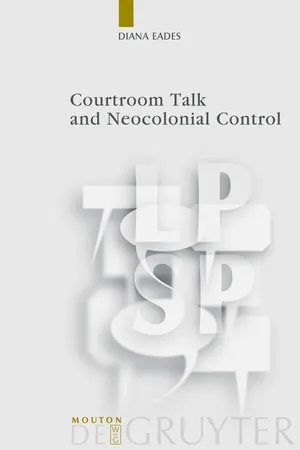
The book uses critical sociolinguistic analysis to examine the social consequences of courtroom talk. The focus of the study is the cross-examination of three Australian Aboriginal boys who were prosecution witnesses in the case of six police officers charged with their abduction. The analysis reveals how the language mechanisms allowed by courtroom rules of evidence serve to legitimize neocolonial control over Indigenous people. In the propositions and assertions made in cross-examination, and their adoption by judicial decision-makers, the three boys were constructed not as victims of police abuse, but rather in terms of difference, deviance and delinquency. This identity work addresses fundamental issues concerning what it means to be an Aboriginal young person, as well as constraints about how to perform or live this identity, and the rights to which Aboriginal people can lay claim, while legitimizing police control over their freedom of movement. Understanding this courtroom talk requires analysis of the sociopolitical and historical actions and structures within which the courtroom hearing was embedded. Through this analysis, the interrelatedness of structure, agency, constraint and change, which is central to critical sociolinguistics, becomes apparent. In its investigation of language ideologies that underpin courtroom talk, as well as the details of how language is used, and the social consequences of this talk, the book highlights the need for far-reaching changes to courtroom rules of evidence.
- 412 pages
- English
- PDF
- Available on iOS & Android
eBook - PDF
Courtroom Talk and Neocolonial Control
About this book
Information
Table of contents
- Frontmatter
- Contents
- Chapter 1. Introduction
- Chapter 2. Setting the theoretical scene
- Chapter 3. The societal and institutional struggle
- Chapter 4. Features of Aboriginal English communicative style
- Chapter 5. Lexical strategies
- Chapter 6. Linguistic mechanisms for identity construction
- Chapter 7. Absolutely no regard whatsoever for law and order: David
- Chapter 8. More court appearances than some solicitors: Albert
- Chapter 9. Not a person to be overborne: Barry
- Chapter 10. No fear of the police: closing the Pinkenba case
- Chapter 11. Developments since the Pinkenba case
- Chapter 12. The power of courtroom talk
- Backmatter
Trusted by 375,005 students
Access to over 1.5 million titles for a fair monthly price.
Study more efficiently using our study tools.
Frequently asked questions
Yes, you can cancel anytime from the Subscription tab in your account settings on the Perlego website. Your subscription will stay active until the end of your current billing period. Learn how to cancel your subscription
No, books cannot be downloaded as external files, such as PDFs, for use outside of Perlego. However, you can download books within the Perlego app for offline reading on mobile or tablet. Learn how to download books offline
Perlego offers two plans: Essential and Complete
- Essential is ideal for learners and professionals who enjoy exploring a wide range of subjects. Access the Essential Library with 800,000+ trusted titles and best-sellers across business, personal growth, and the humanities. Includes unlimited reading time and Standard Read Aloud voice.
- Complete: Perfect for advanced learners and researchers needing full, unrestricted access. Unlock 1.5M+ books across hundreds of subjects, including academic and specialized titles. The Complete Plan also includes advanced features like Premium Read Aloud and Research Assistant.
We are an online textbook subscription service, where you can get access to an entire online library for less than the price of a single book per month. With over 1.5 million books across 990+ topics, we’ve got you covered! Learn about our mission
Look out for the read-aloud symbol on your next book to see if you can listen to it. The read-aloud tool reads text aloud for you, highlighting the text as it is being read. You can pause it, speed it up and slow it down. Learn more about Read Aloud
Yes! You can use the Perlego app on both iOS and Android devices to read anytime, anywhere — even offline. Perfect for commutes or when you’re on the go.
Please note we cannot support devices running on iOS 13 and Android 7 or earlier. Learn more about using the app
Please note we cannot support devices running on iOS 13 and Android 7 or earlier. Learn more about using the app
Yes, you can access Courtroom Talk and Neocolonial Control by Diana Eades in PDF and/or ePUB format, as well as other popular books in Languages & Linguistics & Communication Studies. We have over 1.5 million books available in our catalogue for you to explore.