This volume brings together a series of studies of morphological processing in Germanic (English, German, Dutch), Romance (French, Italian), and Slavic (Polish, Serbian) languages. The question of how morphologically complex words are organized and processed in the mental lexicon is addressed from different theoretical perspectives (single and dual route models), for different modalities (auditory and visual comprehension, writing), and for language development. Experimental work is reported, as well as computational and statistical modeling. Thus, this volume provides a useful overview of the range of issues currently attracting reseach at the intersection of morphology and psycholinguistics.
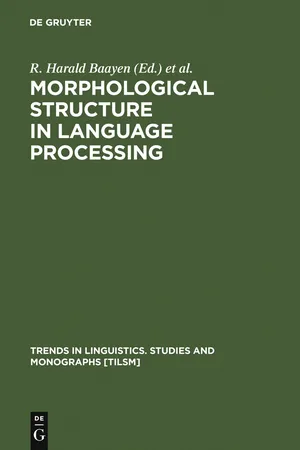
eBook - PDF
Morphological Structure in Language Processing
- 532 pages
- English
- PDF
- Available on iOS & Android
eBook - PDF
Morphological Structure in Language Processing
About this book
Information
Table of contents
- Preface
- Inflectional morphology and word meaning: Orthogonal or co-implicative cognitive domains?
- Visual processing of Italian verbs and adjectives: The role of the inflectional family size
- Morphological resonance in the mental lexicon
- Morphology and frequency: Contrasting methodologies
- Derivational morphology in the German mental lexicon: A dual mechanism account
- The interplay of root, suffix and whole-word frequency in processing derived words
- On the role of derivational affixes in recognizing complex words: Evidence from masked priming
- Morphological facilitation: The role of semantic transparency and family size
- Recognition of spoken prefixed words: The role of early conditional root uniqueness points
- Lexical representation of morphologically complex words: Evidence from Polish
- Identification of spoken prefixed words in French
- Frequency effects in regular inflectional morphology: Revisiting Dutch plurals
- How does a child detect morphology? Evidence from production
- Frequency effects in processing inflected Dutch nouns: A distributed connectionist account
- When word frequencies do not regress towards the mean
- Spelling errors with a view on the mental lexicon: Frequency and proximity effects in misspelling homophonous regular verb forms in Dutch and French
- List of contributors
- Subject index
Trusted by 375,005 students
Access to over 1.5 million titles for a fair monthly price.
Study more efficiently using our study tools.
Frequently asked questions
Yes, you can cancel anytime from the Subscription tab in your account settings on the Perlego website. Your subscription will stay active until the end of your current billing period. Learn how to cancel your subscription
No, books cannot be downloaded as external files, such as PDFs, for use outside of Perlego. However, you can download books within the Perlego app for offline reading on mobile or tablet. Learn how to download books offline
Perlego offers two plans: Essential and Complete
- Essential is ideal for learners and professionals who enjoy exploring a wide range of subjects. Access the Essential Library with 800,000+ trusted titles and best-sellers across business, personal growth, and the humanities. Includes unlimited reading time and Standard Read Aloud voice.
- Complete: Perfect for advanced learners and researchers needing full, unrestricted access. Unlock 1.5M+ books across hundreds of subjects, including academic and specialized titles. The Complete Plan also includes advanced features like Premium Read Aloud and Research Assistant.
We are an online textbook subscription service, where you can get access to an entire online library for less than the price of a single book per month. With over 1.5 million books across 990+ topics, we’ve got you covered! Learn about our mission
Look out for the read-aloud symbol on your next book to see if you can listen to it. The read-aloud tool reads text aloud for you, highlighting the text as it is being read. You can pause it, speed it up and slow it down. Learn more about Read Aloud
Yes! You can use the Perlego app on both iOS and Android devices to read anytime, anywhere — even offline. Perfect for commutes or when you’re on the go.
Please note we cannot support devices running on iOS 13 and Android 7 or earlier. Learn more about using the app
Please note we cannot support devices running on iOS 13 and Android 7 or earlier. Learn more about using the app
Yes, you can access Morphological Structure in Language Processing by R. Harald Baayen, Robert Schreuder, R. Harald Baayen,Robert Schreuder in PDF and/or ePUB format, as well as other popular books in Languages & Linguistics & Linguistics. We have over 1.5 million books available in our catalogue for you to explore.