Word Power: Phrasal Verbs and Compounds is a textbook for guided self-learning intended for post-intermediate and advanced learners of English. It contains some 1,100 phrasal compounds used with 17 particles/prepositions which combine with some 500 different verbs, nouns and adjectives. Numerous glosses allow the teacher to use it in very heterogeneous classes.
Thanks to cognitive linguistics the material is organized around each particle giving the students an astonishing insight into the networks of metaphorical meanings of each particle. Furthermore, the book implements the most important findings and techniques in the field of learning a foreign language. This textbook will be a valuable companion for teachers and students.
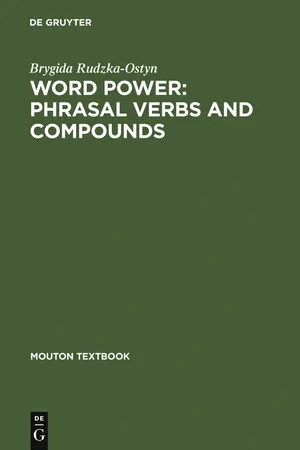
- 224 pages
- English
- PDF
- Available on iOS & Android
eBook - PDF
About this book
Trusted by 375,005 students
Access to over 1.5 million titles for a fair monthly price.
Study more efficiently using our study tools.
Information
Table of contents
- Preface
- How this textbook could be used
- Acknowledgements
- Introduction: Words and the World
- 1 The syntactic frames of phrasal verbs
- 2 The meaning of phrasal verbs
- 2.1 The meaning of the verb
- 2.2 The meaning of the particles
- 2.3 The metaphorical meaning of the whole expression ‘verb + particle’
- 2.4 A phrasal verb with one particle often has several meanings
- 3 What do we use language for?
- 4 How do we perceive and conceive reality?
- 4.1 The trajector and landmark: the moving entity and the place (point, container, surface) where it moves
- 4.2 Symbols used in the drawings
- 4.3 Questions on the Introduction
- 1 OUT is leaving a container
- 1.1 OUT: entities moving out of containers
- 1.2 OUT: eat or inviting to eat away from home
- 1.3 OUT: sets, groups are containers
- 1.4 OUT: bodies, minds, mouths are viewed as containers
- 1.5 OUT: states/situations are containers
- 1.6 OUT: non-existence, ignorance, invisibility also function as containers
- 1.7 OUT: trajectors increasing to maximal boundaries
- 1.8 OUT: key
- 1.9 Expand and test your knowledge of ‘out’
- 1.10 Key to ‘Expand and test your knowledge of ‘out’’
- 2 IN is entering or being inside a container
- 2.1 IN: being inside or entering a container
- 2.2 IN: atmospheric circumstances as containers
- 2.3 IN: time viewed as a container
- 2.4 IN: sets or groups viewed as containers
- 2.5 IN: situations, circumstances as containers
- 2.6 IN: psychological, physical states viewed as containers
- 2.7 IN: key
- 2.8 Expand and test your knowledge of ‘in’
- 2.9 Key to ‘Expand and test your knowledge of ‘in’’
- 3 INTO is entering a container
- 3.1 INTO: motion into a container
- 3.2 INTO: change is motion from one state into another
- 3.3 INTO: key
- 3.4 Expand and test your knowledge of ‘into’
- 3.5 Key to ‘Expand and test your knowledge of ‘into’’
- 4 UP is positive verticality
- 4.1 UP: position at a high place or moving up to a higher one
- 4.2 UP (to): aiming at or reaching a goal, an end, a limit
- 4.3 UP: moving to a higher degree, value or measure
- 4.4 UP: higher up is more visible, accessible, known
- 4.5 UP: covering an area completely/reaching the highest limit
- 4.6 UP: Key
- 4.7 Expand and test your knowledge of ‘up’
- 4.8 Key to ‘Expand and test your knowledge of ‘up’’
- 5 DOWN is negative verticality
- 5.1 DOWN: movement from a higher to a lower place
- 5.2 DOWN: time and geographically orientated motion
- 5.3 DOWN: decrease in intensity, quality, quantity, size, degree, value, activity, status, strength
- 5.4 DOWN: reach a goal, completion, extreme limit down the scale
- 5.5 DOWN: movements of eating or writing
- 5.6 DOWN: key
- 5.7 Expand and test your knowledge of ‘down’
- 5.8 Key to ‘Expand and test your knowledge of ‘down’’
- 6 OFF is breaking contact
- 6.1 OFF: loss of spatial contact or spatial separation
- 6.2 OFF: separation as loss of contact
- 6.3 OFF: separation as interruption of flow/supply
- 6.4 OFF: separation due to motion away from its former state, condition or point of reference
- 6.5 OFF: key
- 6.6 Expand and test your knowledge of ‘off’
- 6.7 Key to ‘Expand and test your knowledge of ‘off’’
- 7 AWAY is disappearing
- 7.1 AWAY: leaving a place or not being at it
- 7.2 AWAY: gradual and continuously growing distance
- 7.3 AWAY: complete disappearance
- 7.4 AWAY: key
- 7.5 Expand and test your knowledge of ‘away’
- 7.6 Key to ‘Expand and test your knowledge of ‘away’’
- 8 ON is contact
- 8.1 ON: contact or getting closer to make contact
- 8.2 ON: from contact to closeness
- 8.3 ON: time viewed as a surface
- 8.4 ON: continuation of an action or situation
- 8.5 ON: cause – effect viewed as two entities in contact
- 8.6 ON: key
- 8.7 Expand and test your knowledge of ‘on’
- 8.8 Key to ‘Expand and test your knowledge of ‘on’’
- 9 OVER is higher than and close to
- 9.1 OVER: being or moving higher than and close to sth or from one side to the other
- 9.2 OVER: crossing a certain distance to get closer
- 9.3 OVER: Motion viewed as covering completely or even in excess
- 9.4 OVER/UNDER: higher than/beyond or lower than/below the norm
- 9.5 OVER: examining thoroughly from all sides
- 9.6 OVER: reflexive motion or completely bent
- 9.7 OVER: key
- 9.8 Expand and test your knowledge of ‘over(-)/under-’
- 9.9 Key to ‘Expand and test your knowledge of ‘over(-)/under-’’
- 10 BACK is returning
- 10.1 BACK: return to or stay at an earlier location
- 10.2 BACK: Return to an earlier state, time, situation
- 10.3 BACK: key
- 10.4 Expand and test your knowledge of ‘back’
- 10.5 Key to ‘Expand and test your knowledge of ‘back’’
- 11 ABOUT is dispersion
- 11.1 ABOUT: location or motion in vicinity but in no particular direction
- 11.2 ABOUT: from motion on a surface to mental motion on topics
- 11.3 ABOUT: from vicinity to proximity in size, time, measure, quantity
- 11.4 ABOUT: key
- 12 (A)ROUND is vicinity or circular motion
- 12.1 (A)ROUND: Location or motion (in different directions) often viewed from a central point
- 12.2 (A)ROUND: figurative activities other than motion
- 12.3 (A)ROUND: key
- 13 ABOUT/(A)ROUND is dispersion vs. circular motion
- 13.1 ABOUT/(A)ROUND: motion along +/- circular paths in different directions
- 13.2 ABOUT/(A)ROUND: (metaphorical) paths in all kinds of directions
- 13.3 ABOUT/(A)ROUND: key
- 13.4 Expand and test your knowledge of ‘about/(a)round’
- 13.5 Key to ‘Expand and test your knowledge of ‘about/(a)round’’
- 14 ACROSS is motion to opposite side
- 14.1 ACROSS (preposition): motion from one side of a surface to another
- 14.2 ACROSS (particle): figurative motion crossing to a human receiver
- 14.3 ACROSS: key
- 15 THROUGH is crossing a container
- 15.1 THROUGH: motion inside an entity from end to end
- 15.2 THROUGH: activities viewed as complete(d) motions
- 15.3 THROUGH: key
- 15.4 Expand and test your knowledge of ‘through’
- 15.5 Key to ‘Expand and test your knowledge of ‘through’’
- 16 BY is vicinity or path
- 16.1 BY: location or motion near or at the side of an entity
- 16.2 BY: closeness or location in time and measurement units
- 16.3 BY: ‘cause- effect’, means viewed as two close objects
- 16.4 BY: key
- 17 ALONG is parallel path or entity
- 17.1 ALONG: to be/to move towards the end of sth long
- 17.2 ALONG: feelings are viewed as accompanying objects
- 17.3 ALONG: key
Frequently asked questions
Yes, you can cancel anytime from the Subscription tab in your account settings on the Perlego website. Your subscription will stay active until the end of your current billing period. Learn how to cancel your subscription
No, books cannot be downloaded as external files, such as PDFs, for use outside of Perlego. However, you can download books within the Perlego app for offline reading on mobile or tablet. Learn how to download books offline
We are an online textbook subscription service, where you can get access to an entire online library for less than the price of a single book per month. With over 1.5 million books across 990+ topics, we’ve got you covered! Learn about our mission
Look out for the read-aloud symbol on your next book to see if you can listen to it. The read-aloud tool reads text aloud for you, highlighting the text as it is being read. You can pause it, speed it up and slow it down. Learn more about Read Aloud
Yes! You can use the Perlego app on both iOS and Android devices to read anytime, anywhere — even offline. Perfect for commutes or when you’re on the go.
Please note we cannot support devices running on iOS 13 and Android 7 or earlier. Learn more about using the app
Please note we cannot support devices running on iOS 13 and Android 7 or earlier. Learn more about using the app
Yes, you can access Word Power: Phrasal Verbs and Compounds by Brygida Rudzka-Ostyn in PDF and/or ePUB format, as well as other popular books in Languages & Linguistics & Languages. We have over 1.5 million books available in our catalogue for you to explore.