"Gamkrelidze and Ivanov's wide-ranging and interdisciplinary work, superbly translated from Russian, is a must for every student of Indo-European prehistory. Its erudition is unsurpassed, and its unorthodox conclusions are a continuing challenge."
Prof. Dr. Martin Haspelmath, Max-Planck-Institut für Evolutionäre Anthropologie
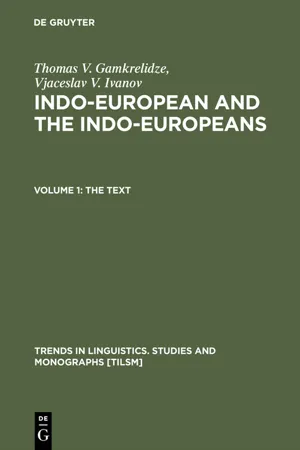
eBook - PDF
Indo-European and the Indo-Europeans
A Reconstruction and Historical Analysis of a Proto-Language and Proto-Culture. Part I: The Text. Part II: Bibliography, Indexes
- 1,272 pages
- English
- PDF
- Available on iOS & Android
eBook - PDF
Indo-European and the Indo-Europeans
A Reconstruction and Historical Analysis of a Proto-Language and Proto-Culture. Part I: The Text. Part II: Bibliography, Indexes
About this book
Information
Table of contents
- Prefaces and Foreword
- Detailed contents
- The languages and their written sources
- Transliteration
- Abbreviations and sources
- Introduction — The linguistic system and the premises of diachronic linguistics
- Part One The Structure of Proto-Indo-European
- Section One: The Phonological System and Morphophonology of Proto-Indo-European
- Chapter One — The three Indo-European stop series: Paradigmatics and syntagmatics
- Chapter Two — The Indo-European points of stop articulation and the Indo-European sibilants: Paradigmatics and syntagmatics
- Chapter Three — The vowel system and the theory of morphophonological alternations. Sonants and laryngeals in Indo-European
- Chapter Four — The structure of the Indo-European root
- Section Two: The Grammatical Structure of Proto-Indo-European
- Chapter Five — Proto-Indo-European as a language of the active type
- Chapter Six — The grammatical syntagmatics of Proto-Indo-European in typological perspective
- Section Three: The Areal Organization of Proto-Indo-European
- Chapter Seven — The differentiation of the Indo-European linguistic region
- Part Two Semantic Dictionary of the Proto-Indo-European Lan¬guage and Reconstruction of the Indo-European Proto- Culture
- Introduction — Methods for reconstructing the semantic dictionary of a protolanguage and the linguistic paleontology of culture
- Section One: Semantic Dictionary of Proto-Indo-European
- Chapter One — The living world: Gods, people, animals
- Chapter Two — Indo-European conceptions of wild animals, and names for them
- Chapter Three — Indo-European terms for domestic animals. The economic functions of animals and their ritual and cultic role among the early Indo-Europeans
- Chapter Four — Indo-European plant names. Uses of plants; their ritual and cultic functions in ancient Indo-European culture
- Chapter Five — Geographical environment and climate. The Indo-European terms for heavenly bodies
- Chapter Six — Economic activity, material culture, crafts, transportation
- Chapter Seven — The social organization, economy, and kinship system of the ancient Indo-Europeans
- Chapter Eight — The connection of ancient social organization with intel¬lectual constructs and the mythological view of the world
- Chapter Nine — Reconstruction of Indo-European rituals. Legal and medical conceptions. The afterworld and burial rites
- Chapter Ten — Reconstruction of Indo-European text fragments. Fragments of poetic speech; Indo-European metrical schemes. The counting system and number symbolism
- Section Two: The Chronology of Proto-Indo-European. The Indo-European Homeland and Migration Routes to the Historical Ter¬ritories of the Indo-European Tribes
- Chapter Eleven — Proto-Indo-European in space and time, based on linguistic and culture-historical data
- Chapter Twelve — The migrations of the Indo-European-speaking tribes from their Near Eastern homeland to their historical territories in Eurasia
- Instead of an Afterword
- The languages and their written sources
- Transliterations
- Abbreviations
- Bibliography
- Indexes
- Languages and Dialects
- Indo-European Languages
- Proto-Indo-European Roots, Stems, and Affixes
- Proto-Indoeuropean Semantemes
- Anatolian Languages
- Hittite
- Sumero-Akkadian Logogramic Hittite
- Luwian
- Hieroglyphic Luwian
- Palaic
- Lycian
- Lydian
- Tocharian Languages
- Tocharian A
- Tocharian B
- Indo-Iranian Language
- Indo-Aryan Languages
- Sanskrit
- Pali
- Mitannian
- Neo-Indic Languages
- Nuristan Languages
- Dardic Languages
- Iranian Languages
- Avestan
- Old Persian
- Pehlevi
- Parthian
- Saka
- Sogdian
- Khwarezmian
- Scythian
- Ossetic
- Yagnobi
- Pashto
- Pamir Languages
- Modern Persian
- Tajik
- Kurdish
- Baluchi
- Parachi
- Talysh
- Greek
- Mycenean
- Old Macedonian
- Armenian
- Albanian
- Daco-Thracian
- Illyrian
- Phrygian
- Italic Languages
- Latin
- Faliscan
- Venetic
- Messapic
- Oscan
- Umbrian
- Romance Languages
- French
- Italian
- Spanish
- Rumanian
- Celtic Languages
- Old Irish
- Middle Irish
- Modern Irish
- Welsh
- Cornish
- Breton
- Gaulish
- Germanic Languages
- Proto-Germanic
- Old Icelandic
- Norwegian
- Swedish
- Danish
- Old English
- Old Frisian
- Old High German
- Old Saxon
- Low German Dialects
- English
- German
- Baltic Languages
- Old Prussian
- Lithuanian
- Latvian
- Slavic Languages
- Old Church Slavic and Proto-Slavic
- Bulgarian
- Serbo-Croatian
- Slovene
- Russian (Old Russian)
- Ukrainian
- Belorussian
- Polish
- Slovincian-Kashubian
- Czech
- Slovak
- Lower Sorbian
- Upper Sorbian
- Polabian
- Non-Indo-European Languages
- Ancient Near Eastern Languages
- Hattic
- Sumerian
- Elamite
- Hurrian
- Urartean
- Afro-Asiatic Languages
- Semitic Languages
- Proto-Semitic
- Akkadian
- Ugaritic
- Phoenician
- Ancient Hebrew
- Aramaic
- Arabic
- South Arabian
- Geez
- African Languages
- Ancient Egyptian
- Coptic
- Chadic
- Nubian
- Caucasian Languages
- Kartvelian Languages
- Proto-Kartvelian
- Georgian
- Svan
- Mingrelian
- Laz
- Northwest Caucasian Languages
- Northeast Caucasian Languages
- Dagestanian Languages
- Nakh Languages
- Uralic Languages
- Finno-Ugric Languages
- Finnish
- Veps
- Vote
- Estonian
- Livonian
- Hungarian
- Ostyak
- Vogul
- Komi-Permian
- Komi-Zhyrian
- Votyak
- Moksha-Mordvin
- Erzja-Mordvin
- Cheremis
- Lapp
- Samoyed Languages
- Yurak
- Altaic Languages
- Turkish
- Old Turkish
- Mongolian Languages
- Mongolian
- Tungus-Manchurian Languages
- Korean
- Japanese
- Dravidian Languages
- Austro-Asiatic Languages
- Burushaski
- Etruscan
- Basque
- Sino-Tibetan
- Paleoasiatic
- Austronesian Languages
- Amerindian Languages
- Navajo
- Quiliute
- Squamish
- Shuswap
- Australian Languages
- Onomastic Indexes
- Gods, Festivals, Mythological Beings, Heroes
- Proper Names
- Ethnonyms
- Hydronyms: Lakes, rivers, and other bodies of water
- Toponyms
- Species
- Sources
Trusted by 375,005 students
Access to over 1.5 million titles for a fair monthly price.
Study more efficiently using our study tools.
Frequently asked questions
Yes, you can cancel anytime from the Subscription tab in your account settings on the Perlego website. Your subscription will stay active until the end of your current billing period. Learn how to cancel your subscription
No, books cannot be downloaded as external files, such as PDFs, for use outside of Perlego. However, you can download books within the Perlego app for offline reading on mobile or tablet. Learn how to download books offline
Perlego offers two plans: Essential and Complete
- Essential is ideal for learners and professionals who enjoy exploring a wide range of subjects. Access the Essential Library with 800,000+ trusted titles and best-sellers across business, personal growth, and the humanities. Includes unlimited reading time and Standard Read Aloud voice.
- Complete: Perfect for advanced learners and researchers needing full, unrestricted access. Unlock 1.5M+ books across hundreds of subjects, including academic and specialized titles. The Complete Plan also includes advanced features like Premium Read Aloud and Research Assistant.
We are an online textbook subscription service, where you can get access to an entire online library for less than the price of a single book per month. With over 1.5 million books across 990+ topics, we’ve got you covered! Learn about our mission
Look out for the read-aloud symbol on your next book to see if you can listen to it. The read-aloud tool reads text aloud for you, highlighting the text as it is being read. You can pause it, speed it up and slow it down. Learn more about Read Aloud
Yes! You can use the Perlego app on both iOS and Android devices to read anytime, anywhere — even offline. Perfect for commutes or when you’re on the go.
Please note we cannot support devices running on iOS 13 and Android 7 or earlier. Learn more about using the app
Please note we cannot support devices running on iOS 13 and Android 7 or earlier. Learn more about using the app
Yes, you can access Indo-European and the Indo-Europeans by Thomas V. Gamkrelidze,Vjaceslav V. Ivanov, Nichols Johanna in PDF and/or ePUB format, as well as other popular books in Languages & Linguistics & Historical & Comparative Linguistics. We have over 1.5 million books available in our catalogue for you to explore.