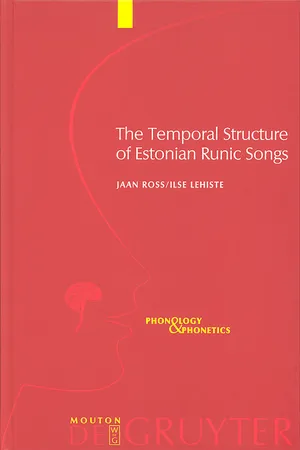
The Kalevala, or runic, songs is a tradition at least a few thousand years old. It was shared by Finns, Estonians and other speakers of smaller Baltic-Finnic languages inhabiting the eastern side of the Baltic Sea in North-Eastern Europe. This book offers a combined perspective of a musicologist and a linguist to the structure of the runic songs. Archival recordings of the songs originating mostly from the first half of the 20th century were used as source material for this study. The results reveal a complex interaction between three different processes participating in singing: speech prosody, metre, and musical rhythm.
- 216 pages
- English
- PDF
- Available on iOS & Android
eBook - PDF
The Temporal Structure of Estonian Runic Songs
About this book
Trusted by 375,005 students
Access to over 1.5 million titles for a fair monthly price.
Study more efficiently using our study tools.
Information
Table of contents
- Preface
- Contents
- Chapter 1 Introduction
- Chapter 2 Estonian old folksongs: history, tradition, collections and availability
- 1. Recent historical background
- 2. Distribution of runic songs in time and space
- 3. Cultural–historical and territorial division of Estonia
- 4. The textual component in runic songs
- 5. A musical characterization of runic songs
- 6. Some peculiarities in the geographical distribution of Estonian folksongs
- 7. Classification of runic songs
- 8. The earliest printed references to runic songs
- 9. Collections and publications of Estonian runic melodies
- 10. Summary
- Chapter 3 Estonian prosody
- 1. Introduction
- 2. Segmental quantity
- 3. Syllabic quantity and the quantity of prosodic feet
- 3.1. Monosyllabic words
- 3.2. Q1 prosodic foot
- 3.3. Q2 prosodic foot
- 3.4. Q3 prosodic foot
- 4. Overlength
- 5. The structure of polysyllabic words and phonological phrases
- 5.1. Trisyllabic feet
- 5.2. Phonological phrases
- 6. Summary
- Chapter 4 The metrical structure of Estonian folksongs
- 1. Trochaic tetrametre and the quantity rules
- 2. Validity of the quantity rules
- Chapter 5 Estonian folksong as musical performance
- 1. General aspects of research on musical performance
- 2. Segmentation of runic song performance
- 3. Prescriptive and descriptive notation
- 4. Deviations of performed events from their regular values: is this approach applicable in the runic songs?
- 5. Friberg’s generative performance rules for timing and their relevance for the runic songs
- 6. Modelling of syllable durations in the runic songs
- 7. Covariance analysis
- 8. Summary
- Chapter 6 Realization of the prosodic structure of Estonian in sung folksongs
- 1. Introduction
- 2. Material and methods
- 3. Encoding of metre with temporal means
- 4. Changes in the temporal realization of word–initial disyllables
- 5. Differences between regular lines and broken lines
- 6. Differences between quantity oppositions manifested by vowels and consonants
- 7. Summary
- Chapter 7 Realization of prosodic structure inrecitation and laments
- 1. Introduction
- 2. Materials and method
- 3. Duration of metric feet
- 4. Intervocalic consonants
- 5. Summary of results
- 6. Trochaic verse in contemporary Estonian and Finnish poetry
- 7. Between speech and song
- Chapter 8 Conclusions
- Appendix Notations of Estonian folksongs and laments
- Notes
- References
- Index
Frequently asked questions
Yes, you can cancel anytime from the Subscription tab in your account settings on the Perlego website. Your subscription will stay active until the end of your current billing period. Learn how to cancel your subscription
No, books cannot be downloaded as external files, such as PDFs, for use outside of Perlego. However, you can download books within the Perlego app for offline reading on mobile or tablet. Learn how to download books offline
Perlego offers two plans: Essential and Complete
- Essential is ideal for learners and professionals who enjoy exploring a wide range of subjects. Access the Essential Library with 800,000+ trusted titles and best-sellers across business, personal growth, and the humanities. Includes unlimited reading time and Standard Read Aloud voice.
- Complete: Perfect for advanced learners and researchers needing full, unrestricted access. Unlock 1.5M+ books across hundreds of subjects, including academic and specialized titles. The Complete Plan also includes advanced features like Premium Read Aloud and Research Assistant.
We are an online textbook subscription service, where you can get access to an entire online library for less than the price of a single book per month. With over 1.5 million books across 990+ topics, we’ve got you covered! Learn about our mission
Look out for the read-aloud symbol on your next book to see if you can listen to it. The read-aloud tool reads text aloud for you, highlighting the text as it is being read. You can pause it, speed it up and slow it down. Learn more about Read Aloud
Yes! You can use the Perlego app on both iOS and Android devices to read anytime, anywhere — even offline. Perfect for commutes or when you’re on the go.
Please note we cannot support devices running on iOS 13 and Android 7 or earlier. Learn more about using the app
Please note we cannot support devices running on iOS 13 and Android 7 or earlier. Learn more about using the app
Yes, you can access The Temporal Structure of Estonian Runic Songs by Jaan Ross,Ilse Lehiste in PDF and/or ePUB format, as well as other popular books in Languages & Linguistics & Languages. We have over 1.5 million books available in our catalogue for you to explore.