eBook - PDF
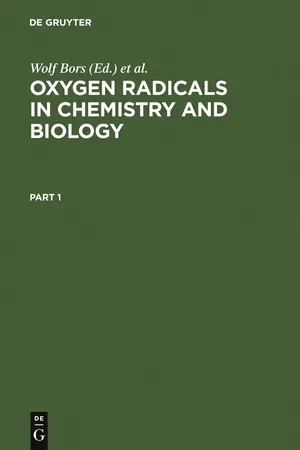
Oxygen Radicals in Chemistry and Biology
Proceedings, 3. Internat. Conference, Neuherberg, Federal Republic of Germany, July 10-15, 1983
- 1,052 pages
- English
- PDF
- Available on iOS & Android
eBook - PDF
Oxygen Radicals in Chemistry and Biology
Proceedings, 3. Internat. Conference, Neuherberg, Federal Republic of Germany, July 10-15, 1983
About this book
No detailed description available for "Oxygen Radicals in Chemistry and Biology".
Information
Topic
Physical SciencesSubtopic
BiochemistryTable of contents
- A – PHYSICO-CHEMICAL AND CHEMICAL PROPERTIES OF OXYGEN RADICALS
- Spectral and kinetic properties of the products resulting from the reactions of HO2/O2¯ with Mn(II) complexes
- New mechanism of the reaction of O2 with H2O2: significance for biology
- Generation of activated oxygen species by electron transfer reduction of dioxygen in the presence of protons, chlorinated hydrocarbons, methyl viologen and transition metal ions
- On reaction of KO2 with sterol hydroperoxides
- The O2 radical reactions in neutral and alkaline solutions
- Reactivities of tert-butoxy radicals in aqueous solution
- Formation and reactions of halothane peroxy free radicals, CF3CHClO2
- Electronic and geometrical structures of ethylene peroxy cation and anion radicals: mechanisms of oxygenation reactions via electron transfers
- ESR and ENDOR studies of free radicals having unpaired spin density localized primarily on oxygen
- Corona discharge as a source of superoxide
- Simultaneous multi-wavelength kinetic spectroscopy: A new set-up for pulse radiolysis studies of oxygen radicals
- Rate constants of sparingly water-soluble phenolic antioxidants with hydroxyl radicals
- A pulse radiolysis study of the addition of hydroxyl free radicals to nitrone spin traps
- General discussion
- B – GENERATION AND REACTIONS OF INORGANIC AND ORGANIC RADICALS
- The reactivities of organic oxygen (oxy) radicals
- Autoxidative cytotoxicity: is there metal-independent formation of hydroxyl radicals? Are there “crypto-hydroxyl” radicals?
- Role of oxygen activation in adriamycin-mediated DNA strand scission and the effect of binding on the redox properties of the drug
- A comparative kinetic study of the initiation of lipid peroxidation with OH radicals and ferrous ion
- Evidence for the initiation of lipid peroxidation by a ferrous-dioxygen-ferric chelate complex
- The biochemical role of ubiquinone and ubiquinone derivatives in the generation of hydroxyl radicals from hydrogen peroxide
- Oxidative metabolism of phenols: conversion of bromocatechol to protein binding species by O2¯
- Generation of superoxide in the autoxidation of ascorbate and glutathione
- Role of metal chelating agents as catalysts in an •OH-forming process – a comparison with the Haber-Weiss reaction
- Reaction of paraquat radicals with H2O2: Effect of O2 and comparison of radicals generated enzymatically and by irradiation
- The chemistry and biochemistry of the radicals in cigarette smoke: ESR evidence for the binding of the tar radical to DNA and polynucleotides
- Oxygen as an inhibitor in the radical-induced chain isomerisation of the (5-nitrofuryl)acrylamide, AF-2
- Generation of the superoxide radical in the red blood cell
- Superoxide degrading activity of desferrioxamine
- Free radical production from the reaction of t_-butyl hydroperoxide with iron complexes
- The effect of cell-bound copper on the toxicity of superoxide and vitamin C
- On the mechanisms of cytotoxicity induced by superoxide
- Microsomal denitrosation of N-nitrosodimethylamine
- C – ACTIVATED OXYGEN SPECIES IN FATTY ACID AND LIPID PEROXIDATION
- Oxidation mechanisms of poly-unsaturated fatty acids
- Preparation, isomerisation and breakdown of hydroperoxides from methyl oleate
- Photolysis of unsaturated fatty acid hydroperoxides
- Isomers of linoleic acid hydroperoxides from peroxidation of microsomal lipids
- Oxidation of phosphatidylcholine and its inhibition by vitamin E and vitamin C
- Product distribution of unsaturated phospholipid oxidation in organic solvent and aqueous emulsion
- Involvement of activated oxygen species in membrane peroxidation: possible mechanisms and biological consequences
- Hydroperoxides, free radicals and prostaglandin synthesis
- Spin-trapping agents protect against microsomal lipid peroxidation
- Low-level chemiluminescence, alkane production and gluthathione depletion in isolated hepatocytes caused by a diffusible product of lipid peroxidation, 4-hydroxynonenal
- Alkane evolution and chemiluminescence induced by aldehydic products of lipid peroxidation
- Role of glutathione and NAD(P)H:quinone oxidoreductase (DT-diaphorase) in determining low-level chemiluminescence during redox cycling of menadione
- The exhaled alkanes indicative for lipid peroxidation in vivo quantitatively measured after CCl4 and ethanol administration
- Lipid peroxidation of red blood cells monitored by the formation of volatile hydrocarbons
- In vitro assessment of hepatic lipid peroxidation by malondialdehyde or ethane determination
- Detection of malondialdehyde by HPLC
- The nature of diene conjugation in biological fluids
- The role of iron in lipid peroxidation induced by adriamycin during redox cycling in liver microsomes
- Comparative evaluation of substrate effect on cumene hydroperoxide-dependent lipid peroxidation in mitochondria and microsomes
- Studies on the compartmental release of lipid peroxidation products in the perfused rat heart
- Ascorbic acid, lipid peroxidation and the interactions of drugs with their receptors in rat brain tissue preparations
- Ellipticines and carbazoles as antioxidants
- Herbicide-induced lipid peroxidation in higher plants: the role of vitamin C
- Suppression of lipid peroxidation by quercetin and its glycosides in illuminated spinach chloroplasts
- D – OXYGEN ACTIVATION BY METAL COMPLEXES AND METALLO-ENZYMES
- The role of metal ions in the chemistry and biology of oxygen
- Activation of dioxygen species with transition metal complexes
- O2-dismutation catalyzed by water soluble porphyrins. A pulse radiolysis study
- The activation of oxygen by bleomycin is catalyzed by NADPH-cytochrome P-450 reductase in the presence of iron ions and NADPH
- Mechanism of co-oxidation reactions during prostaglandin biosynthesis
- Mechanism of arachidonic acid-stimulated singlet oxygen formation by prostaglandin endoperoxide-synthase
- The interaction of hydrogen peroxide with oxymyoglobin
- E – PHOTOOXIDATION AND SINGLET OXYGEN
- Biology and photobiology of singlet oxygen
- Singlet oxygen production from photodynamic sensitizers
- Generation of singlet oxygen from excited singlet states
- Laser flash and steady-state photolysis of benoxaprofen in solution: relevance to singlet oxygen production
- Sensitized photoreactions of purine and pyrimidine 2'-deoxyribonucleosides by 8-methoxypsoralen and 3-carbethoxypsoralen
- Radiolysis and photolysis of aqueous aerated tryptophan solutions
- Photodynamic and reductive mechanisms of oxygen activation by the fungal Phytotoxins, cercosporin and dothistromin
- Dissipation of excess light energy through H2O2 formation in photosynthetic systems
- Efficiency of singlet oxygen production from the O2 quenching of the excited singlet and triplet states of rubrene
- Singlet oxygen reactivity in microheterogeneous systems
- Sensitized photooxygenation of cis-9-tricosene (housefly sex attracant)
- On the reactivity of singlet oxygen with hemoglobin
- Formation of superoxide ion via one-electron transfer from organic electron-donors to singlet oxygen
- Chemiluminescence of Schiff bases catalyzed by horseradish peroxidase
- The mechanism of the direct photo-oxidative decarboxylation of -oxo carboxylic esters
- Menadione mediated photooxidation of purine and pyrimidine 2'-deoxyribonucleosides
- Dye-sensitized photooxidation of tryptophan
- Photodynamic induction of single-strand breaks in XRFI DNA by promazines
- Photosensitized cross-linking in bovine lens proteins by promazines
- F – OXYGEN RADICALS IN RADIATION BIOLOGY
- Membrane aspects of radiation biology
- Radiation peroxidation in micellar fatty acids
- The involvement of polyunsaturated fatty acyl chains of membrane phospholipids in radiation-induced cell death of mammalian cells
- Radiomimetic effects of peroxidizing lipids on nucleic acids and their bases
- The influence of arachidonic acid on radiation effects in a DNA model substance
- The oxygen effect as a probe for classes of ionizing radiation damage resulting in mutation, gene conversion or cell death
- Base damage in irradiated DNA and the effect of oxygen
- Reactions of peroxyl radicals derived from alkyl phosphates in aqueous solutions – model system for DNA strand breakage
- The role of ΟΗ radicals and of absorbed energy in the mechanism of the radiosensitizing action of iodine containing compounds
- Radiation sensitization of bacterial spores by CO2
- Determination of 18O trapping in X-irradiated amino acids by means of nuclear reactions
- G – OXYGEN TOXICITY AND DETOXIFYING SYSTEMS
- Detoxication of oxygen free radicals
- Role of activated oxygen species in the mechanism of cytotoxicity of cysteamine
- Formation of superoxide and cell damage during uv-visible irradiation of melanin
- Effects of copper-deficiency on lipid peroxidation of rat microsomal membranes
- Some properties of oxygen-resistant HeLa cells
- Ultrastructure and antioxygenic enzyme levels of oxygen-resistant Chinese hamster ovary cells
- Role of glutathione peroxidase in tolerance and adaptation of rats to hyperoxia
- Glutathione peroxidase system in the lungs of ozone tolerant and non-tolerant rats
- The glutathione peroxidase active on phospholipid hydroperoxides: studies on the enzyme from pig brain
- Phospholipid hydroperoxides are not substrates for selenium-dependent glutathione peroxidase
- Enhancement of NADPH-dependent lipid peroxidation in vitro and in vivo following glutathione depletion in rats
- Copper-containing oxidases as antioxidants
- Measurement of lipid hydroperoxides and collagen elasticity directly in vivo in mice and man
- Glutathione mixed disulfide formation in livers from fed and fasted rats and the effect on glucose-6-phosphate dehydrogenase activity
- Biliary taurocholate release during redox cycling in perfused rat liver
- Free radical intermediates in the trypanocidal action of drugs and phagocytic cells
- Effect of free radical activity on tryptophan and human gammaglobulin
- Involvement of oxygen radicals in ethanol oxidation and in the ethanol-induced decrease in liver glutathione
- Increased liver mitochondrial susceptibility to lipid peroxidation during ethanol inhalation and withdrawal
- H – SUPEROXIDE DISMUTASES
- Mammalian superoxide dismutases
- The three-dimensional structure of iron superoxide dismutase: kinetic and structural comparison with Cu/Zn and Mn dismutase
- The phylogenetic position of the Cu-Zn-SOD of P. Leiognathi
- Erythrocuprein (Cu2Zn2Superoxide Dismutase) carries 90 % of the erythrocyte copper
- Superoxide-dependent pathology and superoxide dismutase treatment
- SOD treatment in osteoarthritis of the knee joint
- Pharmacological activities of SOD-like copper complexes
- I – PHYSIOLOGICAL ASPECTS OF OXYGEN RADICALS
- Oxygen radicals: physiological and medical aspects, with specific reference to high energy irradiation
- Characterization of the O2/H2O2 generating system in human neutrophils
- The participation of the hypoxanthine-xanthine oxidase system in the generation of free radicals after intestinal ischemia
- Modulation of macrophage chemiluminescence by arachidonic acid products
- Chemiluminescence of granulocytes to detect the immune response to pneumococcal vaccination
- Quantification of polymorphonuclear leukocyte oxygenation activities by chemiluminigenic probing
- Comparison of luminol- and lucigenin-amplified chemiluminescence (CL) of phagocytes
- Correlation between oxidative stress of the heart, evaluated by chemiluminescence emission and contractile function
- Age-dependent modulation of superoxide and hydrogen peroxide secretion and chemiluminescence by in vitro cultivated macrophages
- Effects of different opsonins on the production of oxygen radicals and chemiluminescence of macrophages
- Adriamycin-induced cataract: involvement of a free radical mechanism
- Evidence of lipid peroxidation in hereditary cataract of mouse
- Lipid peroxidation effects on isolated rat retina
- Cell-surface glycoproteins of human granulocytes. I. Effect of trypsin or neuraminidase treatment on NADPH oxidase activity
- Cell-surface glycoproteins of human granulocytes. II. Reverse action of borohydride on the periodate-induced suppression of NADPH oxidase activity
- Changes in ascorbate levels on activation of human neutrophils
- K – MEDICAL ASPECTS OF OXYGEN RADICALS
- Role of oxygen radicals in pulmonary vascular injury
- Some immunological consequences of free radical-production in rheumatoid arthritis
- Superoxide production by polymorphonuclear leukocytes in rheumatoid arthritis (R.A.) and ankylosing spondylitis (A.S.)
- Effects of immunosuppressive therapy in systemic lupus erythematodes
- Investigation of phagocyte oxidative metabolism in microamounts of whole blood from patients with systemic lupus erythematosus
- Investigation of phagocyte oxidative metabolism in microamounts of whole blood from patients with insulino-dependent diabetes
- Comparison of “inflammation” in pine needles and humans
- L – FORUM DISCUSSION
- List of Participants
- List of Contributors
- Subject Index
Trusted by 375,005 students
Access to over 1.5 million titles for a fair monthly price.
Study more efficiently using our study tools.
Frequently asked questions
Yes, you can cancel anytime from the Subscription tab in your account settings on the Perlego website. Your subscription will stay active until the end of your current billing period. Learn how to cancel your subscription
No, books cannot be downloaded as external files, such as PDFs, for use outside of Perlego. However, you can download books within the Perlego app for offline reading on mobile or tablet. Learn how to download books offline
Perlego offers two plans: Essential and Complete
- Essential is ideal for learners and professionals who enjoy exploring a wide range of subjects. Access the Essential Library with 800,000+ trusted titles and best-sellers across business, personal growth, and the humanities. Includes unlimited reading time and Standard Read Aloud voice.
- Complete: Perfect for advanced learners and researchers needing full, unrestricted access. Unlock 1.5M+ books across hundreds of subjects, including academic and specialized titles. The Complete Plan also includes advanced features like Premium Read Aloud and Research Assistant.
We are an online textbook subscription service, where you can get access to an entire online library for less than the price of a single book per month. With over 1.5 million books across 990+ topics, we’ve got you covered! Learn about our mission
Look out for the read-aloud symbol on your next book to see if you can listen to it. The read-aloud tool reads text aloud for you, highlighting the text as it is being read. You can pause it, speed it up and slow it down. Learn more about Read Aloud
Yes! You can use the Perlego app on both iOS and Android devices to read anytime, anywhere — even offline. Perfect for commutes or when you’re on the go.
Please note we cannot support devices running on iOS 13 and Android 7 or earlier. Learn more about using the app
Please note we cannot support devices running on iOS 13 and Android 7 or earlier. Learn more about using the app
Yes, you can access Oxygen Radicals in Chemistry and Biology by Wolf Bors, Manfred Saran, David Tait, Wolf Bors,Manfred Saran,David Tait in PDF and/or ePUB format, as well as other popular books in Physical Sciences & Biochemistry. We have over 1.5 million books available in our catalogue for you to explore.