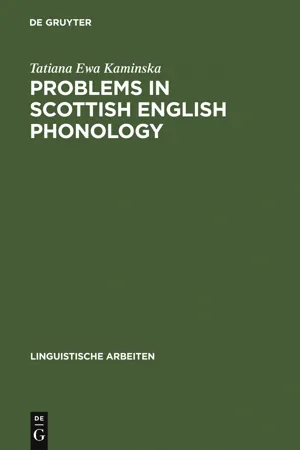
Problems in Scottish English Phonology
eBook - PDF

Problems in Scottish English Phonology

  1. 208 pages
  2. English
  3. PDF
  4. Available on iOS & Android
eBook - PDF

Problems in Scottish English Phonology

About this book

This book presents an account of phonological data related to the study of sonorants in Scottish Standard English (SSE), as compared with Received Pronunciation (RP). These data are analysed and interpreted within the theoretical framework of 'Lexical Phonology' and according to recent non-linear, three-dimensional theories of phonological representation. The basic tenets of 'Lexical Phonology' as well as those of 'Three-Dimensional Phonology' (with particular reference to its application to syllable structure) are explained in chapter 1. In the same chaper, the distinction between Standard English spoken with a Scottish accent (SSE) and Scots, the traditional dialect spoken in southern, eastern and north-eastern Scotland is discussed. The presentation of the theoretical paradigms in question as tested against the linguistic material of SSE is organized around the issues of vowel length and the phonological processes pertaining to the sound [r]. More specifically, the analyses focuses on two lengthening processes operating in SSE, namely the 'Scottish Vowel Lengthening Rule' also referred to as 'Aitken's Law' (chaper 2), and the 'Allophonic Lengthening Rule', a phenomenon universal to accents of English (chapter 3). It is claimed that the former is an accent-specific lexicalization of the latter.

Proposals concerning the phonological interpretation of [r]-related phenomena in both non-rhotic and rhotic accents are examined in chapters 4 and 5. In particular, various ways of accounting for the distribution of [r] in the pronunciation of non-rhotic accents (as exemplified by RP) are looked at and on the basis of evidence from rhotic accents (esp. SSE) an interpretation based on a gradient rule of [r]-weakening is proposed. Finally, Kaminska evaluates the success of the lexical framework in accounting for the data from SSE and RP investigated in the present study.

Frequently asked questions

Yes, you can cancel anytime from the Subscription tab in your account settings on the Perlego website. Your subscription will stay active until the end of your current billing period. Learn how to cancel your subscription.
No, books cannot be downloaded as external files, such as PDFs, for use outside of Perlego. However, you can download books within the Perlego app for offline reading on mobile or tablet. Learn more here.
Perlego offers two plans: Essential and Complete
  • Essential is ideal for learners and professionals who enjoy exploring a wide range of subjects. Access the Essential Library with 800,000+ trusted titles and best-sellers across business, personal growth, and the humanities. Includes unlimited reading time and Standard Read Aloud voice.
  • Complete: Perfect for advanced learners and researchers needing full, unrestricted access. Unlock 1.4M+ books across hundreds of subjects, including academic and specialized titles. The Complete Plan also includes advanced features like Premium Read Aloud and Research Assistant.
Both plans are available with monthly, semester, or annual billing cycles.
We are an online textbook subscription service, where you can get access to an entire online library for less than the price of a single book per month. With over 1 million books across 1000+ topics, we’ve got you covered! Learn more here.
Look out for the read-aloud symbol on your next book to see if you can listen to it. The read-aloud tool reads text aloud for you, highlighting the text as it is being read. You can pause it, speed it up and slow it down. Learn more here.
Yes! You can use the Perlego app on both iOS or Android devices to read anytime, anywhere — even offline. Perfect for commutes or when you’re on the go.
Please note we cannot support devices running on iOS 13 and Android 7 or earlier. Learn more about using the app.
Yes, you can access Problems in Scottish English Phonology by Tatiana Ewa Kaminska in PDF and/or ePUB format, as well as other popular books in Languages & Linguistics & Languages. We have over one million books available in our catalogue for you to explore.

Information

Table of contents

  1. Abstract
  2. Acknowledgements
  3. Symbols and Abbreviations
  4. 1. Theoretical Background
  5. 1.1. Goals of the Book
  6. 1.2. Scots and Scottish Standard English
  7. 1.3. Lexical Phonology
  8. 1.4. Three – Dimensional Phonology
  9. 1.5. Syllable and Sonority Hierarchy
  10. 2. Scottish Vowel Lengthening Rule
  11. 2.1. RP – SSE: A Comparison of Vowel Systems
  12. 2.2. Scottish Vowel Lengthening Rule: Introduction
  13. 2.3. SVLR: Discussion of Rule Formulation
  14. 2.4. SVLR: Discussion of the Status of the Rule in Lexical Phonology
  15. 2.5. SVLR: Concluding Remarks
  16. 3. The Allophonic Rule of Vowel Lengthening in English and Aitken`s Law
  17. 3.1. Duration of Syllable Nuclei in English: Basic Facts
  18. 3.2. Factors Determining Vowel Duration
  19. 3.3. An Interpretation of the Allophonic Lengthening Rule in Lexical Phonology
  20. 3.4. Allophonic Lengthening Rule: Problems Related to Status Assignment in Lexical Phonology
  21. 3.5. Allophonic Lengthening Rule: Concluding Remarks
  22. 3.6. Aitken’s Law Viewed as a Lexicalization of the Allophonic Lengthening Rule
  23. 4. Phonological Account of [r]-Related Processes in RP and SSE: R-Deletion
  24. 4.1. [r]-Distribution in Rhotic and Non-Rhotic Accents of English
  25. 4.2. [r]-Related Processes in Non-Rhotic Accents: Linking [r] and Intrusive [r]
  26. 4.3. [r]-Related Phenomena in Non-Rhotic Accents: Phonological Account
  27. 4.4. Discussion of the R-Deletion Interpretation
  28. 5. Phonological Account of [r]-Related Processes in RP and SSE: R-Weakening
  29. 5.1. The Distinctive Feature Characteristics of English [r]
  30. 5.2. The Rule of [r]-Weakening in Lexical Phonology
  31. 5.3. R-Weakening Analysis: Problems
  32. 5.4. The [r]-Insertion Rule under R-Weakening Analysis: Discussion of Rule Status
  33. 5.5. Formulation of the [r]-Insertion Rule: Basic Facts and Problems
  34. 5.6. Long Vowels Under the R-Weakening Interpretation
  35. 5.7. An Account of the Evidence for [r]-Weakening in a Sound Change in Progress in SSE
  36. 5.8. Concluding Comments to R-Weakening Analysis
  37. Conclusion
  38. Appendix
  39. References